Stock Analysis · VTech Holdings Ltd (VTKLY)
Overview
VTech Holdings Ltd is a consumer electronics and educational products company best known for children’s learning toys, cordless phones, and outsourced manufacturing services. The group is headquartered in Hong Kong and sells globally, with North America and Europe representing major end markets. Its business is easier to understand than many technology companies: it designs and sells physical products used in homes, schools, and by other brands that outsource manufacturing.
Revenue comes from three main divisions. Based on the latest annual reporting, the mix is approximately:
- Electronic Learning Products: about 40% to 45% of revenue. This includes educational toys, toddler products, and interactive learning devices sold under VTech and LeapFrog brands.
- Contract Manufacturing Services: about 35% to 40% of revenue. This division manufactures products for other companies, especially professional audio equipment, industrial products, and internet-connected devices.
- Telecommunication Products: about 15% to 20% of revenue. This includes residential phones and selected business communication products, a mature category that has been under structural pressure for years.
This mix matters for long-term analysis. The learning products unit gives VTech branded consumer exposure, manufacturing services provide scale and industrial know-how, and telecom adds cash generation but also ties part of the company to a shrinking legacy market. The broad pattern in recent years has been stable profitability but uneven sales, with some divisions offsetting weakness in others rather than all three expanding together.
The income flow also shows a business that remains profitable despite lower sales than a few years ago. Revenue has trended down from earlier peaks, but gross profit has held up better than sales, suggesting product mix and cost control have softened the blow. At the same time, selling and administrative costs appear heavier in the latest year, which helps explain why earnings have weakened more than gross profit alone would suggest.
Key Figures
| Metric | Value | Sector ⓘ |
|---|---|---|
| Date | Sep 05, 2026 | |
| Context | ||
| Sector | Technology | |
| Industry | Communication Equipment | |
| Market Cap ⓘ | $1.63B | |
| Beta ⓘ | 0.43 | |
Value (Cheapness) | ||
| P/E Ratio ⓘ | 12.13 | 30.57 |
| FCF Yield ⓘ | 17.70% | 4.30% |
| EBIT / EV ⓘ | 24.44% | 2.81% |
| PEG ⓘ | N/A | |
Growth (Business expansion) | ||
| Revenue Growth ⓘ | -4.70% | 15.80% |
| RPS Growth (5Y CAGR) ⓘ | -3.96% | 8.55% |
| EPS Growth (5Y CAGR) ⓘ | -21.53% | -11.66% |
| Margin Growth (5Y Trend) ⓘ | -0.05% | 0.42% |
| FCF Growth (5Y CAGR) ⓘ | -2.80% | 9.90% |
Quality (Business durability) | ||
| ROIC (Latest) ⓘ | 47.34% | 9.24% |
| ROIC (5Y Median) ⓘ | 24.74% | 8.32% |
| Net Debt / EBIT (Latest) ⓘ | -0.38 | 0.56 |
| Net Debt / EBIT (5Y Median) ⓘ | -0.78 | 0.42 |
| Operating Margin (Latest) ⓘ | 8.65% | 9.56% |
| Operating Margin (5Y Median) ⓘ | 8.66% | 8.22% |
| Debt to Equity (Latest) ⓘ | 19.59% | 33.33% |
| Profit Margin (Latest) ⓘ | 6.61% | 7.14% |
| Free Cash Flow (Latest) ⓘ | $288.32M | |
Momentum (Price trend) | ||
| 3Y Return ⓘ | +38.09% | +41.31% |
| 12M Return (excl. last month) ⓘ | -2.18% | +23.51% |
| 6M Return ⓘ | -15.74% | +16.96% |
| Price vs. 200-Day MA ⓘ | -10.44% | +7.99% |
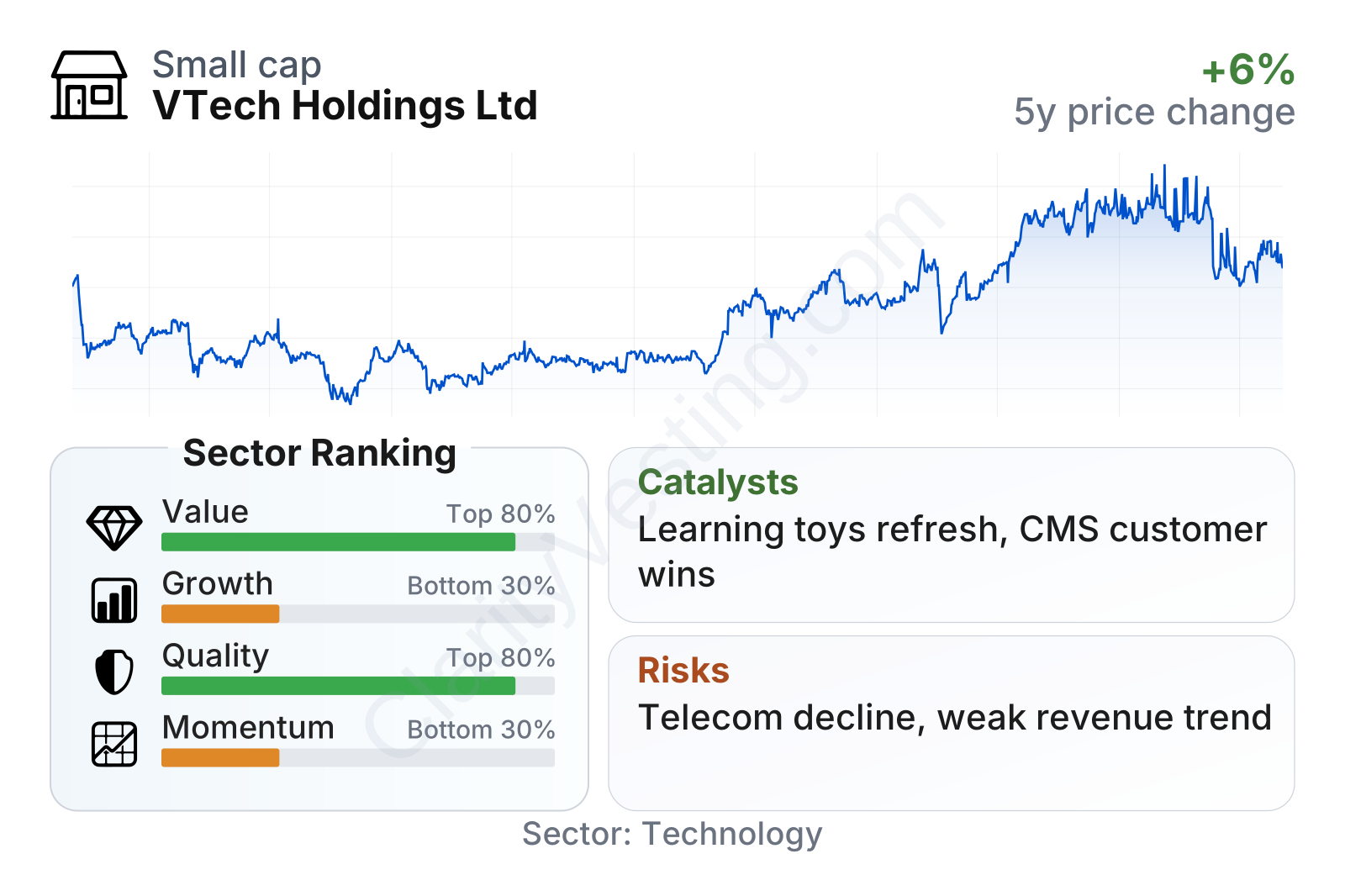
VTech is a relatively small listed company, with a market capitalization around $1.7 billion, and its share price has historically moved less than the broader technology sector, as shown by its low beta. The overall profile is unusual for a technology name: growth ranks weakly versus the sector, but value and balance-sheet quality stand out positively. Profitability is solid rather than exceptional, while recent share-price momentum has been softer.
The most notable strengths in the latest metrics are cash generation, returns on invested capital, and limited leverage. Free cash flow yield is far above the sector median, and the company appears to operate with net cash rather than meaningful net debt. On the other hand, revenue growth has been negative recently and the five-year trend is below the sector by a wide margin, which explains why the market does not value the business like a typical high-growth technology stock.
Growth
VTech operates across a mix of sectors rather than a single fast-growing niche. That makes the growth case more nuanced. Educational toys and early-learning devices can benefit from steady family spending and product refresh cycles, but they are not usually explosive growth markets. Contract manufacturing can expand when customers launch new devices or shift production to trusted partners, yet that business tends to depend on customer programs and broader demand conditions. Telecommunication products face the weakest long-term backdrop because home cordless phone usage is a mature, slowly declining category.
The strategic logic is still coherent. VTech has known brands in children’s learning products, a long operating history, global retailer relationships, and manufacturing expertise that can be used both for its own products and for third-party customers. For long-term growth, the most credible path is not a dramatic transformation but a combination of product innovation in learning devices, better mix in contract manufacturing, and disciplined cost management.
Recent revenue trends do not yet show a strong acceleration. Sales have been uneven, and the latest yearly change remains negative. Over a longer period, revenue per share has also trended down. That said, the business has shown resilience through changing demand conditions, and the decline has not destroyed profitability or cash generation in the way it often does for weaker manufacturers.
Cash flow is an important part of the picture. Even with modest sales trends, VTech has produced substantial free cash flow, although the path has been lumpy from one period to another. That suggests the company still has underlying earnings power and working-capital flexibility, which can support dividends, internal investment, or a cushion during softer years.
A realistic catalyst is the contract manufacturing unit, especially if demand in professional audio, industrial electronics, or connected-device programs improves. Another possible support is product renewal in learning toys, where recognized brands can still matter with parents and retailers. The latest annual reporting also indicates the company continues to invest in research and development, which is important because this is one of the few ways to defend shelf space and maintain relevance in children’s electronics.
There does not appear to be one recent headline that changes the entire growth outlook overnight. Instead, the opportunity is more gradual: stabilization in telecom, selective wins in manufacturing services, and better consumer demand for educational products could together improve the overall trajectory. For a long-term framework, that makes VTech more of an execution-driven business than a company waiting for a single breakthrough event.
Risks
This article is for informational purposes only and does not constitute financial advice. Some content is AI-generated. See Disclaimer