Stock Analysis · Vishay Intertechnology Inc (VSH)
Overview
Vishay Intertechnology is a semiconductor components manufacturer focused on the basic building blocks used in electronic devices. Rather than selling high-profile processors or consumer gadgets, the company makes a broad range of smaller but essential parts such as discrete semiconductors and passive components. These products are used in automobiles, industrial equipment, power supplies, telecom infrastructure, medical devices, consumer electronics, and many other systems where power management, sensing, protection, or signal control are needed.
The business is usually presented in two main product categories, and those categories are the clearest way to understand where revenue comes from.
- Passive components: about 70% to 75% of revenue — This includes resistors, inductors, and capacitors. These parts help regulate current, store energy, filter signals, and protect circuits. Vishay has long been especially known for its resistor franchise.
- Semiconductor products: about 25% to 30% of revenue — This includes diodes, MOSFETs, optoelectronics, and selected integrated circuits. These components are used for switching, rectification, power conversion, lighting, infrared transmission, and other control functions.
By end market, Vishay is highly exposed to areas that need large volumes of reliable, cost-sensitive components. Automotive and industrial customers are especially important, with consumer, computing, telecom, and medical applications making up the rest. This gives the company diversification, but also ties results to manufacturing cycles and inventory swings across the electronics supply chain.
Over the last several years, the company’s financial profile has shown how cyclical this business can be. Revenue and profit expanded strongly during the post-pandemic upcycle, then margins came under pressure as demand softened and customers reduced inventory. The broad takeaway is that Vishay is not a fast-changing design platform company; it is a scaled supplier of essential components where manufacturing discipline, cost control, product breadth, and customer relationships matter a great deal.
The long-term pattern visible here is a sharp profit peak in 2022 followed by a clear contraction in 2024 and 2025. Revenue did not collapse, but gross profit and operating income fell much faster, which shows how sensitive earnings are to utilization rates and pricing when the cycle turns down.
Key Figures
| Metric | Value | Sector ⓘ |
|---|---|---|
| Date | Sep 12, 2026 | |
| Context | ||
| Sector | Technology | |
| Industry | Semiconductors | |
| Market Cap ⓘ | $5.09B | |
| Beta ⓘ | 1.80 | |
Value (Cheapness) | ||
| P/E Ratio ⓘ | 166.05 | 29.51 |
| FCF Yield ⓘ | -0.14% | 4.25% |
| EBIT / EV ⓘ | 2.94% | 2.85% |
| PEG ⓘ | 1.35 | |
Growth (Business expansion) | ||
| Revenue Growth ⓘ | 16.60% | 15.40% |
| RPS Growth (5Y CAGR) ⓘ | 0.38% | 8.56% |
| EPS Growth (5Y CAGR) ⓘ | -52.12% | -11.88% |
| Margin Growth (5Y Trend) ⓘ | -11.86% | 0.46% |
| FCF Growth (5Y CAGR) ⓘ | N/A | 9.80% |
Quality (Business durability) | ||
| ROIC (Latest) ⓘ | 1.52% | 9.44% |
| ROIC (5Y Median) ⓘ | 12.18% | 8.30% |
| Net Debt / EBIT (Latest) ⓘ | -1.48 | 0.54 |
| Net Debt / EBIT (5Y Median) ⓘ | 0.04 | 0.44 |
| Operating Margin (Latest) ⓘ | 3.25% | 9.58% |
| Operating Margin (5Y Median) ⓘ | 13.95% | 8.25% |
| Debt to Equity (Latest) ⓘ | 37.66% | 33.33% |
| Profit Margin (Latest) ⓘ | 0.86% | 7.14% |
| Free Cash Flow (Latest) ⓘ | -$6.96M | |
Momentum (Price trend) | ||
| 3Y Return ⓘ | +41.35% | +45.48% |
| 12M Return (excl. last month) ⓘ | +131.99% | +23.48% |
| 6M Return ⓘ | +94.58% | +20.93% |
| Price vs. 200-Day MA ⓘ | +14.16% | +7.43% |
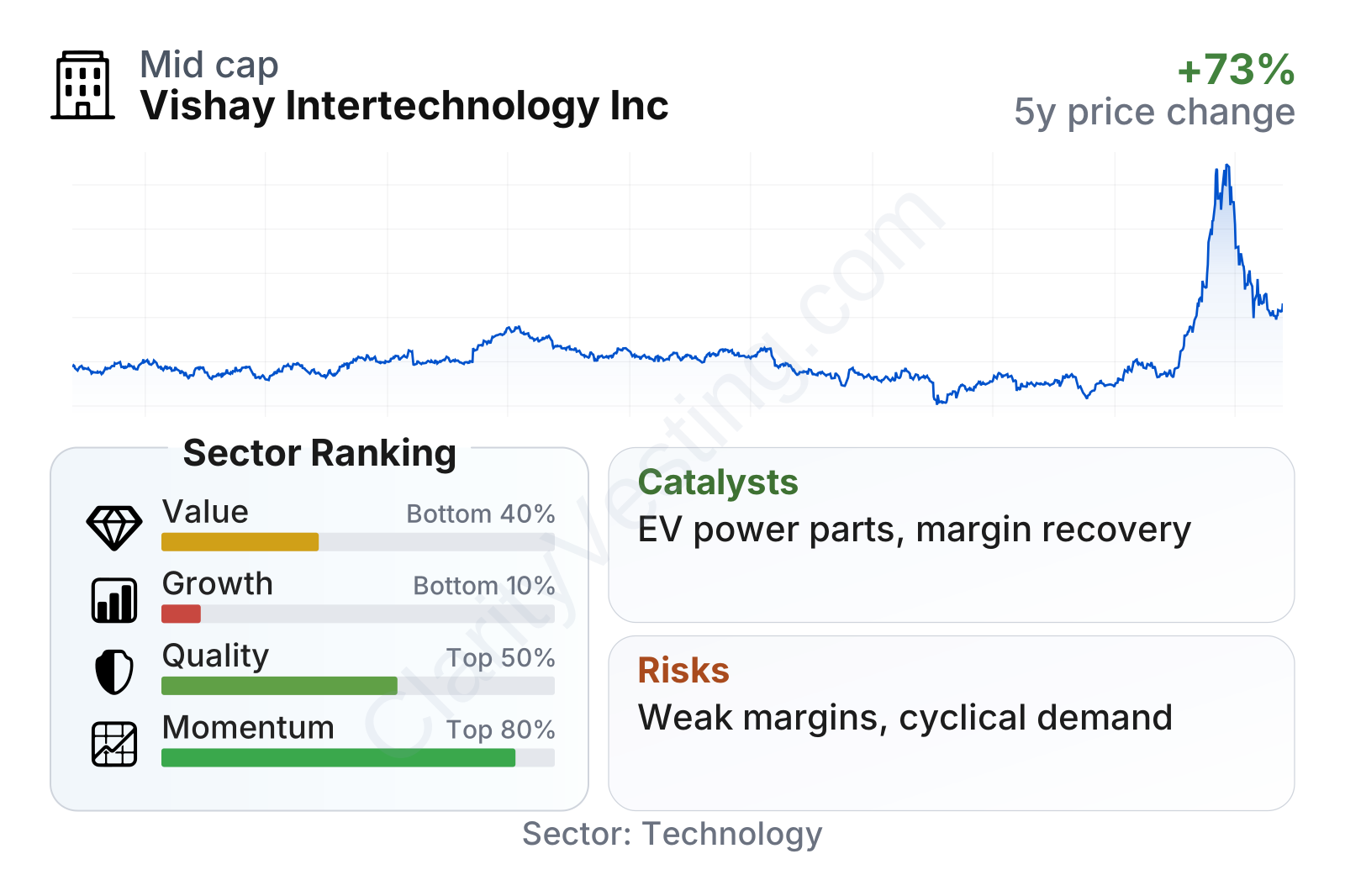
Vishay is a mid-sized semiconductor company with a stock that has been much more volatile than the broader market, as shown by its elevated beta. The recent share-price rebound has been strong, and momentum metrics are well above much of the sector. However, the underlying fundamentals are more mixed. Quality indicators are supported by conservative balance-sheet features, especially net cash relative to EBIT, but current profitability is weak compared with the sector median. Growth metrics also look uneven: recent year-over-year revenue has improved, yet the longer five-year record for revenue per share, earnings, and margin trend is notably weaker than many semiconductor peers. On valuation measures, the picture is distorted by depressed earnings and negative free cash flow, which makes the headline P/E look unusually high and less informative than normal.
Growth
Vishay operates in a sector with durable long-term demand drivers. Power semiconductors and passive components are needed in electric vehicles, advanced driver-assistance systems, industrial automation, renewable energy equipment, power distribution, factory controls, and connected devices. These are not niche themes. They reflect the broader electrification of transportation and industry, rising power-efficiency requirements, and the growing amount of electronics per machine.
For Vishay specifically, the strategic logic is straightforward. The company is focusing on products that benefit from higher power content and harsher operating environments, especially in automotive and industrial applications. That makes sense because these markets generally value reliability, qualification history, and supply continuity more than the lowest possible cost alone. Vishay has also been investing in manufacturing capacity and technology for power components, including silicon carbide-related efforts and higher-value power management niches, which could improve product mix over time if execution is solid.
The revenue trend suggests a classic semiconductor cycle: strong growth earlier in the period, a prolonged decline as customers digested excess inventory, and then a noticeable recovery. The latest jump is impressive, but it also needs to be viewed in context because it comes after a weak base. The key question for long-term analysis is not whether one quarter bounced, but whether Vishay can turn that recovery into a steadier margin rebuild.
Cash generation has been much weaker than the company’s earlier peak earnings would suggest. Free cash flow turned negative after being clearly positive a few years ago, which points to a combination of softer operating performance, working-capital pressure, and ongoing investment needs. For a manufacturer in a cyclical industry, a return to sustainably positive free cash flow would be an important sign that the recovery is becoming more durable rather than just visible in sales growth.
A notable current catalyst is the company’s exposure to power electronics used in electric vehicles, industrial systems, and energy infrastructure. Another is its broad catalog model: when demand recovers across multiple end markets, Vishay can benefit without depending on a single breakthrough product. Recent company communications have also emphasized restructuring, footprint optimization, and actions to improve efficiency. If those efforts coincide with stronger demand, earnings could recover faster than revenue.
Risks
This article is for informational purposes only and does not constitute financial advice. Some content is AI-generated. See Disclaimer


