Stock Analysis · ViaSat Inc (VSAT)
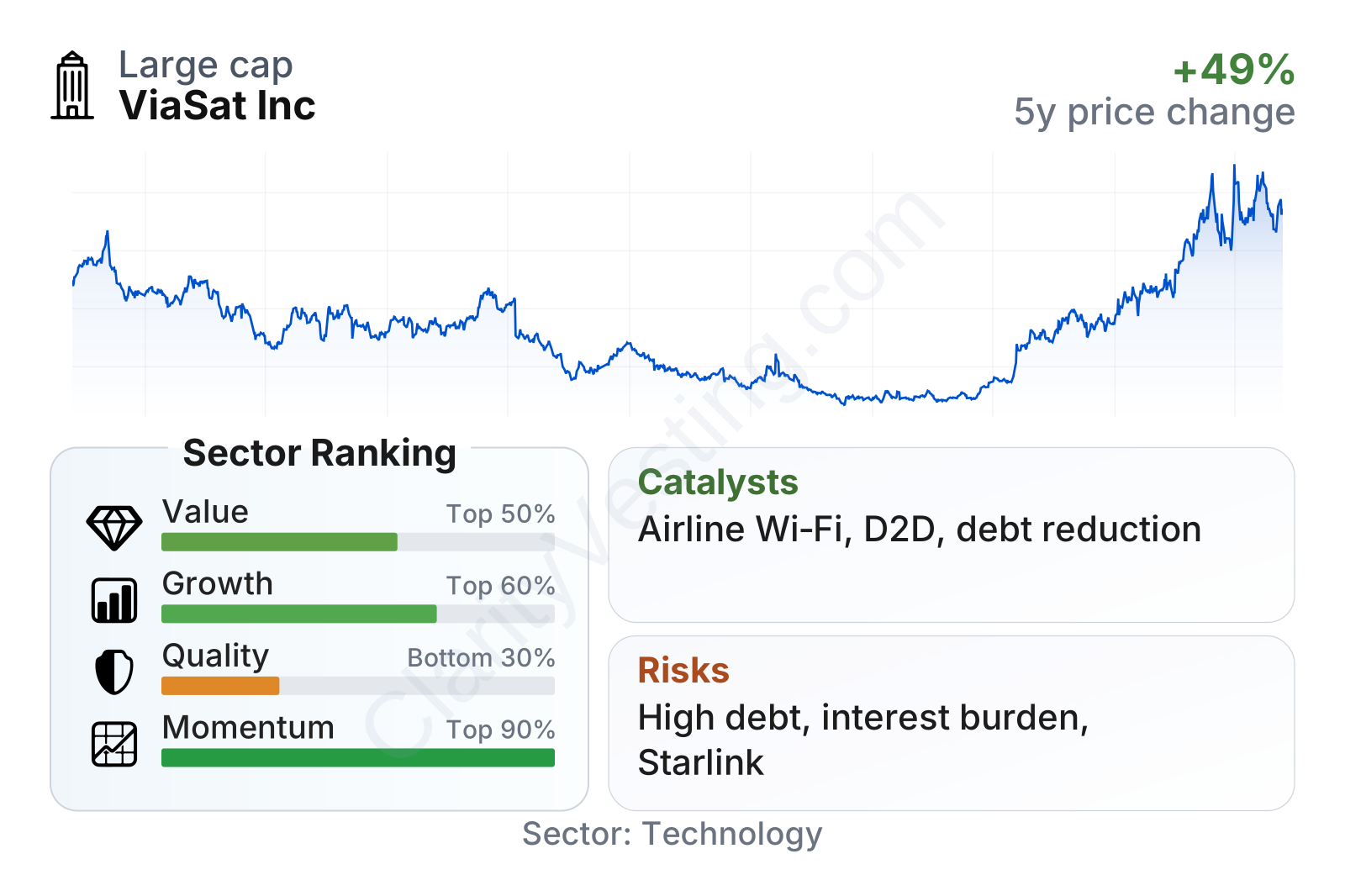
Stock Analysis · ViaSat Inc (VSAT)

Overview

ViaSat is a communications company that builds and operates satellite and wireless networking systems. In simple terms, it helps move data in places where traditional fiber or mobile networks are limited, expensive, or unavailable. Its services are used by households, airlines, governments, militaries, businesses, and mobility customers such as ships and other connected vehicles. The company became much larger after its combination with Inmarsat, which expanded its global satellite coverage and customer base.

Its business is generally organized around three main activities: communication services, defense and advanced technologies, and in-flight and mobility connectivity. Based on recent company reporting, revenue is spread across a few major buckets rather than a single dominant product, which gives the business some diversification even if performance can still vary by end market.

The main sources of revenue can be summarized approximately as follows:

  • Communication services and connectivity: roughly half of revenue. This includes broadband, aviation connectivity, maritime, enterprise, and other managed network services delivered over ViaSat and Inmarsat infrastructure.
  • Defense and advanced technologies: roughly one-quarter to one-third of revenue. This includes secure networking, tactical communications, government systems, and related products and services.
  • Commercial networks, aviation equipment, and other hardware-related activities: roughly one-fifth of revenue. This includes communication systems, terminals, and supporting equipment sold into aviation, government, and enterprise markets.

One notable financial change in the last year is that revenue has continued to rise, while operating profit has improved much faster than sales. That suggests the company is moving out of a heavy integration and investment phase and is starting to show more leverage from its scale.

Key Figures

MetricValueSector
DateJul 18, 2026
Context
SectorTechnology
IndustryCommunication Equipment
Market Cap $9.76B
Beta 1.70
Value
(Cheapness)
P/E Ratio N/A31.76
FCF Yield 6.12%4.18%
EBIT / EV 3.16%2.56%
PEG 0.26
Growth
(Business expansion)
Revenue Growth 2.10%13.50%
RPS Growth (5Y CAGR) 1.12%8.57%
EPS Growth (5Y CAGR) 10.20%-21.87%
Margin Growth (5Y Trend) N/A0.41%
FCF Growth (5Y CAGR) N/A9.76%
Quality
(Business durability)
ROIC (Latest) 2.35%8.54%
ROIC (5Y Median) -1.32%8.12%
Net Debt / EBIT (Latest) 11.270.38
Net Debt / EBIT (5Y Median) N/A0.38
Operating Margin (Latest) 9.93%9.58%
Operating Margin (5Y Median) -3.29%8.25%
Debt to Equity (Latest) 148.91%33.52%
Profit Margin (Latest) -0.74%6.96%
Free Cash Flow (Latest) $597.11M
Momentum
(Price trend)
3Y Return +137.00%+30.91%
12M Return (excl. last month) +390.50%+28.90%
6M Return +62.05%+5.38%
Price vs. 200-Day MA +42.50%+7.61%
Better than sector median
Slightly worse than sector median
More than 20% worse than sector median

ViaSat currently sits in the mid-cap range, with a market value near $9 billion, and the shares have been far more volatile than the broader market, as shown by the elevated beta. The stock’s recent performance has been very strong after a long decline from 2021 through late 2024, which reflects a major shift in market expectations around cash generation, operating improvement, and balance-sheet stabilization.

The metric mix is unusual. On one hand, value measures look relatively favorable versus much of the sector, helped by a free cash flow yield around the high-single-digit range and an enterprise-value-to-EBIT profile above the sector median. Growth measures are more mixed: recent revenue growth is positive but modest, well below the typical fast-growing technology name, although earnings recovery has improved meaningfully from depressed levels. Quality remains the weakest area because returns on invested capital are still low and leverage remains much higher than normal for the sector.

Growth

ViaSat operates in a sector with durable long-term demand. Data traffic keeps expanding across aviation, maritime, defense, remote enterprise sites, and rural broadband. That does not mean growth is automatic, but it does mean the company serves markets where connectivity is becoming more essential over time. In particular, airlines want better onboard internet, governments continue to invest in resilient communications, and mobility customers need broader geographic coverage than terrestrial networks can provide.

The company’s strategy makes sense if viewed over a multi-year horizon. The Inmarsat deal created a broader global platform with exposure to commercial aviation, maritime, and government services. The logic is scale: a larger satellite fleet, more spectrum, a wider customer footprint, and the ability to sell integrated connectivity across multiple end markets. If execution improves, that larger platform can support better asset utilization and stronger operating margins than the legacy business could achieve on its own.

Revenue growth has clearly slowed after the big jump caused by the Inmarsat combination, but the recent pattern looks more stable than weak. The business is no longer posting the extraordinary merger-related growth rates seen in 2023 and early 2024; instead, it appears to be settling into low-single-digit organic expansion. For a satellite operator carrying a large infrastructure base, the more important question is not only sales growth but whether incremental revenue drops through to profit and cash flow.

That is where the recent improvement becomes important. Free cash flow moved from deeply negative territory over several years to solidly positive in the latest trailing period. This is one of the clearest signs that the company may be transitioning from a capital-heavy buildout and integration phase into a period where the network starts producing more cash than it consumes. If sustained, that would matter more than modest top-line growth because it could support debt reduction and greater financial flexibility.

Recent company updates have also pointed to continued focus on operational efficiencies, satellite network integration, and commercial momentum in mobility and government markets. The stronger operating income seen recently suggests those efforts are beginning to show up in reported results. A meaningful catalyst is the possibility that management turns this operational progress into consistent positive earnings and cash generation over the next several reporting periods.

Risks

The biggest risk is leverage. ViaSat carries much more debt than the typical communications equipment company, and that matters because satellite businesses are capital-intensive even in good times. High debt reduces flexibility, raises refinancing sensitivity, and makes the equity more reactive to disappointments. Even though operating performance has improved, the company still has a high net-debt-to-EBIT burden compared with the sector.

The debt-to-equity trend remains elevated at roughly one and a half times equity, versus a sector norm closer to one-third. That gap is large. Recent improvement in operating income and free cash flow helps, but the balance sheet is still a central part of the investment debate. In practice, this means a larger share of future business progress may need to go toward strengthening the capital structure rather than purely expanding the business.

A second risk is profitability consistency. ViaSat has improved sharply at the operating level, but net profit is still around break-even to slightly negative. Interest expense remains substantial, which can absorb much of the operational progress. This is especially important for a company that has gone through a major merger and still needs to prove that the combined platform can deliver durable earnings, not just occasional periods of improvement.

The profit margin trend shows how uneven results have been. The latest margin is much better than the losses seen through much of 2024 and 2025, but it still trails the sector by a wide margin. That tells readers the turnaround is underway, yet not complete. A few more quarters of improvement would make the recovery look more convincing.

Competition is also significant. In consumer and mobility broadband, ViaSat competes with satellite and network providers such as Starlink, Eutelsat OneWeb, SES, Intelsat, and Hughes, depending on the market. In aviation connectivity, competition includes Gogo in some service layers as well as other global satellite operators. In defense and government communications, the company competes with larger defense and aerospace groups such as L3Harris, Northrop Grumman, and other specialized secure-network providers. ViaSat is not the overall leader across the full satellite industry by scale, and it does not have the same public visibility as Starlink. Its advantage is more specific: a deep position in mobility, aviation, government-grade communications, and a mixed fleet and service model built over many years.

That competitive position has real strengths but also limits. ViaSat has technical know-how, long customer relationships, regulatory approvals, and infrastructure that is difficult to replicate quickly. These are meaningful barriers to entry. However, the sector is changing fast, especially with low-Earth-orbit constellations pushing customer expectations higher for speed, latency, and coverage. The company therefore needs to keep investing while also managing debt, which creates a difficult balancing act.

There has not been a major public scandal defining the current thesis, but long-term risk monitoring should include execution on integration, network performance, satellite deployment timing, and the company’s ability to convert operating gains into sustained net profitability.

Valuation

Assessing ViaSat through a traditional price-to-earnings lens is difficult because earnings have been inconsistent and the latest net margin is still slightly negative. In that setting, cash flow and enterprise-value-based measures are more useful than headline P/E.

The historical earnings multiple has often been either distorted or not meaningful, which is exactly what happens when profits swing around break-even. That makes the current valuation less about near-term accounting earnings and more about whether the recent operating and cash flow improvement is durable.

On that basis, the stock does not look obviously stretched relative to the company’s recovery profile. Value indicators are better than the sector median, and the free cash flow yield is notable for a business with hard-to-replace infrastructure. At the same time, the sharp rebound in the share price means part of the operational recovery is already reflected in the market’s expectations.

The valuation therefore rests on a narrow but understandable logic: the market appears to be pricing ViaSat less as a distressed satellite operator and more as a company emerging from a difficult integration period with improving cash generation. That framework can be justified if the business keeps producing positive free cash flow, protects margins, and gradually lowers leverage. If those conditions weaken, the current price can look demanding because the margin for error is not especially large.

Conclusion

ViaSat is now easier to understand than it was a year ago. It is no longer mainly a case about ambitious satellite assets and merger complexity; it is increasingly a case about whether a larger global connectivity platform can translate scale into dependable cash flow. Recent results are encouraging on that front. Revenue is still growing, operating profit has improved markedly, and free cash flow has turned positive after several difficult years.

The challenge is that the company is not yet fully through the hard part. Debt remains high, net profitability is still only near break-even, and competition in satellite communications is intense. That leaves ViaSat in a transitional position: financially stronger than the market once feared, but not yet strong enough to remove balance-sheet concerns from the discussion.

Overall, the company currently looks more like a recovering infrastructure and communications operator than a classic high-growth technology name. The most persuasive part of the picture is the improving cash profile and the strategic value of its aviation, mobility, and government communications footprint. The main limitation is that this progress still has to outrun leverage. That combination makes the current setup more compelling on operational momentum than on financial simplicity.

Sources:

  • ViaSat, Inc. — Annual Report on Form 10-K for fiscal year ended March 31, 2026
  • ViaSat, Inc. — SEC filings available through the SEC EDGAR database in 2026
  • ViaSat Investor Relations — Fiscal 2026 earnings releases and shareholder materials
  • ViaSat Investor Relations — Company overview and business segment information
  • Wikipedia — ViaSat basic company history and Inmarsat acquisition background

This article is for informational purposes only and does not constitute financial advice. Some content is AI-generated. See Disclaimer


Sign up for exclusive research and insights.

Unsubscribe anytime.
