Stock Analysis · Vishay Precision Group Inc (VPG)
Overview
Vishay Precision Group is a small industrial technology company that makes highly specialized sensors, weighing systems, and measurement products. Its equipment is used when customers need very accurate readings for force, weight, pressure, or industrial process control. The company serves a wide range of end markets including transportation, steel, construction, medical, agriculture, aerospace, and general manufacturing.
VPG reports its business through three operating segments. Based on the latest annual filing, revenue is split approximately as follows:
- Sensors – about 40% to 45% of revenue. This segment includes precision foil technology products such as strain gages, load cells, transducers, and onboard weighing sensors used in measurement and control applications.
- Weighing Solutions – about 30% to 35% of revenue. This business provides weighing modules, systems, and related components used in industrial and commercial weighing.
- Measurement Systems – about 20% to 25% of revenue. This segment includes data acquisition systems, measurement instrumentation, and process control products for more specialized industrial uses.
Geographically, the company sells across the Americas, Europe, and Asia, which gives it some diversification, but it remains tied to industrial capital spending rather than consumer demand. The broad pattern in recent years has been clear: revenue peaked in 2022, softened in 2023 and 2024 as industrial demand weakened, and remained under pressure in 2025, while profitability compressed much more sharply than sales.
The business model is attractive in concept because customers often need reliability, certification, and precision rather than the lowest possible price. That can support sticky customer relationships and repeat demand in niche applications.
The long-term financial flow shows a business that once converted revenue into solid operating profit, but whose margins narrowed materially after 2022. Sales have stayed close to the low-$300 million range more recently, yet operating income and net income fell much faster, which suggests cost absorption and pricing have become more challenging.
Key Figures
| Metric | Value | Sector ⓘ |
|---|---|---|
| Date | Sep 12, 2026 | |
| Context | ||
| Sector | Technology | |
| Industry | Scientific & Technical Instruments | |
| Market Cap ⓘ | $862.97M | |
| Beta ⓘ | 1.47 | |
Value (Cheapness) | ||
| P/E Ratio ⓘ | 223.72 | 29.51 |
| FCF Yield ⓘ | -0.87% | 4.25% |
| EBIT / EV ⓘ | 1.28% | 2.85% |
| PEG ⓘ | 3.81 | |
Growth (Business expansion) | ||
| Revenue Growth ⓘ | 11.70% | 15.40% |
| RPS Growth (5Y CAGR) ⓘ | -0.22% | 8.56% |
| EPS Growth (5Y CAGR) ⓘ | -59.62% | -11.88% |
| Margin Growth (5Y Trend) ⓘ | -5.04% | 0.46% |
| FCF Growth (5Y CAGR) ⓘ | -21.21% | 9.80% |
Quality (Business durability) | ||
| ROIC (Latest) ⓘ | 2.52% | 9.44% |
| ROIC (5Y Median) ⓘ | 6.73% | 8.30% |
| Net Debt / EBIT (Latest) ⓘ | -3.25 | 0.54 |
| Net Debt / EBIT (5Y Median) ⓘ | -0.60 | 0.44 |
| Operating Margin (Latest) ⓘ | 2.71% | 9.58% |
| Operating Margin (5Y Median) ⓘ | 8.54% | 8.25% |
| Debt to Equity (Latest) ⓘ | 11.80% | 33.33% |
| Profit Margin (Latest) ⓘ | 1.20% | 7.14% |
| Free Cash Flow (Latest) ⓘ | -$7.47M | |
Momentum (Price trend) | ||
| 3Y Return ⓘ | +77.51% | +45.48% |
| 12M Return (excl. last month) ⓘ | +295.30% | +23.48% |
| 6M Return ⓘ | +15.90% | +20.93% |
| Price vs. 200-Day MA ⓘ | -0.90% | +7.43% |
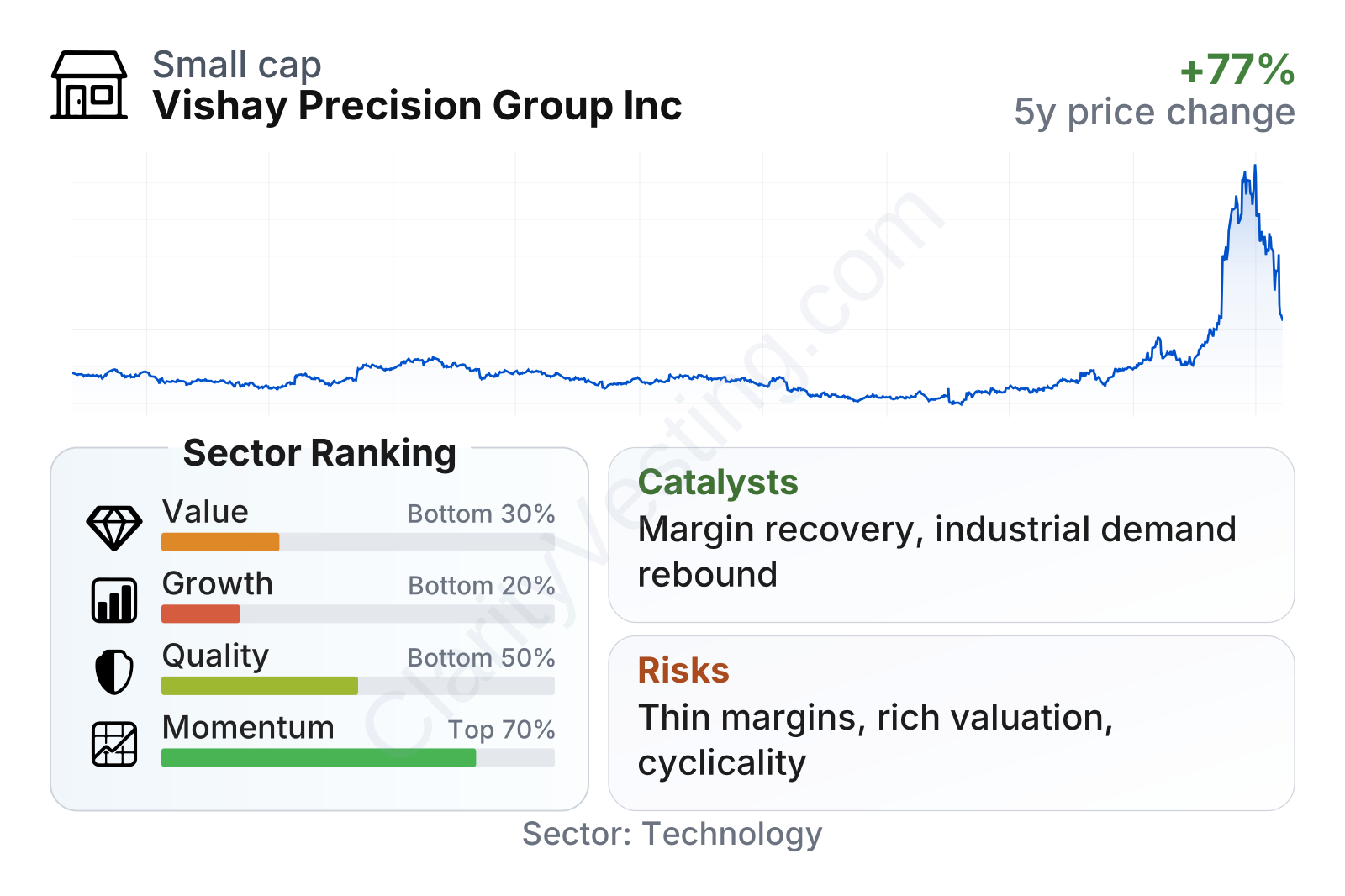
VPG is a small-cap company with a share price that has been extremely volatile, including a very sharp rise in 2026. On fundamental metrics, the picture is mixed. Balance sheet strength stands out, with low debt and net cash, but value, growth, and profitability measures rank weakly versus the broader technology sector. The current earnings multiple is unusually high because profits are very low, not because the business is delivering exceptional growth.
Growth
VPG operates in parts of the industrial sensing, measurement, and automation market that should benefit over time from factory digitization, process control, quality assurance, and the need for higher precision in manufacturing. These are real long-term themes. As more equipment becomes connected and as industrial customers seek tighter efficiency and safety standards, demand for accurate sensing and weighing products has a logical runway.
That said, a favorable end market does not automatically translate into strong company-level growth. Over the last several years, VPG’s growth record has been uneven. Revenue expanded strongly in 2021 and 2022, then turned negative through much of 2023 and 2024 before recovering in late 2025 and accelerating sharply in the latest quarter. That jump is encouraging, but it should be viewed carefully because it comes after a weak comparison base and does not yet prove a durable multi-year trend.
The company’s strategy is sensible for a niche player: focus on precision applications where product performance matters, maintain engineering know-how, and serve specialized industrial customers that may prefer proven suppliers over low-cost alternatives. VPG has also pursued selective acquisitions in the past to broaden technology and market access. If industrial spending improves and management executes well, this positioning can support a recovery.
Cash generation, however, is the more important test. Free cash flow was positive and improving through 2024, then weakened materially and recently turned negative on a trailing basis. That suggests the current rebound in revenue has not yet translated into consistently healthy cash conversion.
A meaningful catalyst in 2026 is the market’s reassessment of the company after a major surge in the stock price. That kind of move usually reflects expectations for a much better operating outlook, strategic change, or a major corporate development. For a business of this size, even moderate improvements in orders, margins, or portfolio mix can have an outsized impact on earnings.
Recent company communications also point to continued attention on operational efficiency and portfolio execution. For VPG, the main opportunity is not simply selling more products; it is restoring margins closer to earlier levels while converting revenue into cash again.
Risks
This article is for informational purposes only and does not constitute financial advice. Some content is AI-generated. See Disclaimer


