Stock Analysis · Vodafone Group PLC (VODPF)
Overview
Vodafone Group PLC is one of the largest telecommunications companies in Europe and Africa. It provides mobile and fixed-line connectivity, broadband, TV, cloud and digital services, and enterprise communications. In simple terms, Vodafone runs the networks that let consumers and businesses make calls, use mobile data, connect homes to broadband, and increasingly use digital tools such as cybersecurity, Internet of Things connections, and managed services.
The business is built around recurring subscription revenue, which is one reason telecom companies often attract attention in long-term analysis. Customers tend to pay monthly for mobile plans, home internet, and business connectivity, creating a more predictable revenue base than many cyclical industries. Vodafone has been reshaping its footprint in recent years by selling weaker or non-core operations, increasing focus on larger markets, and putting more attention on areas where network scale and converged services can support pricing and customer retention.
Based on Vodafone’s latest annual reporting structure, revenue is spread across a mix of geographies and customer groups rather than a single product. The broad revenue picture is approximately as follows:
- Service revenue from mobile customers: the largest contributor, driven by monthly voice and data plans across Europe and Africa.
- Fixed broadband and converged household services: a major source, especially in markets where Vodafone bundles mobile, broadband, and TV.
- Enterprise and business services: connectivity, cloud, IoT, security, and managed communications for corporate clients.
- Handset and equipment sales: lower-margin revenue from devices and related hardware.
- Other services and partner arrangements: smaller contributions from wholesale, roaming, and adjacent digital activities.
On a regional basis, Germany has historically been the largest single market, followed by the U.K., other European operations, and Africa through Vodacom. While exact percentages move year to year with disposals and currency movements, the company remains primarily a Europe-centered telecom operator with meaningful African exposure.
The operating picture has been uneven over the last several years. Revenue has recently improved from prior lows, while operating profit has recovered from a weak 2025 level. However, financing costs, taxes, and restructuring effects have weighed on final earnings, which helps explain why cash generation can look much stronger than net income.
The long-term pattern suggests a company with resilient gross profit and recurring sales, but one that has had to absorb significant restructuring, portfolio changes, and financing costs. That matters because the investment case depends less on fast expansion and more on whether simplification and stronger execution can convert stable telecom demand into cleaner, more durable profitability.
Key Figures
| Metric | Value | Sector ⓘ |
|---|---|---|
| Date | Aug 22, 2026 | |
| Context | ||
| Sector | Communication Services | |
| Industry | Telecom Services | |
| Market Cap ⓘ | $37.21B | |
| Beta ⓘ | 0.33 | |
Value (Cheapness) | ||
| P/E Ratio ⓘ | N/A | 18.56 |
| FCF Yield ⓘ | 53.53% | 12.89% |
| EBIT / EV ⓘ | N/A | 4.84% |
| PEG ⓘ | 0.58 | |
Growth (Business expansion) | ||
| Revenue Growth ⓘ | 7.30% | 5.50% |
| RPS Growth (5Y CAGR) ⓘ | -2.60% | 4.59% |
| EPS Growth (5Y CAGR) ⓘ | N/A | -18.25% |
| Margin Growth (5Y Trend) ⓘ | 2.95% | 0.60% |
| FCF Growth (5Y CAGR) ⓘ | -1.57% | 5.47% |
Quality (Business durability) | ||
| ROIC (Latest) ⓘ | N/A | 8.59% |
| ROIC (5Y Median) ⓘ | 2.47% | 8.11% |
| Net Debt / EBIT (Latest) ⓘ | N/A | 1.70 |
| Net Debt / EBIT (5Y Median) ⓘ | 23.11 | 2.74 |
| Operating Margin (Latest) ⓘ | 11.06% | 14.91% |
| Operating Margin (5Y Median) ⓘ | 5.67% | 13.15% |
| Debt to Equity (Latest) ⓘ | N/A | 58.36% |
| Profit Margin (Latest) ⓘ | -0.98% | 8.93% |
| Free Cash Flow (Latest) ⓘ | $19.92B | |
Momentum (Price trend) | ||
| 3Y Return ⓘ | +124.30% | +44.85% |
| 12M Return (excl. last month) ⓘ | +39.48% | +2.33% |
| 6M Return ⓘ | +13.35% | +4.05% |
| Price vs. 200-Day MA ⓘ | +25.78% | +3.35% |
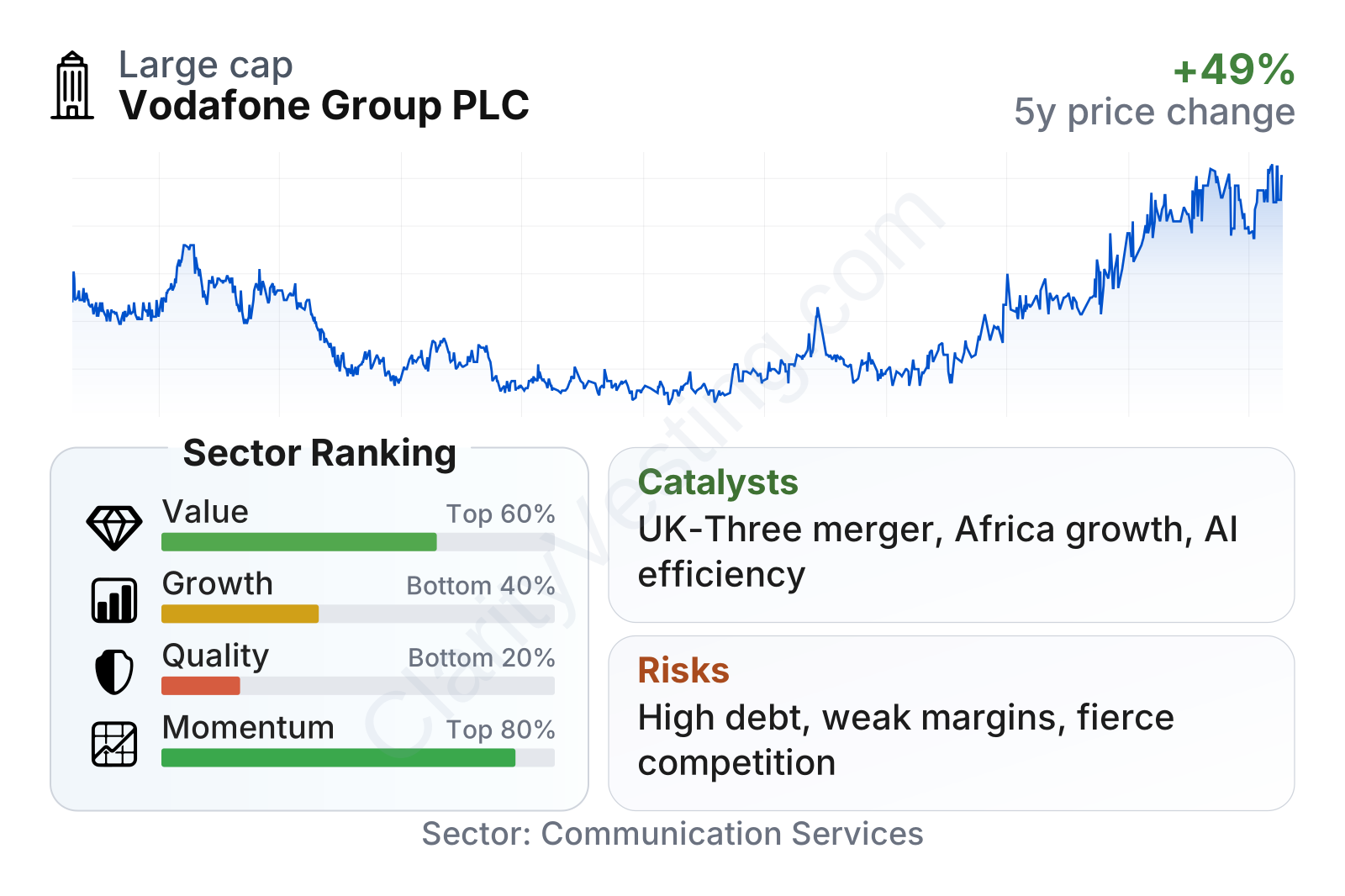
Vodafone’s profile is mixed. Size and cash generation stand out, with a market value in the mid-$30 billions and unusually high free cash flow yield versus much of the sector. Momentum has also been strong, as the share price rebounded sharply from its 2024 lows into 2025 and early 2026. At the same time, the quality picture is weaker: leverage is elevated, returns on invested capital are below sector norms, and profitability metrics remain pressured. Growth is not absent, but it is modest and inconsistent over longer periods, which fits the reality of a mature telecom group rather than a high-expansion platform.
Growth
Telecom is not a high-growth industry in the usual sense, but it is part of a sector with durable long-term demand. Mobile data usage keeps rising, fiber broadband remains important for households and businesses, and connected devices continue to expand. Vodafone’s opportunity is therefore not about inventing a new market from scratch. It is about improving monetization of essential infrastructure, reducing churn, cross-selling more services per customer, and expanding higher-value business offerings such as IoT and digital enterprise solutions.
Vodafone’s strategy broadly makes sense for that environment. Management has focused on simplifying the portfolio, improving operational efficiency, and concentrating on markets where scale can matter. In a mature sector, this can be more important than pure revenue growth. The company has also emphasized network quality, converged offerings, and business services, all of which are intended to deepen customer relationships and defend pricing.
Recent revenue growth has been positive but not dramatic. The latest trend points to low- to mid-single-digit year-over-year expansion, which is respectable for a large incumbent telecom operator. That said, the longer five-year picture remains less impressive, showing that Vodafone is still working through restructuring and asset portfolio changes rather than delivering uninterrupted compounding.
Cash generation is one of the more important growth-related supports in Vodafone’s story. Free cash flow remains very large in absolute terms, even though the longer-term growth rate in free cash flow has been uneven. In practical terms, this means the company has real financial resources to fund networks, support debt reduction, maintain strategic flexibility, and absorb restructuring while still operating at scale.
A major catalyst has been Vodafone’s ongoing reshaping of its European footprint. The merger of Vodafone UK with Three UK creates a larger operator with better scale in one of Vodafone’s most important markets. If execution is solid, that deal could improve network economics, reduce duplication, and strengthen competitive positioning. Another visible catalyst is the continued expansion of African operations through Vodacom, where digital financial services, mobile connectivity, and data demand offer structurally better growth than many Western European markets. The company has also continued to present AI-enabled customer service and operational efficiency initiatives as part of its broader modernization effort.
Risks
This article is for informational purposes only and does not constitute financial advice. Some content is AI-generated. See Disclaimer


