Stock Analysis · Vontier Corp (VNT)
Overview
Vontier is an industrial technology company focused on mobility infrastructure. In simple terms, it sells equipment, software, and services that help fuel stations operate, enable vehicle repair shops to diagnose and service cars, support fleet management, and connect transportation systems through data and automation. Its products are used across gas stations, convenience retail sites, workshops, and commercial vehicle operations.
The business is organized around a group of operating companies and brands. Based on recent company reporting, revenue is mainly generated from the following activities:
- Mobility Technologies segment: about 55% to 60% of revenue. This includes fueling equipment, payment and point-of-sale systems for convenience and fuel retailers, tank monitoring, telematics, and software solutions used to manage site operations and fleets. Key brands include Gilbarco Veeder-Root and Teletrac Navman.
- Repair Solutions segment: about 40% to 45% of revenue. This includes vehicle diagnostics, repair tools, wheel service equipment, emissions and inspection systems, and workshop software used by auto repair professionals. Key brands include Matco Tools and other diagnostics and service equipment businesses.
Within those segments, Vontier also benefits from a mix of equipment sales, recurring software subscriptions, parts, and service-related revenue. That matters because recurring revenue tends to be more stable than one-time hardware orders. The company’s footprint is broad, but a meaningful portion of demand still depends on fuel retail and vehicle maintenance markets, which are mature rather than fast-expanding.
The business model has shown steady gross profit generation over the last several years, with annual revenue mostly staying near the $3 billion level and operating income remaining resilient. One notable trend is that gross profit has held up better than total sales, suggesting decent pricing discipline and cost control even during periods of softer demand.
Key Figures
| Metric | Value | Sector ⓘ |
|---|---|---|
| Date | Sep 12, 2026 | |
| Context | ||
| Sector | Technology | |
| Industry | Scientific & Technical Instruments | |
| Market Cap ⓘ | $4.23B | |
| Beta ⓘ | 1.13 | |
Value (Cheapness) | ||
| P/E Ratio ⓘ | 13.25 | 29.51 |
| FCF Yield ⓘ | 7.87% | 4.25% |
| EBIT / EV ⓘ | 7.92% | 2.85% |
| PEG ⓘ | 0.79 | |
Growth (Business expansion) | ||
| Revenue Growth ⓘ | -2.20% | 15.40% |
| RPS Growth (5Y CAGR) ⓘ | 4.37% | 8.56% |
| EPS Growth (5Y CAGR) ⓘ | -15.85% | -11.88% |
| Margin Growth (5Y Trend) ⓘ | -1.44% | 0.46% |
| FCF Growth (5Y CAGR) ⓘ | 0.45% | 9.80% |
Quality (Business durability) | ||
| ROIC (Latest) ⓘ | 11.50% | 9.44% |
| ROIC (5Y Median) ⓘ | 14.37% | 8.30% |
| Net Debt / EBIT (Latest) ⓘ | 3.52 | 0.54 |
| Net Debt / EBIT (5Y Median) ⓘ | 3.47 | 0.44 |
| Operating Margin (Latest) ⓘ | 15.43% | 9.58% |
| Operating Margin (5Y Median) ⓘ | 18.75% | 8.25% |
| Debt to Equity (Latest) ⓘ | 161.91% | 33.33% |
| Profit Margin (Latest) ⓘ | 11.34% | 7.14% |
| Free Cash Flow (Latest) ⓘ | $332.60M | |
Momentum (Price trend) | ||
| 3Y Return ⓘ | +8.71% | +45.48% |
| 12M Return (excl. last month) ⓘ | -20.28% | +23.48% |
| 6M Return ⓘ | -11.01% | +20.93% |
| Price vs. 200-Day MA ⓘ | -6.72% | +7.43% |
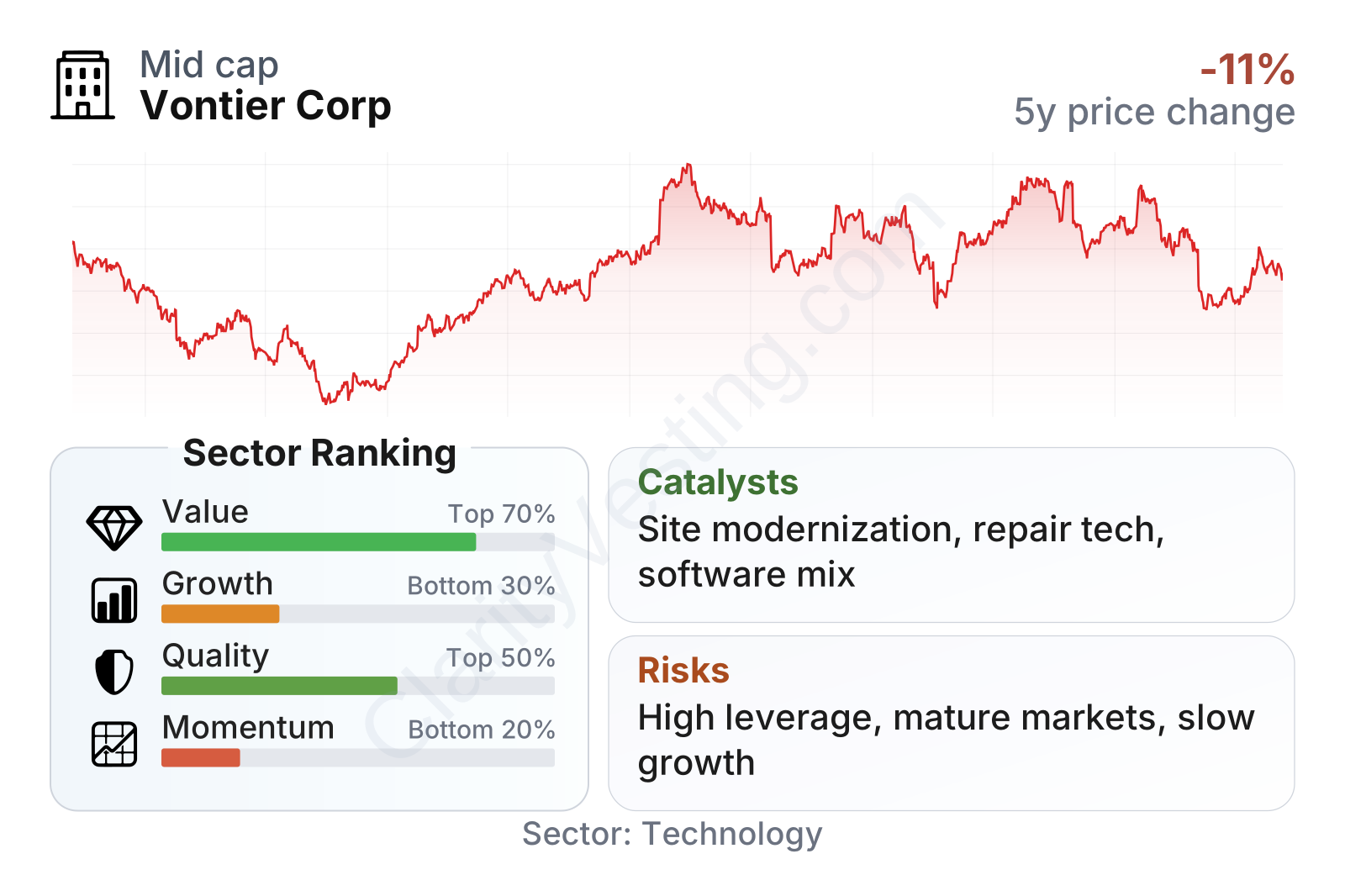
Vontier currently sits in an interesting position: profitability and cash generation look stronger than much of its sector, while growth and market performance have been weaker. The business ranks well on value measures, with an earnings multiple far below the sector median and a free cash flow yield above the sector norm. Quality is also respectable, supported by operating margins in the mid-teens and returns on invested capital above typical peers. The weaker points are growth, which has trailed the sector, and momentum, with the stock underperforming over recent periods.
The share price history reflects that mixed picture. After recovering strongly through 2023 and much of 2024, the stock became more volatile and gave back a meaningful part of those gains in 2026. That kind of movement often signals that the market is debating whether Vontier is a dependable cash compounder or a business facing limited growth.
Growth
Vontier operates in several markets with long-term relevance, but they do not all grow at the same speed. The traditional fueling and vehicle service businesses are mature, while software, telematics, connected shop tools, payment systems, and alternative-fueling infrastructure offer better expansion potential. This means the company is not in a pure high-growth sector, but it does have exposure to areas where technology adoption is still increasing.
Its strategy broadly makes sense for future growth. Management has been working to increase the share of software-enabled, recurring, and workflow-oriented revenue. That is important because customers in fuel retail and vehicle repair increasingly want integrated systems rather than stand-alone machines. Vontier’s installed base can help here: once a retailer or workshop uses its hardware, software and service upgrades can become easier to sell.
Revenue growth, however, has been uneven. After stronger periods in 2022, the company went through several quarters of contraction, then returned to modest growth before slipping slightly again most recently. That pattern suggests the business is resilient but not currently showing sustained acceleration. Compared with many technology names, Vontier’s top-line profile is clearly slower.
Free cash flow is one of the more encouraging parts of the growth picture. Over the last few years, annualized free cash flow has remained solid, generally in the low-to-mid $300 million range, with a stronger peak around 2024. That gives the company financial flexibility for debt reduction, acquisitions, and shareholder returns, even if revenue growth stays moderate.
A meaningful catalyst is the modernization of fuel and convenience retail sites. Operators continue to invest in payment systems, site automation, compliance, and monitoring. Another catalyst is repair complexity in modern vehicles, which supports demand for advanced diagnostics and workshop technology. Vontier also has exposure to energy transition themes through alternative-fueling and related infrastructure, though this is still an added opportunity rather than the core engine of the business today.
Recent company updates have continued to emphasize portfolio shaping, operational discipline, and technology-led offerings. For long-term analysis, the central question is less about whether demand disappears and more about whether Vontier can shift enough of its mix toward faster-growing software and connected solutions to lift its overall growth rate.
Risks
This article is for informational purposes only and does not constitute financial advice. Some content is AI-generated. See Disclaimer