Stock Analysis · Valeo SE (VLEEF)
Overview
Valeo SE is a French automotive supplier that sells components, systems, and software to car manufacturers and to the aftermarket. Its products are used in areas that matter more as vehicles become more electrified, connected, and automated: powertrain electrification, driver-assistance systems, lighting, thermal management, and interior electronics. In simple terms, Valeo does not sell cars directly to consumers; it supplies many of the technologies that go inside them.
The company organizes its business into four main operating segments. Based on recent annual reporting, revenue is broadly distributed as follows:
- Power, about 27% — electrical systems, power electronics, and technologies linked to vehicle electrification, including solutions used in hybrid and battery electric vehicles.
- Thermal, about 26% — climate control, thermal systems for combustion vehicles and EVs, and battery or powertrain cooling.
- Comfort & Driving Assistance Systems, about 24% — sensors, cameras, parking assistance, interior electronics, and advanced driver-assistance features.
- Visibility, about 23% — lighting systems, wiper systems, and related exterior visibility equipment.
In addition to those product lines, Valeo also has an aftermarket business that sells replacement parts and services after the original vehicle sale. Geographically, the company is diversified across Europe, Asia, and the Americas, which helps reduce reliance on one single auto market but also ties results to global vehicle production cycles.
Looking at the business model over the last several years, revenue climbed from roughly €17 billion in 2021 to about €21 billion in 2025, while research and development spending stayed very high at around €2.0 billion to €2.3 billion a year. That is a notable feature of Valeo: it is spending heavily to stay relevant in a fast-changing car industry. At the same time, net income remained relatively modest compared with sales, showing that scale alone has not yet translated into strong profitability.
The broad picture is a company with large sales, very significant engineering expense, and thin earnings. That mix can be attractive if the auto technology transition keeps rewarding suppliers with strong product portfolios, but it also leaves little room for execution mistakes.
Key Figures
| Metric | Value | Sector ⓘ |
|---|---|---|
| Date | Sep 12, 2026 | |
| Context | ||
| Sector | Consumer Cyclical | |
| Industry | Auto Parts | |
| Market Cap ⓘ | $3.99B | |
| Beta ⓘ | 1.31 | |
Value (Cheapness) | ||
| P/E Ratio ⓘ | 17.37 | 17.10 |
| FCF Yield ⓘ | 75.49% | 8.53% |
| EBIT / EV ⓘ | N/A | 6.46% |
| PEG ⓘ | 0.18 | |
Growth (Business expansion) | ||
| Revenue Growth ⓘ | -2.60% | 5.75% |
| RPS Growth (5Y CAGR) ⓘ | 4.62% | 9.14% |
| EPS Growth (5Y CAGR) ⓘ | -59.71% | -18.21% |
| Margin Growth (5Y Trend) ⓘ | -0.42% | -0.23% |
| FCF Growth (5Y CAGR) ⓘ | 20.67% | 4.91% |
Quality (Business durability) | ||
| ROIC (Latest) ⓘ | 22.53% | 12.61% |
| ROIC (5Y Median) ⓘ | 4.60% | 10.72% |
| Net Debt / EBIT (Latest) ⓘ | 1.98 | 2.10 |
| Net Debt / EBIT (5Y Median) ⓘ | 4.99 | 2.32 |
| Operating Margin (Latest) ⓘ | 4.71% | 9.25% |
| Operating Margin (5Y Median) ⓘ | 3.59% | 9.64% |
| Debt to Equity (Latest) ⓘ | 202.26% | 75.78% |
| Profit Margin (Latest) ⓘ | 0.98% | 5.33% |
| Free Cash Flow (Latest) ⓘ | $3.01B | |
Momentum (Price trend) | ||
| 3Y Return ⓘ | -1.96% | +14.53% |
| 12M Return (excl. last month) ⓘ | +44.22% | +3.08% |
| 6M Return ⓘ | +49.66% | +0.55% |
| Price vs. 200-Day MA ⓘ | +22.25% | -0.54% |
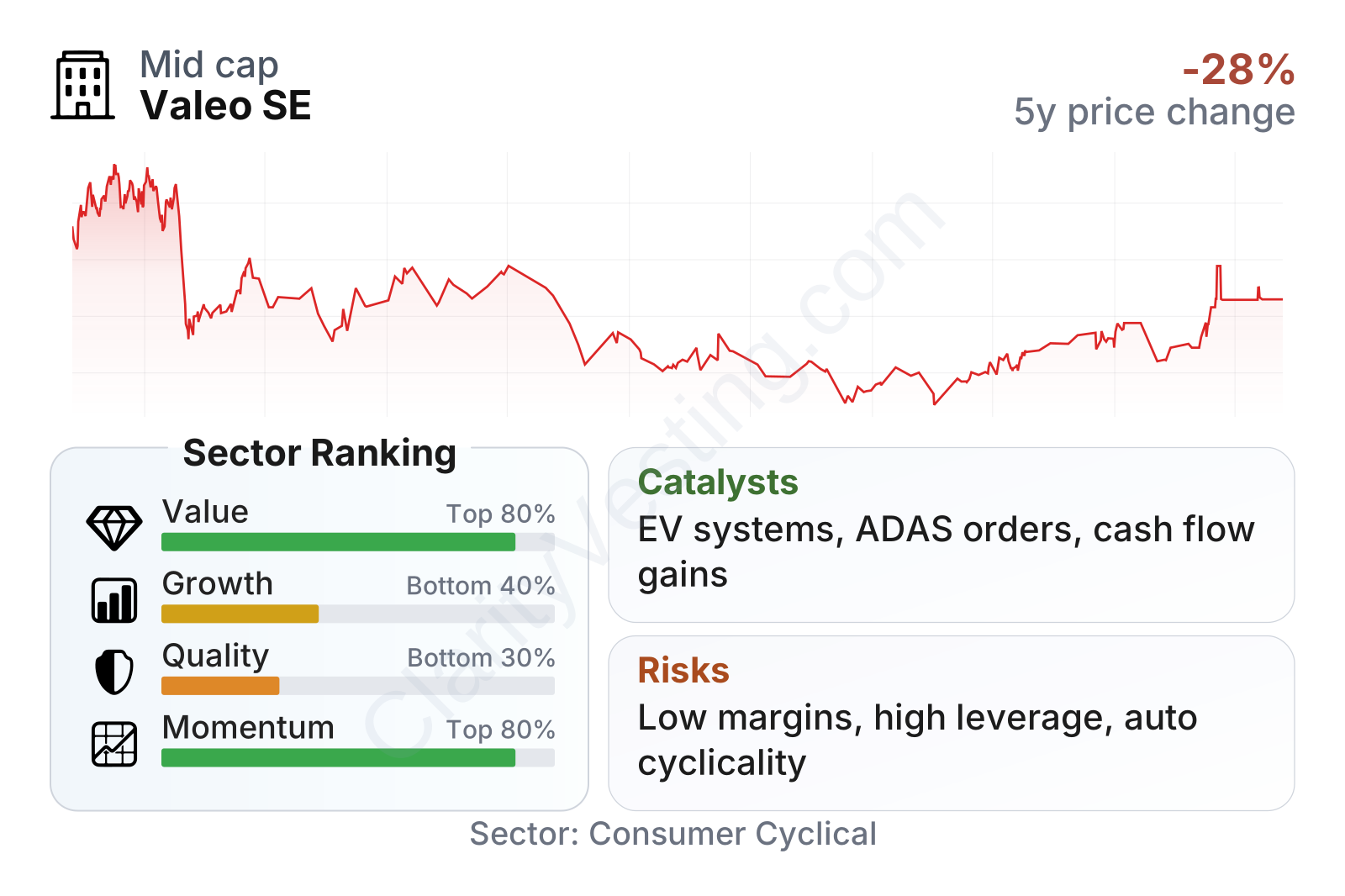
Valeo is a mid-sized listed auto supplier with above-average share price volatility, as reflected by a beta around 1.3. The factor snapshot is mixed. On valuation, the stock looks inexpensive relative to many peers, helped by a P/E ratio close to the sector median and unusually strong free-cash-flow yield. Momentum has also improved sharply over the last year, with recent price performance well ahead of the broader sector.
The weaker areas are growth and operating quality. Recent revenue growth has been slightly negative while the sector median remained positive, and margins remain well below peer levels. One encouraging point is that return on invested capital over the last twelve months appears much better than the longer-term average, suggesting some recent operational improvement even if the full record is still uneven.
Growth
Valeo operates in parts of the auto industry that still have structural growth drivers. Electrification increases demand for power electronics, thermal management, and high-voltage systems. Driver-assistance features also continue to spread from premium vehicles into more affordable models. Lighting is becoming more software-driven and differentiated, while cockpit electronics and sensors are taking a larger role in vehicle design. These are not niche themes; they are central to how the automotive supply chain is evolving.
Valeo’s strategy broadly fits that direction. The company has spent heavily on research and development for years, and that expense level only makes sense if management believes it can convert engineering depth into long-cycle customer programs. Its presence across several high-value systems is important because automakers increasingly want suppliers that can deliver integrated solutions rather than isolated parts.
That said, the near-term growth record is not especially strong. Recent year-over-year revenue has slipped slightly, and over the last five years revenue per share growth has lagged the sector median. This suggests that while Valeo is in attractive categories, it has not consistently converted industry tailwinds into faster top-line expansion than peers.
Free cash flow is one of the more constructive elements in the current picture. The longer-term cash flow trend has improved materially, and the latest annualized level is strong in relation to the company’s market value. For a capital-intensive supplier, that matters: good cash conversion can support debt reduction, technology investment, and resilience during weaker vehicle production periods.
Recent company communication has also emphasized order intake in electrification and advanced driver-assistance technologies, which is relevant because suppliers often secure business years before vehicles reach production. If those awards convert into profitable ramp-ups, they can become a meaningful medium-term catalyst. Another favorable industry backdrop is the continued rise in hybrid and electric platforms, where thermal and electrical content per vehicle is typically higher than in traditional combustion models.
Risks
This article is for informational purposes only and does not constitute financial advice. Some content is AI-generated. See Disclaimer


