Stock Analysis · Vimian Group AB (VIMGF)
Overview
Vimian Group AB is a Sweden-based animal health company focused on specialty products and services for companion animals and selected livestock uses. Rather than operating as a broad pharmaceutical giant, Vimian has built a portfolio of niche businesses across veterinary diagnostics, specialty pharmaceuticals, medical technology, and veterinary services. Its strategy has largely centered on acquiring specialized companies, keeping their domain expertise, and using the group’s scale to support distribution, product development, and international expansion.
The business is mainly exposed to animal health, a market supported by long-term trends such as rising pet ownership, higher spending per pet, and increasing demand for more advanced veterinary care. Within that market, Vimian is positioned in areas where customers often value reliability, regulatory know-how, and specialized products more than low prices alone.
Based on recent annual reporting, revenue is spread across four operating areas. The mix can shift somewhat from year to year, but the business is broadly organized as follows:
- Specialty Pharma: approximately 35% to 40% of revenue. This includes niche animal health pharmaceuticals, often for chronic or specialized treatments.
- Diagnostics: approximately 25% to 30% of revenue. This area includes veterinary diagnostic products and services used by clinics and laboratories.
- MedTech: approximately 20% to 25% of revenue. This segment includes veterinary medical devices and related products.
- Veterinary Services: approximately 10% to 15% of revenue. This includes selected service operations aimed at supporting veterinarians and animal care providers.
At the group level, the financial profile has improved meaningfully over the last several years. Revenue has expanded from roughly $190 million in 2021 to about $470 million in 2025, while operating income and net income have also strengthened. Gross profit has grown faster than cost of revenue, suggesting that scale and mix have supported margins even as the company has expanded.
The main takeaway from the business mix is that Vimian is not dependent on a single product. It combines recurring demand from diagnostics and animal care with higher-margin specialty areas, which helps explain the clear improvement in operating profitability over time.
Key Figures
| Metric | Value | Sector ⓘ |
|---|---|---|
| Date | Nov 21, 2026 | |
| Context | ||
| Sector | Healthcare | |
| Industry | Diagnostics & Research | |
| Market Cap ⓘ | $2.20B | |
| Beta ⓘ | 0.99 | |
Value (Cheapness) | ||
| P/E Ratio ⓘ | 51.97 | 25.50 |
| P/B Ratio ⓘ | N/A | 4.14 |
| FCF Yield ⓘ | 4.50% | 2.68% |
| Dividend Yield ⓘ | N/A | 1.52% |
| EBIT / EV ⓘ | 3.97% | 2.99% |
| PEG ⓘ | N/A | |
Growth (Business expansion) | ||
| Revenue Growth ⓘ | 15.30% | 7.10% |
| RPS Growth (5Y CAGR) ⓘ | 13.03% | 8.61% |
| EPS Growth (5Y CAGR) ⓘ | 19.94% | -10.82% |
| BVPS Growth (5Y CAGR) ⓘ | 6.44% | 3.59% |
| Margin Growth (5Y Trend) ⓘ | 6.08% | -0.63% |
| FCF Growth (5Y CAGR) ⓘ | 111.57% | 1.59% |
| DPS Growth (5Y CAGR) ⓘ | N/A | 6.65% |
Quality (Business durability) | ||
| ROIC (Latest) ⓘ | 7.21% | 5.62% |
| ROA (Latest) ⓘ | 3.34% | 2.70% |
| ROIC (5Y Median) ⓘ | 3.77% | 4.51% |
| ROA (5Y Median) ⓘ | 1.20% | 1.78% |
| Net Debt / EBIT (Latest) ⓘ | 2.50 | 1.33 |
| Net Debt / EBIT (5Y Median) ⓘ | 4.93 | 2.00 |
| Net Debt / EBITDA (Latest) ⓘ | 1.72 | 0.99 |
| Net Debt / Assets ⓘ | 18.89% | 6.14% |
| EBITDA / Interest ⓘ | 7.39 | 9.65 |
| Operating Margin (Latest) ⓘ | 19.81% | 9.28% |
| Operating Margin (5Y Median) ⓘ | 13.06% | 7.24% |
| Debt to Equity (Latest) ⓘ | 37.46% | 28.47% |
| Profit Margin (Latest) ⓘ | 8.40% | 3.67% |
| Free Cash Flow (Latest) ⓘ | $98.74M | |
Momentum (Price trend) | ||
| 3Y Return ⓘ | +84.78% | +38.93% |
| 12M Return (excl. last month) ⓘ | -7.97% | +13.18% |
| 6M Return ⓘ | +50.09% | +10.51% |
| Price vs. 200-Day MA ⓘ | +45.71% | +3.72% |
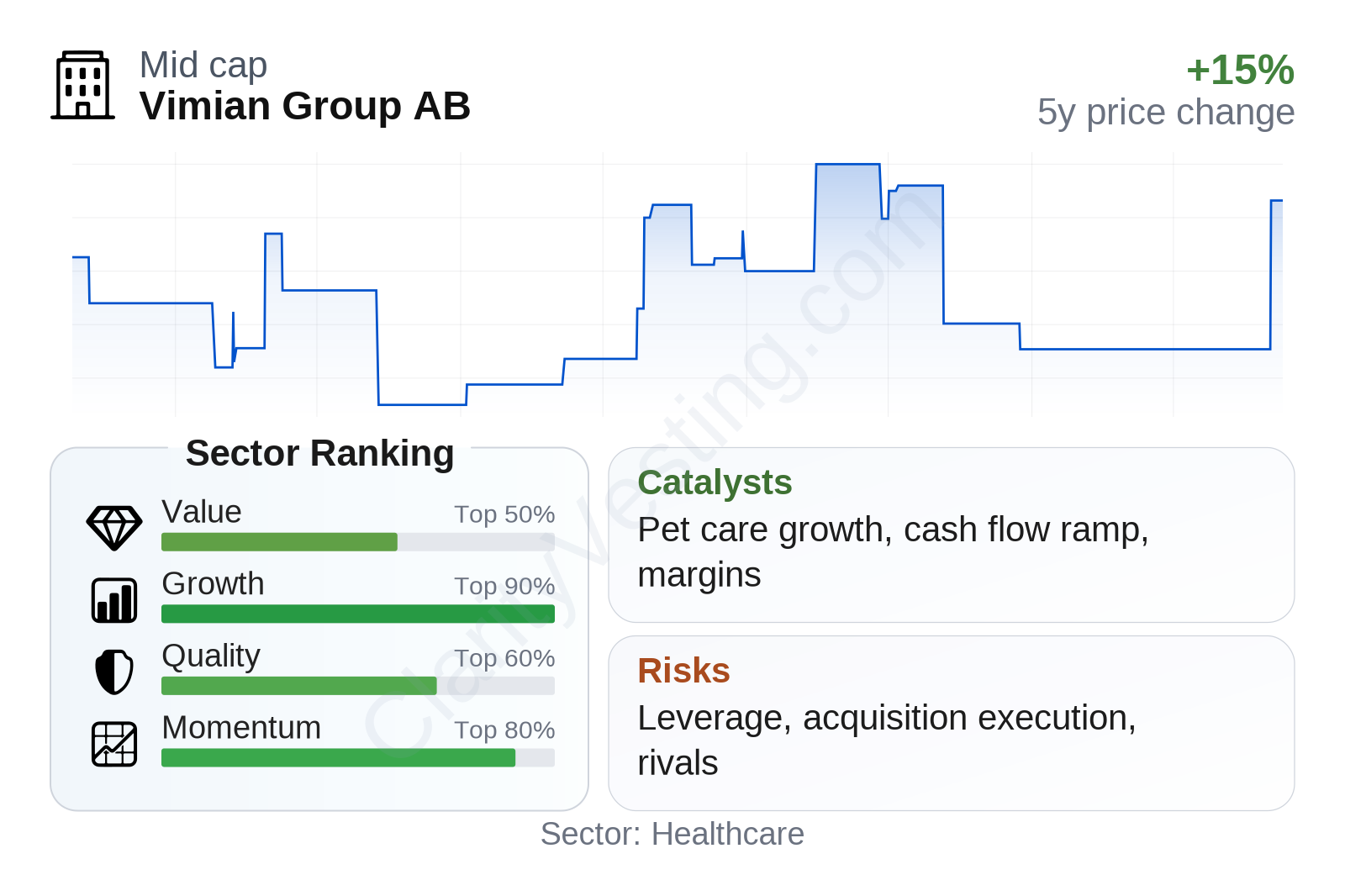
Vimian is a mid-sized healthcare company with a market value a little above $2 billion and a share price history that has been volatile. After peaking well above recent levels, the stock pulled back sharply, which matters because the current valuation sits against a business that is still growing and generating cash but has not been rewarded with a stable market rating.
The overall factor profile is mixed in an interesting way. Growth stands out strongly versus the healthcare sector, quality is above average, and value is more balanced than the headline earnings multiple suggests. The price-to-earnings ratio is elevated at a little above 50, but free cash flow yield and EBIT relative to enterprise value compare better than sector medians. In simple terms, the market is still paying a premium for growth, but the business is also producing real cash and better operating margins than many peers.
Profitability also looks healthier than the sector median. Operating margin is around 20% and profit margin is around 8%, both clearly above many diagnostics and research names. Balance sheet leverage remains noticeable, however, so the company does not fit the profile of a debt-light healthcare compounder.
Growth
Animal health remains a favorable long-term market. Pet owners in many countries are spending more on treatment, diagnostics, and chronic care, and veterinary medicine continues to become more sophisticated. That creates room for companies with specialized products that solve specific clinical needs. Vimian is operating in that direction rather than competing in low-value commodity categories.
The company’s strategy also makes sense for future expansion. Vimian has used acquisitions to assemble a portfolio of niche businesses, and this can work well in animal health because many attractive markets are fragmented. A larger parent can help acquired businesses expand internationally, broaden sales channels, and improve purchasing power. The trade-off is integration risk, but the logic behind the model is understandable and consistent.
Recent growth has normalized after the very high rates seen during the acquisition-heavy phase, but it remains solid. Year-over-year revenue growth is now generally in the high-single-digit to mid-teens range, still ahead of the sector median. That is slower than the earlier surge, yet it is more relevant for long-term analysis because it gives a better sense of what the underlying business may deliver without depending on unusually large transactions.
Cash generation has improved materially. Free cash flow moved from weak or negative territory to roughly $100 million on a trailing basis, which is one of the clearest signs that the business is maturing. Stronger cash conversion matters because it gives management more flexibility to reduce debt, fund product development, support selective acquisitions, or absorb slower periods without stressing the balance sheet.
A meaningful catalyst is the combination of improving margins and cash flow. Another is continued expansion in companion animal health, especially in diagnostics and specialty treatments where customer demand tends to be less cyclical than in many other industries. Recent company communications have also emphasized operational discipline and portfolio optimization, which suggests future progress may rely less on deal-making alone and more on extracting value from the assets already acquired.
Risks
This article is for informational purposes only and does not constitute financial advice. Some content is AI-generated. See Disclaimer