Stock Analysis · Viking Holdings Ltd (VIK)
Overview
Viking Holdings Ltd is a cruise company focused on adults and older travelers, with a brand built around destination-focused travel rather than large-ship entertainment. The group operates river cruises, ocean cruises, and expedition cruises. Its offering is positioned in the premium end of the market, with an emphasis on cultural itineraries, smaller ships, and an experience that is intentionally different from mass-market cruise operators.
The company’s revenue mainly comes from passenger ticket sales and onboard or travel-related purchases. Based on the company’s business structure and fleet mix, the biggest economic driver is river cruising, followed by ocean cruising, with expedition still much smaller but strategically important as a newer growth platform. Public filings typically present revenue by business activity rather than a detailed line-by-line breakdown for every onboard category, so the cleanest way to think about the business is by operating segment:
- River cruises: the largest contributor, estimated at roughly 50% to 60% of revenue in recent years. This includes European and other river itineraries, where Viking has long had strong brand recognition.
- Ocean cruises: estimated at roughly 35% to 45% of revenue. This includes destination-focused voyages on smaller ocean ships than those used by the largest mainstream cruise groups.
- Expedition cruises: estimated at roughly 5% to 10% of revenue. This includes specialty voyages to more remote destinations and is currently the smallest platform.
- Other onboard and travel services: a smaller contribution embedded within the cruise businesses, including excursions, beverage packages where applicable, and other guest purchases.
What stands out is that Viking is not trying to compete directly on the same model as the biggest family-focused cruise brands. It has carved out a narrower lane: affluent, typically older travelers looking for quieter ships, curated itineraries, and more time ashore. That focus matters because it shapes pricing, customer loyalty, and the type of demand the company can capture.
The business recovery since the pandemic has been powerful. Revenue has risen from well under $1 billion in 2021 to more than $6 billion in 2025, while profitability has improved sharply as occupancy, pricing, and scale have recovered. Interest expense has also become less burdensome relative to revenue, which is important in a capital-intensive industry.
Key Figures
| Metric | Value | Sector ⓘ |
|---|---|---|
| Date | Sep 12, 2026 | |
| Context | ||
| Sector | Consumer Cyclical | |
| Industry | Travel Services | |
| Market Cap ⓘ | $37.97B | |
| Beta ⓘ | 1.41 | |
Value (Cheapness) | ||
| P/E Ratio ⓘ | 27.96 | 17.10 |
| FCF Yield ⓘ | 2.75% | 8.53% |
| EBIT / EV ⓘ | 4.24% | 6.46% |
| PEG ⓘ | N/A | |
Growth (Business expansion) | ||
| Revenue Growth ⓘ | 16.50% | 5.75% |
| RPS Growth (5Y CAGR) ⓘ | 78.06% | 9.14% |
| EPS Growth (5Y CAGR) ⓘ | -13.48% | -18.21% |
| Margin Growth (5Y Trend) ⓘ | 296.98% | -0.23% |
| FCF Growth (5Y CAGR) ⓘ | N/A | 4.91% |
Quality (Business durability) | ||
| ROIC (Latest) ⓘ | 25.60% | 12.61% |
| ROIC (5Y Median) ⓘ | 19.61% | 10.72% |
| Net Debt / EBIT (Latest) ⓘ | 1.31 | 2.10 |
| Net Debt / EBIT (5Y Median) ⓘ | 4.86 | 2.32 |
| Operating Margin (Latest) ⓘ | 24.25% | 9.25% |
| Operating Margin (5Y Median) ⓘ | 10.32% | 9.64% |
| Debt to Equity (Latest) ⓘ | 374.76% | 75.78% |
| Profit Margin (Latest) ⓘ | 19.33% | 5.33% |
| Free Cash Flow (Latest) ⓘ | $1.04B | |
Momentum (Price trend) | ||
| 3Y Return ⓘ | N/A | +14.53% |
| 12M Return (excl. last month) ⓘ | +74.52% | +3.08% |
| 6M Return ⓘ | +25.38% | +0.55% |
| Price vs. 200-Day MA ⓘ | +2.56% | -0.54% |
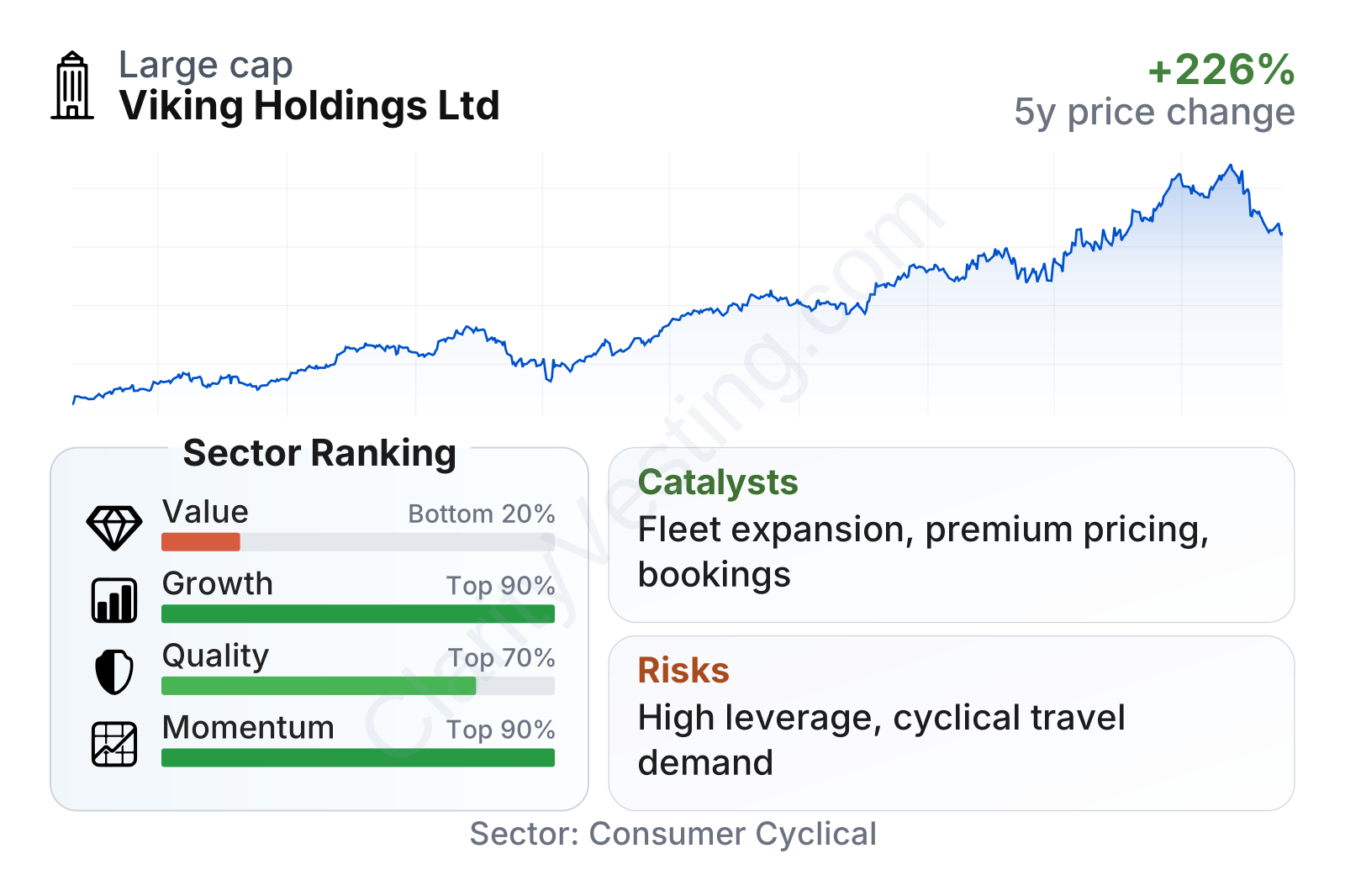
Viking is now a large public travel company, with a market value in the tens of billions of dollars. The share price has climbed strongly since listing, reflecting how quickly the market has repriced the company after its earnings recovery. The broader profile is unusual: growth and profitability look strong relative to much of the consumer discretionary universe, while valuation metrics sit in the weaker end of the sector ranking because the stock already reflects a lot of that progress.
The quality profile is one of the more encouraging points. Returns on invested capital are well above the sector median, operating margins are far stronger than typical travel peers, and net debt relative to EBIT looks manageable on a current earnings basis. At the same time, the stock shows a high-beta profile, meaning it is likely to be more volatile than the overall market.
Growth
The company operates in a sector with favorable long-term demand drivers. Cruise travel continues to benefit from aging but active consumers, rising interest in experience-led spending, and a customer base that increasingly values premium travel. Viking’s niche is particularly aligned with demographic trends: older travelers in North America and Europe often have more discretionary income and more time for longer itineraries.
Its strategy also makes sense operationally. Viking has spent years building a recognizable premium brand, and that brand can support pricing discipline better than a pure volume-driven model. The company is expanding capacity through new ships across its river, ocean, and expedition fleets, while keeping a relatively consistent product style. In practical terms, this means growth can come from both more berths and better pricing, rather than relying only on filling ships with discounts.
Recent growth has remained strong, with year-over-year revenue gains staying in the mid-teens to upper-20% range over the last several reported quarters. That is well above the sector median and suggests that Viking is still in an expansion phase rather than a mature plateau. The longer-run revenue-per-share growth profile is especially striking, showing that growth has not only come from temporary pricing spikes.
Cash generation strengthens the growth case. Free cash flow has stayed above $1 billion on a trailing basis and has trended upward. For a cruise company, this matters because growth is expensive: ships require heavy upfront capital commitments. A business that can internally generate meaningful cash has more flexibility to fund fleet expansion, reduce leverage over time, or absorb demand swings.
Recent company updates have continued to point to healthy booking trends, strong pricing, and a fleet pipeline that supports future capacity additions. In a travel company, demand visibility can change quickly, but Viking appears to be entering that next stage of growth from a position of operational strength rather than recovery-mode fragility.
Risks
This article is for informational purposes only and does not constitute financial advice. Some content is AI-generated. See Disclaimer


