Stock Analysis · Vicor Corporation (VICR)
Overview
Vicor Corporation designs and manufactures power conversion products. In simple terms, its technology helps electronic systems take electricity from a source and deliver the right amount of power, at the right voltage, to processors, accelerators, networking equipment, industrial systems, vehicles, and other demanding applications. The company is especially known for high-density modular power components, which are valuable when customers need to save space, improve efficiency, and support very high-performance computing loads.
Vicor sells mainly to customers building advanced computing and infrastructure systems. Based on recent company filings, revenue is concentrated in power modules and related power systems rather than spread across many separate business lines. The reporting is not highly segmented, but the business can be understood through its main product families and end uses.
- Advanced Products: approximately 85% to 90% of revenue in recent years. This category includes Vicor’s newer high-performance modular power solutions, including products used in AI computing, data centers, networking, industrial equipment, and other high-power applications.
- Brick Products: approximately 10% to 15% of revenue. These are more mature DC-DC converter products, often sold into industrial, defense, and communications uses.
- Geographic exposure: the company sells globally, with a meaningful share of revenue coming from customers outside the United States, though sales are generally discussed by customer and application demand more than by region.
What stands out is not just the product mix, but the economics behind it. Over the last few years, Vicor has maintained gross profit near or above revenue cost, while continuing to spend heavily on research and development. That suggests a business trying to protect specialized know-how rather than compete mainly on commodity pricing.
The long-term pattern shows a business that went through a weaker 2024, then recovered sharply in 2025 as revenue, operating income, and net income improved. Research spending has also continued to rise over time, which is important for a company competing in fast-moving power architecture markets.
Key Figures
| Metric | Value | Sector ⓘ |
|---|---|---|
| Date | Sep 12, 2026 | |
| Context | ||
| Sector | Technology | |
| Industry | Electronic Components | |
| Market Cap ⓘ | $9.12B | |
| Beta ⓘ | 2.36 | |
Value (Cheapness) | ||
| P/E Ratio ⓘ | 57.20 | 29.51 |
| FCF Yield ⓘ | 0.56% | 4.25% |
| EBIT / EV ⓘ | 1.06% | 2.85% |
| PEG ⓘ | N/A | |
Growth (Business expansion) | ||
| Revenue Growth ⓘ | 49.30% | 15.40% |
| RPS Growth (5Y CAGR) ⓘ | 3.23% | 8.56% |
| EPS Growth (5Y CAGR) ⓘ | 13.22% | -11.88% |
| Margin Growth (5Y Trend) ⓘ | 7.39% | 0.46% |
| FCF Growth (5Y CAGR) ⓘ | 102.29% | 9.80% |
Quality (Business durability) | ||
| ROIC (Latest) ⓘ | 20.22% | 9.44% |
| ROIC (5Y Median) ⓘ | 10.67% | 8.30% |
| Net Debt / EBIT (Latest) ⓘ | -3.26 | 0.54 |
| Net Debt / EBIT (5Y Median) ⓘ | -4.12 | 0.44 |
| Operating Margin (Latest) ⓘ | 25.86% | 9.58% |
| Operating Margin (5Y Median) ⓘ | 14.87% | 8.25% |
| Debt to Equity (Latest) ⓘ | 0.91% | 33.33% |
| Profit Margin (Latest) ⓘ | 30.65% | 7.14% |
| Free Cash Flow (Latest) ⓘ | $51.27M | |
Momentum (Price trend) | ||
| 3Y Return ⓘ | +214.04% | +45.48% |
| 12M Return (excl. last month) ⓘ | +366.90% | +23.48% |
| 6M Return ⓘ | +17.94% | +20.93% |
| Price vs. 200-Day MA ⓘ | -3.20% | +7.43% |
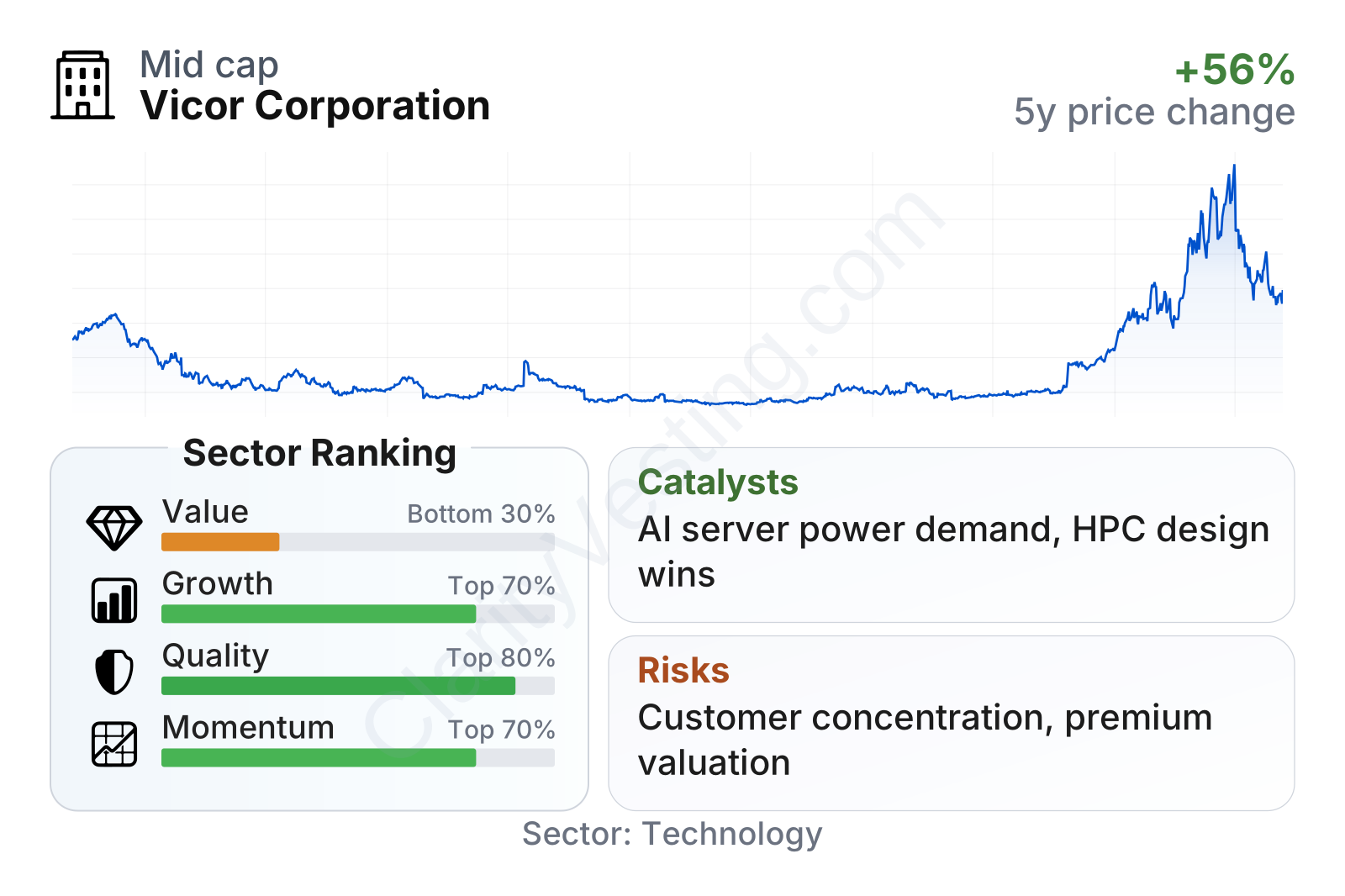
Vicor is a mid-sized technology component company with unusually strong profitability and balance-sheet quality for its sector, but also with a stock that moves much more sharply than average. Growth, quality, and momentum all rank well versus much of the sector, while valuation metrics look demanding. In other words, the operating business currently looks stronger than the stock’s conventional value profile.
The share price history also shows how volatile market expectations have been. The stock fell heavily during the 2022-2024 period and then rebounded dramatically into 2026. That kind of move usually means the market has gone from doubting demand visibility to pricing in a much stronger outlook.
Growth
Vicor operates in a sector with attractive long-term drivers. Modern processors, AI accelerators, and high-performance networking systems need more electricity in tighter spaces, and that raises the importance of efficient power delivery. This is one of the company’s clearest growth opportunities: as chips become more powerful, the supporting power architecture becomes more valuable, not less.
The company’s strategy is coherent with that trend. Rather than compete broadly across commodity power supplies, Vicor focuses on specialized high-density modular solutions where performance matters. That approach makes sense in AI servers, data centers, and other environments where power efficiency, thermal control, and board space can directly affect system performance and operating cost.
Recent growth has been uneven, which is common in component businesses tied to customer program timing. Revenue contracted during much of 2024, then recovered strongly in 2025. The latest year-over-year growth rate has cooled from the peak seen during that rebound, so the company is no longer in a straight-line acceleration phase. Even so, the broader pattern points to a business that has regained demand momentum after a soft patch.
Cash generation has improved meaningfully. Free cash flow was negative in 2022 and 2023, turned positive in 2024, and increased further through 2025 into 2026. That shift matters because it suggests recent earnings strength is increasingly showing up in cash, not just accounting profit. For a hardware-related company with ongoing manufacturing and R&D needs, that is an encouraging operating signal.
A major catalyst is continued investment in AI infrastructure. Vicor has highlighted opportunities tied to high-performance computing and power delivery for accelerated systems. If large customers keep scaling next-generation server and accelerator platforms, the company could benefit from higher content per system and broader adoption of its advanced products. Recent company communications have also pointed to design wins and platform activity in high-current power delivery, which supports the idea that this is not only a cyclical rebound but also a product-positioning opportunity.
Risks
This article is for informational purposes only and does not constitute financial advice. Some content is AI-generated. See Disclaimer


