Stock Analysis · VF Corporation (VFC)
Overview
VF Corporation is a global apparel, footwear, and accessories company best known for owning outdoor and lifestyle brands. Its portfolio is centered on names such as The North Face, Vans, Timberland, and Dickies. The group designs products, works with third-party manufacturers, and sells through a mix of wholesale partners, company-owned stores, and digital channels.
For long-term analysis, the main point is that VF is not a single-brand business. It is a branded portfolio company, which can be a strength when one label is weak and another is performing better. At the same time, the company has gone through a difficult reset after years of softer demand, brand execution issues, and pressure on profitability.
Revenue is mainly generated by its largest brands and by sales in the Americas, Europe, and Asia-Pacific. Based on recent company disclosures, the business mix is approximately:
- The North Face: roughly one-third of total revenue, the largest brand and currently the clearest profit and growth driver.
- Vans: around one-quarter of revenue, still a major brand but materially weaker than in its peak years.
- Timberland: about the mid-teens percentage of revenue.
- Dickies: around high-single-digit percentage of revenue.
- Other brands: the remainder, including smaller labels and residual portfolio activity.
Its sales channels are also diversified:
- Wholesale: the largest source of sales, typically more than half of revenue.
- Direct-to-consumer: a large secondary contributor through stores and e-commerce, generally around one-third to two-fifths of revenue.
- Other: a small remaining share.
The recent financial flow shows a business that has stabilized after a sharp decline from 2022 to 2025. Revenue has stopped falling, gross profit improved from the prior year, and net income turned positive again. However, selling and administrative costs still absorb a large portion of sales, which explains why the recovery in earnings remains modest relative to the size of the company.
Key Figures
| Metric | Value | Sector ⓘ |
|---|---|---|
| Date | Jul 18, 2026 | |
| Context | ||
| Sector | Consumer Cyclical | |
| Industry | Apparel Manufacturing | |
| Market Cap ⓘ | $6.66B | |
| Beta ⓘ | 0.97 | |
Value (Cheapness) | ||
| P/E Ratio ⓘ | 26.53 | 18.58 |
| FCF Yield ⓘ | 7.66% | 7.99% |
| EBIT / EV ⓘ | 4.74% | 5.91% |
| PEG ⓘ | 0.42 | |
Growth (Business expansion) | ||
| Revenue Growth ⓘ | 1.00% | 5.50% |
| RPS Growth (5Y CAGR) ⓘ | -5.31% | 9.20% |
| EPS Growth (5Y CAGR) ⓘ | -35.45% | -26.43% |
| Margin Growth (5Y Trend) ⓘ | -8.96% | -0.18% |
| FCF Growth (5Y CAGR) ⓘ | -1.45% | 5.02% |
Quality (Business durability) | ||
| ROIC (Latest) ⓘ | 6.94% | 12.03% |
| ROIC (5Y Median) ⓘ | 7.00% | 10.82% |
| Net Debt / EBIT (Latest) ⓘ | 7.97 | 2.12 |
| Net Debt / EBIT (5Y Median) ⓘ | 8.24 | 2.25 |
| Operating Margin (Latest) ⓘ | 5.43% | 9.28% |
| Operating Margin (5Y Median) ⓘ | 5.29% | 9.64% |
| Debt to Equity (Latest) ⓘ | 269.39% | 75.23% |
| Profit Margin (Latest) ⓘ | 5.55% | 5.28% |
| Free Cash Flow (Latest) ⓘ | $510.01M | |
Momentum (Price trend) | ||
| 3Y Return ⓘ | -6.10% | +10.68% |
| 12M Return (excl. last month) ⓘ | +43.86% | +5.26% |
| 6M Return ⓘ | -10.53% | -2.41% |
| Price vs. 200-Day MA ⓘ | -2.43% | +1.55% |
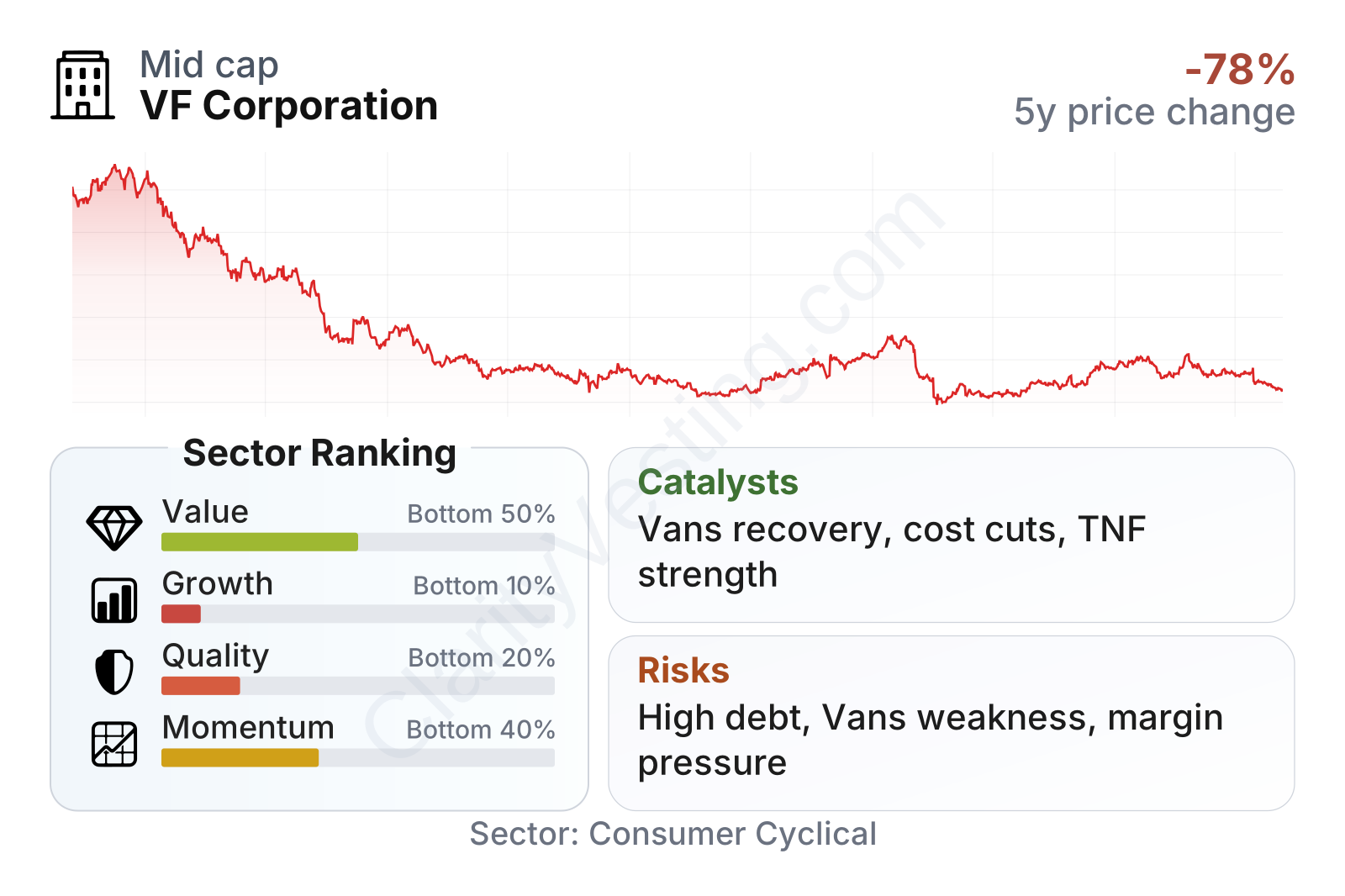
VF currently sits in a mixed position. Market value is around the mid-single-digit billions, making it a meaningful but no longer dominant player in global branded apparel. The stock has recovered from its lows but remains far below where it traded several years ago, reflecting both the depth of the previous downturn and the market’s caution about the pace of the turnaround.
The summary metrics point to a company with weaker-than-sector growth and quality characteristics, while momentum has improved somewhat. Profitability is still below many peers, returns on invested capital are modest, and leverage remains elevated. On the other hand, free cash flow has turned back positive and the recent earnings multiple is no longer distorted by losses, which makes the valuation discussion more meaningful than it was during the restructuring phase.
Growth
VF operates in a sector that still has attractive long-term characteristics. Global demand for outdoor wear, casual footwear, active lifestyles, and direct-to-consumer shopping remains structurally relevant. Consumers continue to spend on recognizable brands with strong identity, and the industry still rewards companies that combine product innovation, global distribution, and disciplined inventory management.
VF’s challenge is that the sector itself is not the issue; company-specific execution has been. Revenue growth has been volatile for several years, with repeated declines followed by only modest stabilization more recently. The latest pattern suggests that the steep contraction phase may be over, but the recovery is still shallow compared with the broader consumer discretionary space.
The most credible growth engine is The North Face. It remains the company’s strongest brand, with global recognition and exposure to attractive categories such as outdoor apparel, performance outerwear, and premium lifestyle products. If management can continue to protect this franchise while improving product cycles and distribution discipline across the rest of the portfolio, VF has a clearer path to rebuilding revenue quality.
Another important catalyst is the ongoing turnaround plan. Recent company communications have emphasized cost control, inventory normalization, balance sheet repair, and sharper brand management. That strategy is logical for where VF stands today. The company does not need a dramatic expansion story first; it needs a cleaner operating base so that future sales growth translates into better margins and cash generation.
Cash flow trends are especially important here. Free cash flow has been uneven, including a deeply negative period, but it has recovered back into positive territory. That matters because it gives the company more flexibility to reduce debt, support restructuring, and reinvest in core brands without relying solely on accounting profits. In a branded consumer business, steady cash generation often says more about operating health than a single year of earnings.
As for recent opportunity signals, the main one is not a headline-grabbing new product launch but the gradual improvement in fundamentals: positive net income again, better cash generation, and signs that the business is moving from emergency repair toward operational rebuilding. If Vans stabilizes and The North Face continues to lead, the upside to group performance could become more visible.
Risks
The biggest risk is that VF remains a turnaround rather than a fully repaired business. Several years of declining sales, compressed margins, and weak brand execution have left the company with less room for error than stronger peers. The most obvious pressure point is leverage.
Debt relative to equity remains far above the sector norm even after some improvement. Net debt relative to EBIT is also high, which means operating profit still carries a heavy burden in relation to the balance sheet. This matters because consumer brand companies can face rapid swings in demand, wholesale orders, and inventory levels. A more leveraged structure reduces resilience if another slowdown hits.
Margins are another issue. While profit margin has recovered from loss-making levels, operating margin is still well below the sector median. That tells a more cautious story than net income alone.
The margin trend shows that VF has moved off the bottom, but it has not yet returned to the profitability profile expected from a high-quality global brand owner. The gap versus peers suggests that a large part of the turnaround still depends on execution rather than on favorable industry conditions alone.
Competitive positioning is mixed. VF does have real advantages: globally known brands, broad distribution, deep merchandising experience, and scale across regions and channels. Those are meaningful assets. However, it is not the clear leader in the broader athletic or lifestyle apparel market. In footwear and apparel, it competes against much larger and often better-executing groups such as Nike, Adidas, Deckers, Columbia Sportswear, and Levi Strauss, depending on category. In outdoor and workwear, it also faces specialized competitors with sharper brand focus.
Among VF’s own brands, Vans is the most important brand-specific risk. Because it still represents a large share of revenue, a slow recovery there can offset progress elsewhere. Brand heat in fashion and footwear can fade quickly, and rebuilding relevance usually takes time, marketing investment, and better product cadence.
Recent company developments do not point to a major scandal, but they do underline execution risk. Ongoing restructuring, leadership decisions, portfolio simplification, and debt reduction efforts all need to work together. If one piece lags, the company may struggle to convert stable sales into durable earnings improvement.
Valuation
VF’s valuation is difficult to judge through a simple lens because the company is emerging from a weak earnings period. A stock can look inexpensive on sales or cash flow while appearing expensive on earnings if margins are still depressed. That is largely the case here.
The recent price-to-earnings ratio sits above the sector median, which suggests the stock is not obviously cheap on current earnings. That premium would normally be easier to justify if growth and returns were strong, but VF’s recent operating record remains below peer standards. In other words, the present multiple seems to reflect expectations of further recovery rather than the strength of today’s business.
Other valuation measures are somewhat less demanding. Free cash flow yield is not far from sector norms, which indicates the market is giving some credit to cash generation despite the weak margin profile. Still, with growth metrics in the bottom tier of the sector and quality measures also lagging, the valuation case depends heavily on whether the turnaround continues.
So the current price looks less like a distressed bargain and more like a recovery valuation. That can be justified if operating margin steadily improves, debt continues to come down, and the core brands regain momentum. Without those steps, the earnings multiple looks full for a business that is still rebuilding.
Conclusion
VF Corporation remains a well-known branded apparel company with real strategic assets, especially The North Face and a global distribution platform that many smaller competitors cannot match. The business appears to have moved past its most severe deterioration, and the return of positive earnings and solid free cash flow are meaningful signs of stabilization.
Even so, the company is still defined more by recovery than by strength. Revenue growth is modest, operating margins remain below peer levels, and leverage is high for a consumer business that depends on brand relevance and retail execution. That combination makes the long-term picture more sensitive to management performance than it would be for a sector leader.
The overall direction is improving, but the financial profile is not yet fully repaired and the valuation already reflects some optimism about the turnaround. VF stands out today as a recognizable global brand owner with genuine recovery potential, but also one that still has to prove that stabilization can turn into durable, higher-quality growth.
Sources:
- VF Corporation — Annual Report on Form 10-K for fiscal year ended March 29, 2025
- VF Corporation — Quarterly Report on Form 10-Q for fiscal quarter ended December 27, 2025
- VF Corporation — Current Reports on Form 8-K filed in 2026
- SEC EDGAR — VF Corporation filings database
- VF Corporation Investor Relations — earnings releases and presentation materials published in 2026
- VF Corporation Investor Relations — webcast materials and company-hosted earnings call information
- Wikipedia — VF Corporation
This article is for informational purposes only and does not constitute financial advice. Some content is AI-generated. See Disclaimer


