Stock Analysis · Vertex (VERX)
Overview
Vertex is a software company focused on indirect tax automation. In simple terms, it helps businesses calculate, manage, and document sales tax, value-added tax, use tax, payroll-related tax rules, and other transaction taxes across many jurisdictions. This is a difficult area for companies because tax rules change often, differ by location, and become more complex as commerce moves across online, cloud, and global channels. Vertex sells software and services that fit into business systems such as ERP, e-commerce, and billing platforms so customers can automate tax work inside their normal operations.
The business model is largely recurring. Revenue mainly comes from software subscriptions and cloud-based arrangements, with additional contributions from software licenses, support, and professional services tied to implementation and consulting. Based on company reporting in recent annual filings, the revenue mix is approximately:
- Software subscriptions and cloud revenue: about 75% to 80% — recurring access to Vertex tax applications delivered through cloud and term-based arrangements.
- Services: about 15% to 20% — implementation, consulting, training, and other customer support work.
- Software licenses and other: about 5% to 10% — license-related and smaller ancillary sources.
That mix matters because recurring subscription revenue is usually more stable than one-time project work. It also helps explain why Vertex has been able to grow revenue steadily even when profits have been uneven. Over the last several years, revenue has climbed from roughly $426 million in 2021 to about $748 million in 2025, while gross profit remained strong, showing that the core product has attractive economics before overhead costs such as sales and administration.
The business is still relatively small compared with many large enterprise software vendors, but it serves a mission-critical function. Tax compliance is not optional, and mistakes can create penalties, disrupted invoicing, and operational headaches for customers.
The overall financial flow shows a business with solid gross profit generation but historically heavy operating expenses, especially in selling and administrative costs. Revenue and gross profit have expanded consistently, while operating income only recently turned slightly positive, which suggests Vertex is still in the phase of translating scale into durable profitability.
Key Figures
| Metric | Value | Sector ⓘ |
|---|---|---|
| Date | Sep 12, 2026 | |
| Context | ||
| Sector | Technology | |
| Industry | Software - Application | |
| Market Cap ⓘ | $1.99B | |
| Beta ⓘ | 0.82 | |
Value (Cheapness) | ||
| P/E Ratio ⓘ | N/A | 29.51 |
| FCF Yield ⓘ | 2.94% | 4.25% |
| EBIT / EV ⓘ | -2.80% | 2.85% |
| PEG ⓘ | N/A | |
Growth (Business expansion) | ||
| Revenue Growth ⓘ | 10.50% | 15.40% |
| RPS Growth (5Y CAGR) ⓘ | 9.58% | 8.56% |
| EPS Growth (5Y CAGR) ⓘ | 0.94% | -11.88% |
| Margin Growth (5Y Trend) ⓘ | N/A | 0.46% |
| FCF Growth (5Y CAGR) ⓘ | 0.35% | 9.80% |
Quality (Business durability) | ||
| ROIC (Latest) ⓘ | -2.61% | 9.44% |
| ROIC (5Y Median) ⓘ | -2.48% | 8.30% |
| Net Debt / EBIT (Latest) ⓘ | N/A | 0.54 |
| Net Debt / EBIT (5Y Median) ⓘ | N/A | 0.44 |
| Operating Margin (Latest) ⓘ | -7.49% | 9.58% |
| Operating Margin (5Y Median) ⓘ | -0.69% | 8.25% |
| Debt to Equity (Latest) ⓘ | 145.13% | 33.33% |
| Profit Margin (Latest) ⓘ | 0.45% | 7.14% |
| Free Cash Flow (Latest) ⓘ | $58.46M | |
Momentum (Price trend) | ||
| 3Y Return ⓘ | -42.92% | +45.48% |
| 12M Return (excl. last month) ⓘ | -51.04% | +23.48% |
| 6M Return ⓘ | -10.77% | +20.93% |
| Price vs. 200-Day MA ⓘ | -15.31% | +7.43% |
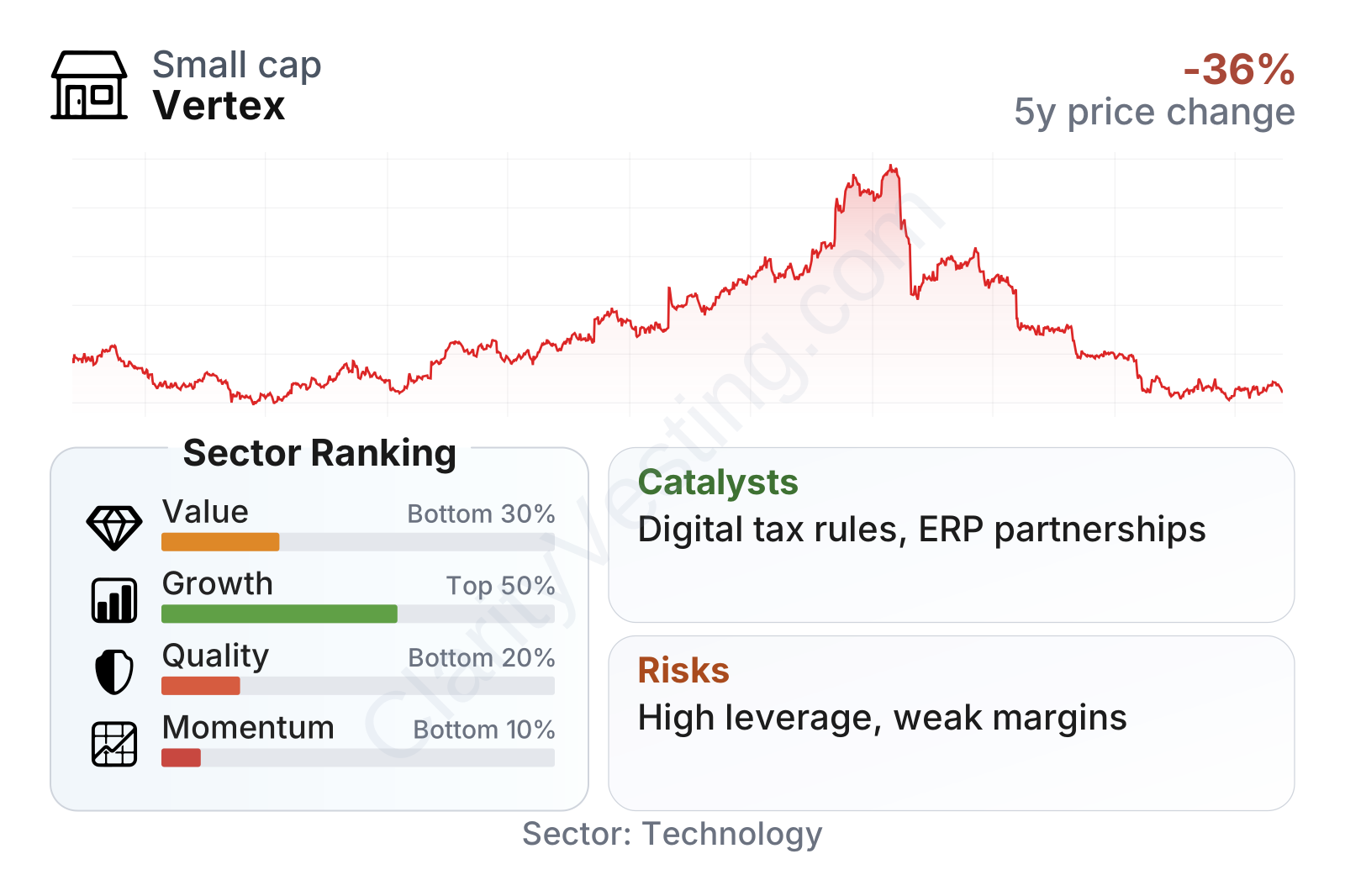
Vertex currently sits in a mixed position. Growth remains respectable for a mature software business, and five-year revenue expansion is slightly better than the sector median. At the same time, quality and momentum appear weak: profitability is still thin, returns on invested capital are negative, leverage is elevated, and recent share-price performance has been far worse than the broader software group. The company is also low-beta, which means the stock has historically moved a bit less than the market overall, but that has not prevented a sharp decline in the last year.
Growth
Vertex operates in a sector with durable long-term demand. Tax complexity tends to rise, not fall. Governments keep updating rates and rules, cross-border commerce is expanding, digital invoicing is becoming more common, and companies increasingly want tax determination embedded directly into transaction systems. Those forces support demand for automation over manual processes.
The company’s strategy also makes logical sense. Rather than trying to be a general business software platform, Vertex stays focused on a narrow but essential problem and connects its tools to larger enterprise systems. That specialization can be valuable because customers often prefer proven tax engines over building the capability internally. Partnerships and integrations with major ERP, billing, procurement, and commerce platforms are especially important because they can make Vertex part of the customer’s core workflow and raise switching costs.
Revenue growth has remained positive for years, though the pace has moderated. Earlier periods were commonly in the mid-to-high teens, while recent growth has moved closer to 10% to 11%. That is still healthy in absolute terms, but it shows Vertex is no longer in a faster expansion phase. Future upside likely depends less on raw customer acquisition alone and more on cross-selling, international reach, enterprise adoption, and a greater mix of cloud products.
Cash generation is more encouraging than reported earnings. Free cash flow has improved meaningfully from earlier swings and has risen to a much stronger level over the last year. That matters because it suggests the business is gaining operating discipline even though accounting profits remain modest. For long-term analysis, this is one of the more constructive signals in the current profile.
A notable catalyst is the broader move toward real-time and digitally enforced tax compliance in many countries. As tax authorities require faster, more detailed, and more automated reporting, specialized software becomes more relevant. Vertex has also continued expanding product capabilities and partnerships in areas such as e-commerce, invoicing, and enterprise workflow integration, which can widen its addressable market beyond its traditional base.
Risks
This article is for informational purposes only and does not constitute financial advice. Some content is AI-generated. See Disclaimer


