Stock Analysis · Veeco Instruments Inc (VECO)
Overview
Veeco Instruments is a semiconductor equipment company. In simple terms, it builds highly specialized machines used to manufacture advanced electronic devices. Its tools help customers deposit ultra-thin materials, process compound semiconductors, and support production steps that are important in markets such as data center infrastructure, artificial intelligence hardware, advanced packaging, RF devices, power electronics, and certain optoelectronics applications.
The business is mainly organized around equipment platforms rather than consumer-facing products. Based on recent annual disclosures, revenue is primarily generated from sales of semiconductor manufacturing systems, with a smaller but recurring contribution from services, support, spare parts, and upgrades.
- Semiconductor equipment systems: approximately 85% to 90% of revenue. This includes process equipment used in areas such as laser annealing, ion beam systems, single-wafer etch and clean, and deposition technologies tied to advanced semiconductor production.
- Services, parts, and support: approximately 10% to 15% of revenue. This typically includes maintenance, spare parts, field service, and tool upgrades for the installed base.
Within equipment, Veeco has been emphasizing areas tied to advanced logic and memory manufacturing, heterogeneous integration, and compound semiconductor applications. The company is not a broad, all-purpose chip-equipment giant; it is a more focused supplier that tries to win in niche process steps where technical performance matters.
The business mix also shows a company that has been investing heavily in research and development while expanding revenue over the past several years, although profitability has been uneven. Revenue rose from roughly $580 million in 2021 to about $717 million in 2024 before easing to about $664 million in 2025, showing both progress and the cyclical nature of the industry.
One clear pattern is that gross profit has generally improved with scale, but operating income and net income have been more volatile because Veeco continues to spend heavily on product development and commercial expansion. That fits the profile of a mid-sized equipment supplier trying to deepen its role in a few high-value manufacturing steps.
Key Figures
| Metric | Value | Sector ⓘ |
|---|---|---|
| Date | Sep 12, 2026 | |
| Context | ||
| Sector | Technology | |
| Industry | Semiconductor Equipment & Materials | |
| Market Cap ⓘ | $2.68B | |
| Beta ⓘ | 1.36 | |
Value (Cheapness) | ||
| P/E Ratio ⓘ | 118.65 | 29.51 |
| FCF Yield ⓘ | 3.17% | 4.25% |
| EBIT / EV ⓘ | 1.10% | 2.85% |
| PEG ⓘ | 0.81 | |
Growth (Business expansion) | ||
| Revenue Growth ⓘ | 16.50% | 15.40% |
| RPS Growth (5Y CAGR) ⓘ | 0.21% | 8.56% |
| EPS Growth (5Y CAGR) ⓘ | -35.87% | -11.88% |
| Margin Growth (5Y Trend) ⓘ | -1.96% | 0.46% |
| FCF Growth (5Y CAGR) ⓘ | 13.96% | 9.80% |
Quality (Business durability) | ||
| ROIC (Latest) ⓘ | 2.59% | 9.44% |
| ROIC (5Y Median) ⓘ | 8.58% | 8.30% |
| Net Debt / EBIT (Latest) ⓘ | 1.49 | 0.54 |
| Net Debt / EBIT (5Y Median) ⓘ | 2.31 | 0.44 |
| Operating Margin (Latest) ⓘ | 4.19% | 9.58% |
| Operating Margin (5Y Median) ⓘ | 9.26% | 8.25% |
| Debt to Equity (Latest) ⓘ | 28.47% | 33.33% |
| Profit Margin (Latest) ⓘ | 3.40% | 7.14% |
| Free Cash Flow (Latest) ⓘ | $85.17M | |
Momentum (Price trend) | ||
| 3Y Return ⓘ | +62.72% | +45.48% |
| 12M Return (excl. last month) ⓘ | +119.36% | +23.48% |
| 6M Return ⓘ | +42.50% | +20.93% |
| Price vs. 200-Day MA ⓘ | +1.41% | +7.43% |
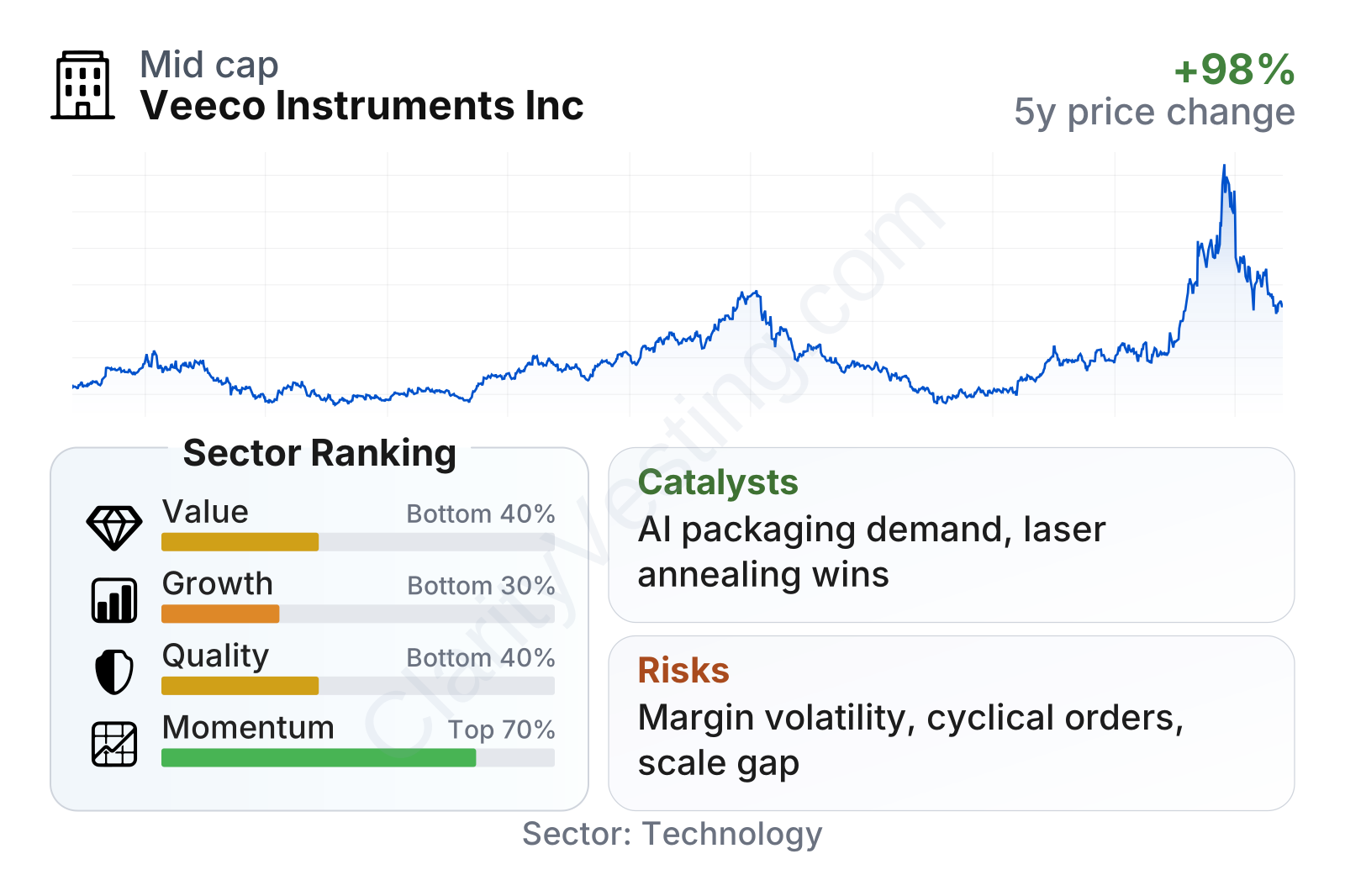
Veeco is a mid-sized technology company with a market value a little above $3 billion, and the stock has shown above-average volatility, reflected in a beta near 1.4. The market has rewarded the shares strongly over the last year and over three years, but the underlying factor picture is mixed. Momentum is strong relative to much of the technology sector, while value, quality, and growth rankings are weaker. In practice, that means the recent stock move has been much stronger than the company’s long-term profitability profile.
Growth
Veeco operates in a sector with solid long-term demand drivers. Semiconductor manufacturing keeps becoming more complex, and that usually creates room for specialized equipment suppliers. The rise of AI servers, advanced packaging, high-bandwidth memory, power devices based on silicon carbide, and next-generation wireless infrastructure all increase the need for precision process tools. This broad direction supports Veeco’s focus on advanced manufacturing steps rather than commodity equipment.
The company’s strategy also makes industrial sense. Instead of trying to compete everywhere, Veeco concentrates on targeted process areas where customers may accept a smaller supplier if the tool performance is differentiated enough. That is especially relevant in laser annealing and certain deposition and process applications where a tool can be inserted into a very specific step in the chipmaking flow. For a company of Veeco’s size, this selective approach is more realistic than trying to match the scale of the largest equipment vendors.
Growth has not been smooth. Year-over-year revenue has swung between expansion and contraction, which is common in wafer-fab equipment because orders depend on customer capital spending cycles. More recently, revenue growth has turned positive again, with the latest year-over-year reading around the mid-teens, slightly above the sector median. That improvement matters because it suggests demand has reaccelerated after a softer period in 2025.
Cash generation is another constructive point, even if it is not perfectly steady. Free cash flow has remained positive over time and has grown meaningfully over a five-year view, despite quarterly swings. For long-term analysis, that is important because it shows Veeco is not relying solely on accounting profits; the business is still producing real cash that can support debt reduction, internal investment, or acquisitions.
A notable catalyst is the company’s exposure to advanced packaging and laser annealing, both of which are tied to increasingly demanding semiconductor architectures. As leading chipmakers look for better ways to improve performance and power efficiency, process steps where Veeco already has relevant products could become more valuable. Recent company communications have also pointed to customer interest connected to AI-related infrastructure and to opportunities across leading-edge manufacturing nodes and heterogeneous integration.
Risks
This article is for informational purposes only and does not constitute financial advice. Some content is AI-generated. See Disclaimer


