Stock Analysis · Visteon Corp (VC)
Overview
Visteon is an automotive technology supplier that focuses on the electronics and software found inside modern vehicles. Instead of making engines or body parts, the company designs and supplies digital cockpit systems such as instrument clusters, infotainment displays, domain controllers, and software platforms that help automakers manage multiple in-car functions through centralized computing. Its customers are global vehicle manufacturers, and its products are typically built into cars under long production contracts.
The company’s revenue is mainly tied to cockpit electronics programs awarded by automakers. Based on recent company reporting, the business is organized around a few major product categories, with digital cockpit and display-related systems representing the clear majority of sales.
- Digital instrument clusters and information displays: approximately 35% to 45% of revenue. These are the screens behind the steering wheel and other driver information interfaces.
- Infotainment and connected cockpit systems: approximately 25% to 35% of revenue. This includes center-stack displays, media and navigation interfaces, and integrated cabin software.
- Domain controllers and compute platforms: approximately 15% to 25% of revenue. These systems consolidate several electronic functions into fewer, more powerful computing units.
- Other electronics, services, and legacy programs: approximately 5% to 15% of revenue. This includes smaller product lines, engineering support, and remaining non-core programs.
Geographically, Visteon is diversified across major auto production regions, with meaningful exposure to Asia, Europe, and the Americas. That matters because vehicle production can slow in one region while staying healthier in another. The trade-off is that the company remains closely linked to global auto volumes and model launch timing.
The business mix also shows a useful pattern: revenue has stayed around the upper-$3 billion range in recent years, while operating income improved more than revenue did. That suggests efficiency gains and a portfolio shift toward higher-value electronics, even though net income has been affected at times by tax items and other non-operating effects.
Key Figures
| Metric | Value | Sector ⓘ |
|---|---|---|
| Date | Sep 12, 2026 | |
| Context | ||
| Sector | Consumer Cyclical | |
| Industry | Auto Parts | |
| Market Cap ⓘ | $2.69B | |
| Beta ⓘ | 1.31 | |
Value (Cheapness) | ||
| P/E Ratio ⓘ | 19.37 | 17.10 |
| FCF Yield ⓘ | 5.94% | 8.53% |
| EBIT / EV ⓘ | 11.54% | 6.46% |
| PEG ⓘ | 1.01 | |
Growth (Business expansion) | ||
| Revenue Growth ⓘ | -0.90% | 5.75% |
| RPS Growth (5Y CAGR) ⓘ | 8.74% | 9.14% |
| EPS Growth (5Y CAGR) ⓘ | -10.71% | -18.21% |
| Margin Growth (5Y Trend) ⓘ | 5.79% | -0.23% |
| FCF Growth (5Y CAGR) ⓘ | N/A | 4.91% |
Quality (Business durability) | ||
| ROIC (Latest) ⓘ | 10.11% | 12.61% |
| ROIC (5Y Median) ⓘ | 14.68% | 10.72% |
| Net Debt / EBIT (Latest) ⓘ | -0.82 | 2.10 |
| Net Debt / EBIT (5Y Median) ⓘ | -0.27 | 2.32 |
| Operating Margin (Latest) ⓘ | 7.89% | 9.25% |
| Operating Margin (5Y Median) ⓘ | 6.63% | 9.64% |
| Debt to Equity (Latest) ⓘ | 26.94% | 75.78% |
| Profit Margin (Latest) ⓘ | 3.78% | 5.33% |
| Free Cash Flow (Latest) ⓘ | $160.00M | |
Momentum (Price trend) | ||
| 3Y Return ⓘ | -26.59% | +14.53% |
| 12M Return (excl. last month) ⓘ | -9.44% | +3.08% |
| 6M Return ⓘ | +12.62% | +0.55% |
| Price vs. 200-Day MA ⓘ | -0.66% | -0.54% |
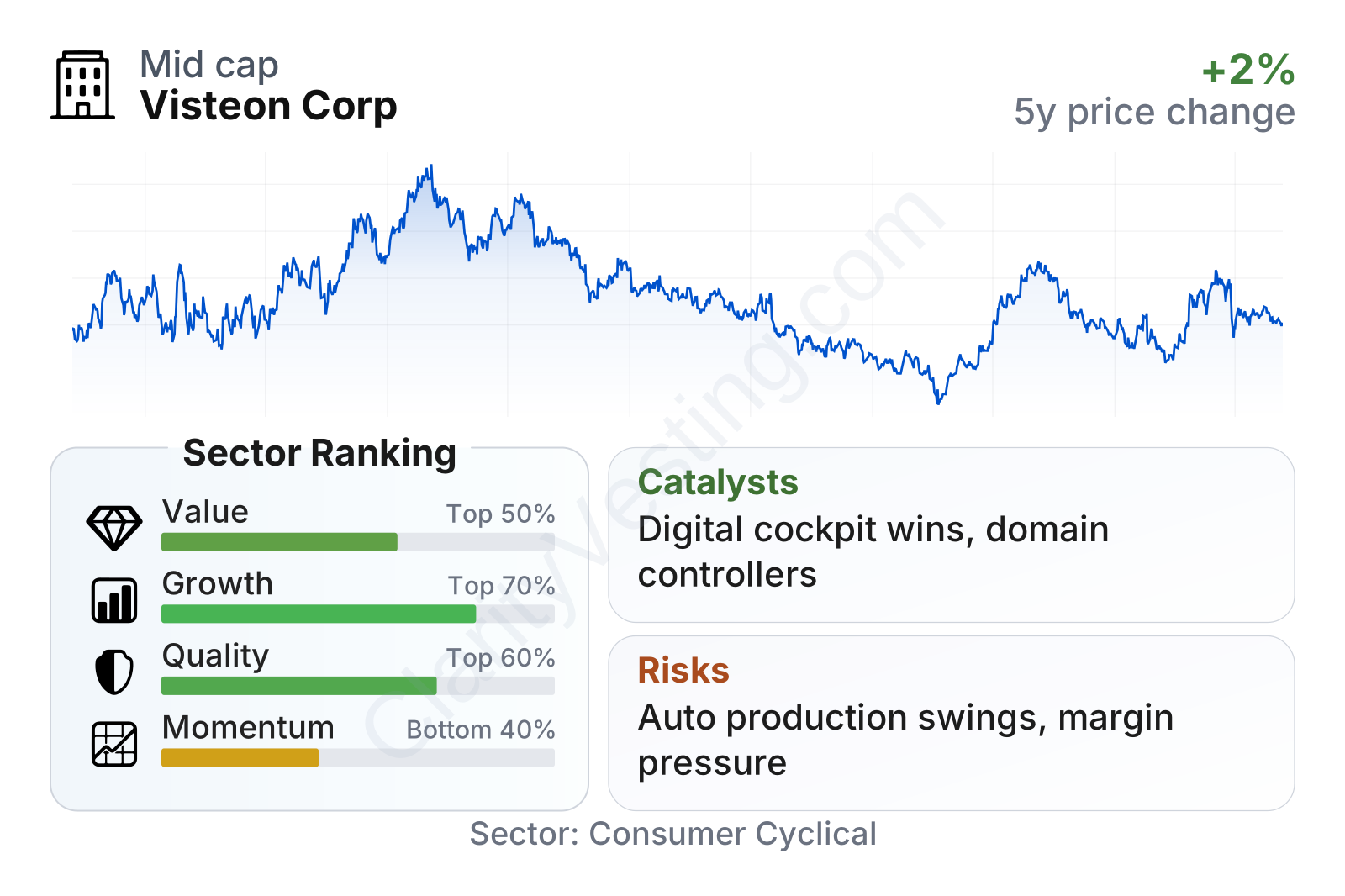
Visteon is a mid-sized auto technology supplier with stock volatility above the broader market, which is normal for a company exposed to both cyclical vehicle production and fast-changing electronics demand. The overall metric profile is mixed but constructive: valuation is around the sector middle, quality is supported by a strong balance sheet, and growth ranks below stronger auto-parts peers because recent revenue has been flat to slightly down. One notable strength is leverage. Debt to equity is around 27%, far below the sector median near 75%, and net debt remains below zero relative to EBIT, showing a balance sheet that is much cleaner than many industrial peers.
The share price has been uneven over the last several years, with a weak three-year return but a much better performance over the past year excluding the latest month. That pattern fits a company whose earnings expectations have reset several times but whose recent operational results have stabilized enough to rebuild confidence.
Growth
Visteon operates in a part of the auto industry that still has a clear long-term growth path: the electronic content per vehicle keeps rising. Carmakers are adding larger displays, more software-driven interfaces, richer connectivity, and centralized computing architectures. Even when total vehicle unit growth is modest, suppliers with exposure to this trend can still expand by capturing more dollar content in each car.
Visteon’s strategy broadly matches that industry direction. The company has been moving away from lower-value legacy products and toward digital cockpit platforms, display solutions, and domain controllers. This is important because automakers increasingly want fewer electronic control units and more integrated computing systems. If that transition continues, Visteon can potentially benefit from larger program wins per vehicle rather than relying only on higher car production.
Revenue growth has been volatile. After very strong growth in 2022 and early 2023, the pattern turned choppy, with several quarters of small declines and only limited rebounds. That does not necessarily mean the long-term thesis is broken, but it does show that growth depends heavily on launch schedules, customer production levels, and regional auto demand. In other words, this is not a smooth compounding business today.
Cash generation has improved meaningfully from the negative level seen in 2022. Free cash flow moved strongly higher through 2024 and remained clearly positive afterward, even if it eased from its peak. That matters because it suggests Visteon has been converting its engineering-heavy business model into real cash while keeping leverage under control. For a supplier in a cyclical industry, that is a valuable sign of discipline.
A major catalyst is the continued shift toward software-defined vehicles and larger integrated cockpit systems. Visteon has emphasized its domain controller and high-performance computing offerings, and these products line up with where vehicle architecture is moving. Another possible tailwind is new business wins that expand the company’s backlog and increase content on future vehicle platforms. In this industry, booked business often matters more than short-term quarterly revenue because programs can last for years once designed into a model.
Recent company updates have also highlighted ongoing product launches and customer awards tied to cockpit electronics and display platforms. Those developments point to a meaningful opportunity if automakers continue prioritizing digital user experience as a competitive feature in new models.
Risks
This article is for informational purposes only and does not constitute financial advice. Some content is AI-generated. See Disclaimer