Stock Analysis · Wolfspeed Inc (WOLF)
Overview
Wolfspeed, Inc. is a U.S.-based semiconductor company focused on silicon carbide (SiC) materials and power devices. In simple terms, it makes specialized chips and the underlying “wafer” material that help manage high power efficiently and handle high temperatures. These components are used in places where energy efficiency and durability matter, such as electric vehicles (EVs), fast-charging infrastructure, solar/wind power systems, and certain industrial and communications applications.
Wolfspeed organizes its business around SiC materials (the wafers other chipmakers can use) and SiC devices (power components sold to customers). Historically, the company has emphasized expanding manufacturing capacity in the U.S. to support long-term demand for SiC, which is a key building block for improving power efficiency in electrification.
Main sources of revenue (from largest to smallest, when disclosed in filings):
- Power devices (SiC power components sold to end markets like automotive and industrial)
- Materials (SiC wafers and related materials sold to other manufacturers)
Public filings describe these segments, but the exact mix can shift by year and quarter depending on customer demand and capacity ramps.
Over the years shown, revenue increased from about $526M (FY2021) to about $808M (FY2024), then eased to about $758M (FY2025). At the same time, operating costs and interest expense rose materially, and net income remained negative in each of the displayed periods—highlighting how the company’s expansion phase has weighed on profitability.
Key Figures
| Metric | Value | Industry ⓘ |
|---|---|---|
| Date | Apr 13, 2026 | |
| Context | ||
| Sector | Technology | |
| Industry | Semiconductors | |
| Market Cap ⓘ | $1.12B | |
| Beta ⓘ | N/A | |
| Fundamental | ||
| P/E Ratio ⓘ | N/A | 48.45 |
| Profit Margin ⓘ | -91.64% | 9.42% |
| Revenue Growth ⓘ | -6.60% | 16.85% |
| Debt to Equity ⓘ | 329.31% | 25.70% |
| PEG ⓘ | 2.55 | |
| Free Cash Flow ⓘ | -$993.00M | |
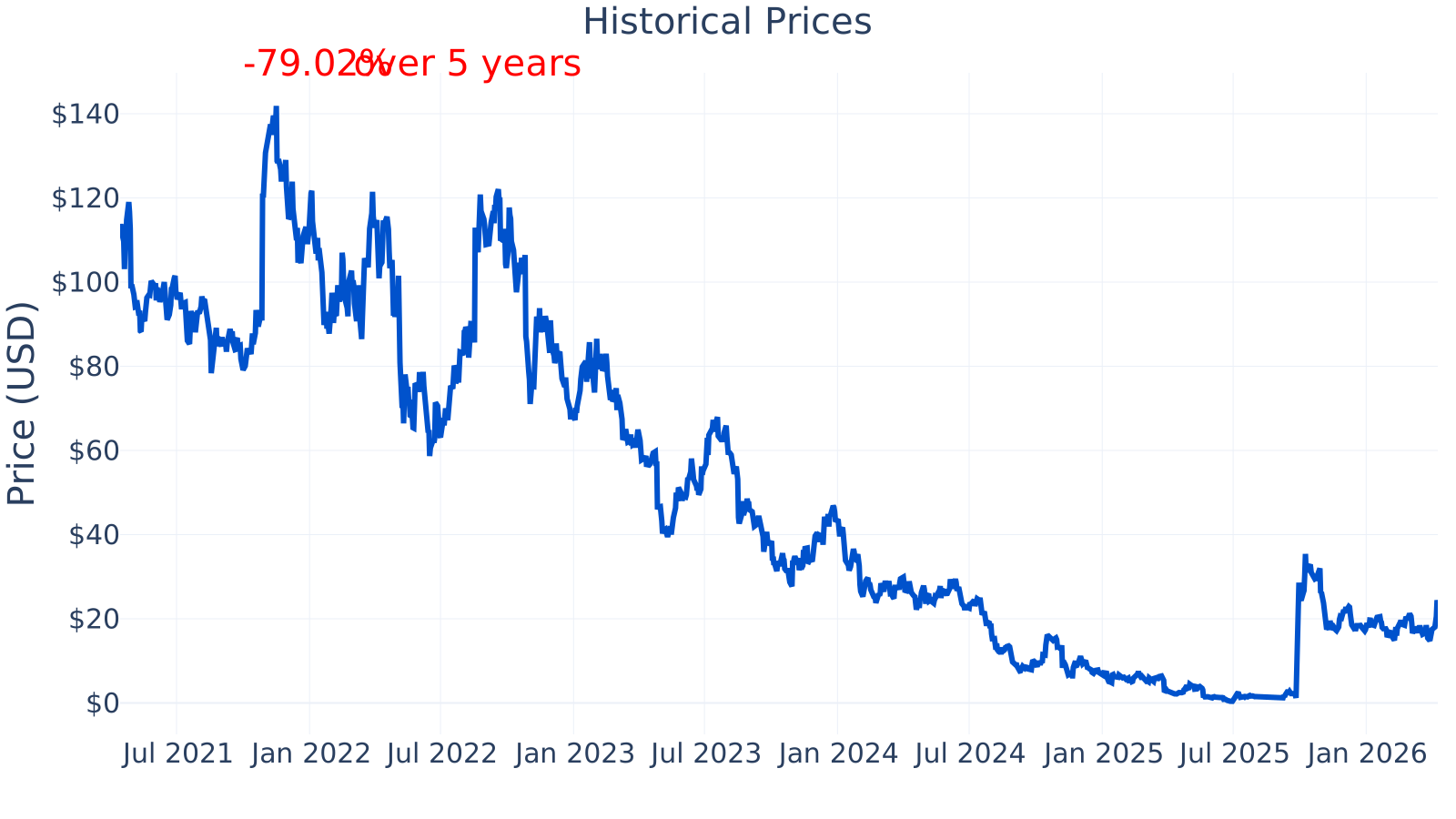
Based on the latest available metrics, Wolfspeed’s market capitalization is about $1.12B. Profitability is currently weak, with a profit margin around -91.64% versus an industry median near 9.42%, meaning the company is reporting sizable losses relative to revenue. Growth has also been under pressure recently: year-over-year revenue growth around -6.6%, compared with an industry median near 16.85%. Leverage is elevated, with debt-to-equity around 329% versus an industry median around 25.70%. Free cash flow over the trailing twelve months is about -$993M, consistent with heavy investment and ongoing operating losses.
Growth (Medium)
Wolfspeed operates in the broader semiconductor space, but its core exposure is to power semiconductors for electrification. The long-term direction of several end markets—especially EV powertrains, charging networks, renewable energy inverters, and energy-efficient industrial power systems—supports demand for higher-efficiency power components. Silicon carbide is often used when systems need higher voltage operation, higher switching efficiency, or improved thermal performance compared with conventional silicon-based solutions.
The company’s strategy has centered on scaling SiC capacity (materials and devices). In principle, this can make sense in an industry where manufacturing scale, yield improvement (how many good chips/wafers are produced), and long-term customer relationships can shape economics over time. The key question for long-term fundamentals is whether expanded capacity converts into higher utilization, better unit costs, and more stable profitability as demand normalizes and production ramps mature.
Revenue growth was strong earlier in the period shown (often above 30% year-over-year in 2021–2022), but it later slowed and turned negative in several quarters, including roughly -6.6% most recently. That pattern suggests the company is not currently in a smooth scaling phase, and end-demand timing plus ramp execution are meaningful drivers of near-term results.
Free cash flow has been deeply negative across the trailing periods shown (for example, around -$2.59B at one point and about -$1.94B later, with the latest listed at roughly -$993M). For a manufacturing-heavy semiconductor business, negative free cash flow can occur during major build-outs, but it raises the importance of liquidity, debt costs, and the timeline to reach sustainable operating cash generation.
Potential catalysts typically discussed in company materials for businesses like this include: higher factory utilization as new capacity ramps, improved manufacturing yields, multi-year customer agreements translating into steadier shipments, and any normalization in EV/industrial ordering cycles. Whether and when these translate into financial improvement depends on execution and market conditions.
Risks (Very High)
The most important risks are currently financial and operational. Wolfspeed is in a capital-intensive expansion phase, and the combination of large losses, high debt levels, and negative free cash flow increases sensitivity to interest rates, covenant or refinancing constraints, and any delays in ramping production efficiently.
Leverage increased sharply over the period shown. Debt-to-equity moved from roughly 41% (mid-2021) to very high levels later (peaking well above 1,000% during the period shown) and is about 329% most recently, compared with an industry median near 26%. Large swings (including negative readings in parts of 2025) can occur when equity changes significantly due to accumulated losses or accounting impacts, but the overall takeaway is that the balance-sheet risk profile is materially different from the typical peer in the same industry grouping.
Profit margins have also been volatile and often deeply negative. The most recent value is about -233.92%, far below an industry median near 9.42%. Even though there were brief quarters with positive margins in the period shown, the broader pattern indicates the company has not yet reached consistent profitability—an important consideration for long-term durability, especially during industry downturns.
On competitive positioning, Wolfspeed is a recognized participant in silicon carbide, with operations spanning both materials (wafers) and devices. That vertical footprint can be an advantage if it improves supply assurance, performance, and cost over time. However, competition is significant across the SiC ecosystem. Major competitors include:
- STMicroelectronics (power semiconductors; meaningful SiC investment)
- onsemi (power and sensing; SiC strategy focused on automotive/industrial)
- Infineon Technologies (broad power semiconductor leader with SiC portfolio)
- ROHM (power semiconductors; SiC devices and modules)
- Coherent and other wafer/material suppliers (competition on SiC substrates in particular)
Relative to larger, more diversified semiconductor companies, Wolfspeed can be more exposed to execution risk in a single technology and to the timing of end-market adoption. Larger rivals may have stronger balance sheets, broader customer bundles, and more flexibility to fund multi-year ramps through down cycles.
Valuation
For many companies, the price-to-earnings (P/E) ratio is a quick way to compare valuation. Here, Wolfspeed’s P/E is not consistently meaningful over much of the period shown because earnings have often been negative (the P/E values are frequently displayed as 0 on the chart for that reason). In such cases, valuation discussions often shift toward balance-sheet strength, cash burn trajectory, and the path to future profitability rather than a simple earnings multiple comparison.
One available point in the series shows a low positive P/E in early 2025 (around 2.5–5.0), while the industry median stayed far higher (roughly 30–46 across the period). A very low P/E reading can happen when earnings temporarily turn positive or when accounting items affect net income; it does not necessarily indicate stable earning power. Given the company’s recent margin profile and cash flow, the current valuation context is better described through the lens of turnaround and ramp execution uncertainty and financial leverage than through traditional steady-state multiples.
Conclusion
Wolfspeed is positioned in silicon carbide power semiconductors, a category connected to long-term electrification trends. The business model—selling both SiC materials and power devices—targets markets where efficiency improvements can be valuable, and scaling manufacturing can matter over time.
At the same time, the current fundamentals show substantial challenges: negative profit margins, negative free cash flow, and high leverage versus industry norms. Revenue growth has also been inconsistent, including recent contraction. Overall, the long-term narrative depends heavily on whether expanded manufacturing capacity translates into improved utilization, cost structure, and sustained profitability while managing financing and liquidity constraints.
Sources:
- SEC EDGAR — Wolfspeed, Inc. Form 10-K (Annual Report): Business segments, risk factors, and financial statements
- SEC EDGAR — Wolfspeed, Inc. Form 10-Q (Quarterly Reports): Updates on operating performance, liquidity, and debt
- Wolfspeed Investor Relations — Annual reports, shareholder materials, and company presentations (as posted by the company)
- Wikipedia — “Wolfspeed” and “Wolfspeed, Inc.” (basic company background only)
This article is for informational purposes only and does not constitute financial advice. Some content is AI-generated. See Disclaimer