Stock Analysis · Scholastic Corporation (SCHL)
Overview
Scholastic Corporation (SCHL) is a publishing and education company best known for children’s books and reading-related programs sold through schools. Its business is closely tied to the K–12 school channel in the U.S. and also includes trade publishing (books sold through retailers and online) and educational resources used in classrooms. A defining feature of Scholastic is its school-based distribution network, including book clubs and book fairs, which connects the company directly with teachers, students, and families.
In its SEC filings, Scholastic describes operations across three main segments. While exact mix can shift year to year, the company’s revenue is commonly discussed in these buckets:
- Children’s Book Publishing and Distribution (typically the largest; includes school book clubs and book fairs, and children’s trade publishing)
- Education Solutions (literacy programs, instructional materials, and related classroom offerings)
- International (similar activities outside the U.S., depending on market)
Because sales are strongly seasonal (with major peaks around back-to-school and school-year events), results can vary substantially by quarter even when the longer-term business is stable.
Over the last several fiscal years shown, total revenue has moved in a relatively narrow band (roughly $1.3B to $1.7B). Net income has been more variable, ranging from meaningful profitability in some years to near break-even or losses in others, which highlights how sensitive final earnings can be to costs, operating efficiency, and interest expense.
Key Figures
| Metric | Value | Industry ⓘ |
|---|---|---|
| Date | Apr 13, 2026 | |
| Context | ||
| Sector | Communication Services | |
| Industry | Publishing | |
| Market Cap ⓘ | $1.01B | |
| Beta ⓘ | 1.08 | |
| Fundamental | ||
| P/E Ratio ⓘ | 16.42 | |
| Profit Margin ⓘ | 3.89% | 9.24% |
| Revenue Growth ⓘ | -1.90% | 1.30% |
| Debt to Equity ⓘ | 32.64% | 52.00% |
| PEG ⓘ | 1.80 | |
| Free Cash Flow ⓘ | $22.10M | |
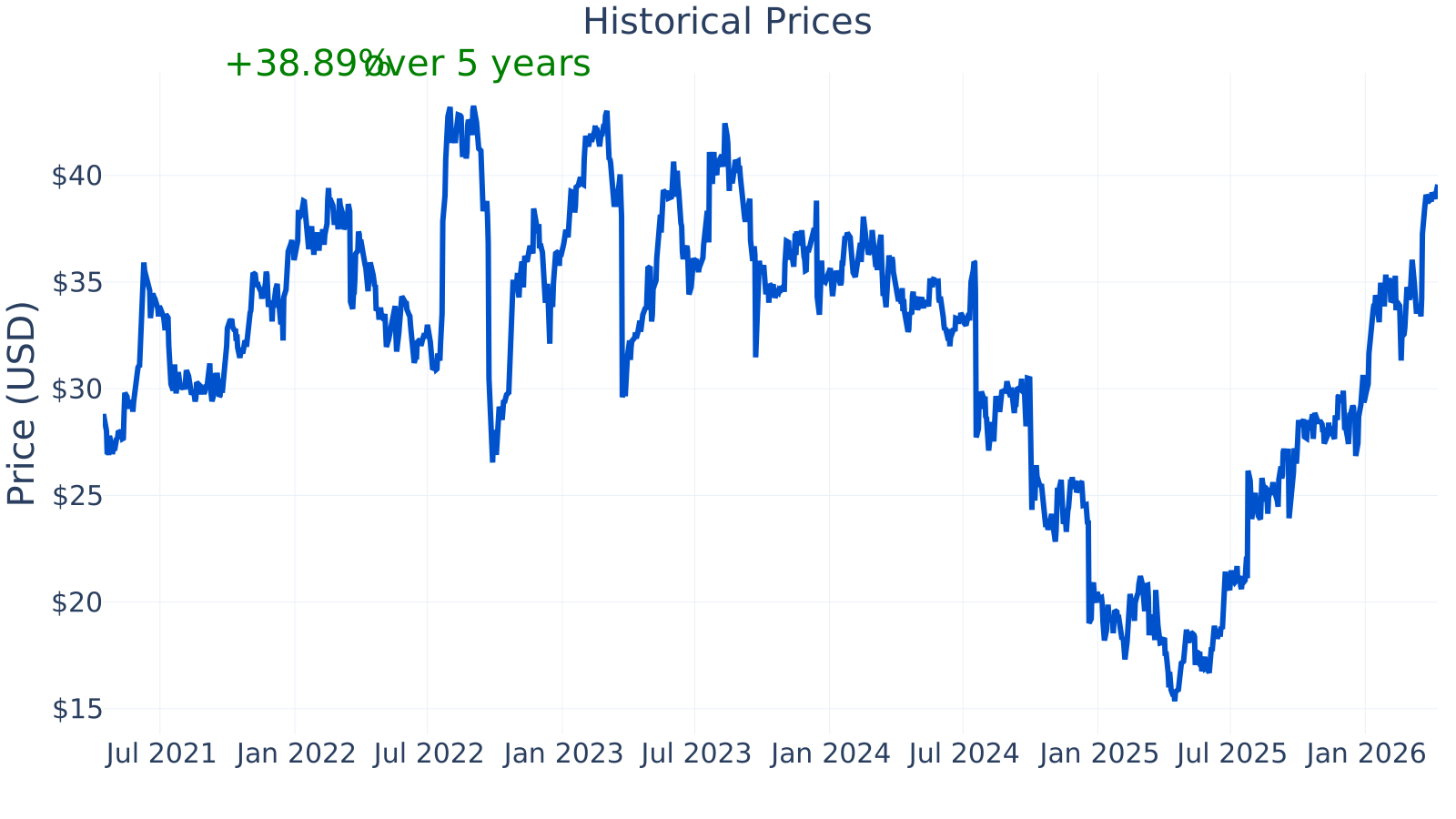
Scholastic’s market capitalization is about $1.01B and its beta is 1.08, which indicates price movements that have been somewhat similar to the broader market on average. The current P/E ratio is 16.42. Recent profitability is modest: the profit margin is ~3.89%, below the publishing industry median of ~9.24% shown here. Growth has been uneven, with year-over-year revenue growth of about -1.90% versus an industry median of ~1.30%. Leverage appears moderate: debt-to-equity is ~32.64%, below the industry median of ~52.00%. Trailing twelve-month free cash flow is about $22.1M, and the PEG ratio is 1.80 (a ratio that relates valuation to expected growth, and is sensitive to forecasting assumptions).
Growth (Low to Medium)
Scholastic operates in a mature corner of the media and publishing world: children’s books and school-linked educational products. This is not typically a “hyper-growth” industry, but it can be resilient when reading demand and school engagement remain steady. The company’s strategy centers on leveraging its long-standing school relationships and recognizable children’s brands to sustain demand and maintain distribution advantages (especially through in-school channels that are harder for general retailers to replicate in the same way).
The year-over-year revenue pattern shown is uneven, including periods of solid growth and periods of contraction. More recently, growth appears slightly negative (about -1.9%), which fits a picture of a business that can fluctuate with school calendars, program adoption cycles, and consumer spending on children’s books rather than following a smooth upward path.
Free cash flow has also varied widely over time (from much higher levels to more modest levels such as the latest ~$22.1M). For a long-term business assessment, this variability matters because it can influence flexibility for reinvestment, share repurchases, dividends, or balance sheet management across different parts of the cycle.
Potential catalysts discussed in company materials often relate to execution in its school channels (book fairs and clubs), product mix (what titles and programs resonate), and operational efficiency (containing costs while protecting the customer experience). Because the company’s model is closely tied to schools, participation levels and successful event execution can have an outsized impact versus many other publishers.
Risks (Medium to High)
Scholastic’s biggest risk is that a meaningful portion of its business depends on the school ecosystem. Factors such as changes in school budgets, administrative policies, scheduling constraints, and participation rates for in-school programs can influence sales. The business is also seasonal, so disruptions during key selling periods can have a disproportionately large effect on full-year results.
Competition is another important consideration. Scholastic competes with large trade publishers and children’s publishers (for authors, titles, and shelf space), and also faces pressure from digital entertainment options that compete for children’s attention and family spending. In educational materials, it competes with education-focused providers and curriculum publishers. Scholastic’s long-established school distribution network is a notable competitive advantage, but it does not remove competitive pressure on content quality, pricing, and service levels.
The debt-to-equity trend shows leverage rising from relatively low levels earlier in the period to higher levels later, with the latest around 32.64%. This is still below the industry median shown (~52.00%), but the upward movement over time can matter because higher leverage may reduce flexibility during weaker operating periods and can increase sensitivity to interest costs.
Profit margins have been inconsistent, including several periods near break-even or negative margins, followed by a more recent improvement to about 3.89%. Even after that rebound, profitability is below the industry median shown (~9.24%), suggesting the company may be operating with less cushion against cost inflation, discounting, or demand softness than some peers.
Valuation
The current P/E ratio is about 16.42. Historically, the P/E shown has been volatile, including spikes that typically occur when earnings are temporarily very low (which can make the ratio mechanically jump). For interpretation, the P/E is most informative when earnings are representative of a “normal” operating period, which can be challenging for a business with variable profitability.
In context, a mid-teens P/E can look moderate on the surface, but it needs to be viewed alongside (1) uneven revenue growth, (2) variable margins, and (3) fluctuating free cash flow. When profitability is not steady, valuation based on a single-period earnings number can be less reliable, so it is often paired with a broader review of multi-year earnings power, cash generation, and balance sheet strength.
Conclusion
Scholastic is a well-known children’s publishing and education company with a distinctive school-based distribution model. Its business profile is shaped by seasonality and the health of school-linked selling channels, which can create meaningful swings in profitability and cash flow from year to year. Recent metrics show modest profitability (below the industry median presented), slightly negative year-over-year revenue growth, moderate leverage versus peers, and a mid-teens earnings multiple.
From a long-term perspective, the central questions tend to be whether Scholastic can (1) sustain participation and relevance in school channels, (2) maintain strong content and program offerings, and (3) convert revenue into more consistent margins and cash flow over a cycle. The available figures highlight a company with recognizable strengths and a differentiated route to customers, alongside variability that increases uncertainty compared with more steadily compounding businesses.
Sources:
- SEC EDGAR — Scholastic Corporation Form 10-K (Annual Report)
- SEC EDGAR — Scholastic Corporation Form 10-Q (Quarterly Report)
- Scholastic Investor Relations — Annual Reports / SEC Filings section
- Wikipedia — “Scholastic Corporation” (company background and general description)
This article is for informational purposes only and does not constitute financial advice. Some content is AI-generated. See Disclaimer