Stock Analysis · Applied Digital Corporation (APLD)
Overview
Applied Digital Corporation (APLD) is a technology company that builds and operates specialized data center infrastructure. In simple terms, it develops large facilities filled with computing equipment and power/cooling systems, then monetizes that infrastructure by providing computing and hosting services to customers that need large-scale, energy-intensive processing.
Historically, the business has been closely associated with high-performance computing workloads, including digital asset (blockchain) compute and, more recently, broader data center and hosting use cases. The long-term investment question often comes down to whether APLD can turn heavy up-front construction spending into stable, long-duration customer contracts that generate predictable cash flow.
Main revenue sources can vary over time as the company shifts its operating mix, but the business is generally organized around providing data center capacity and computing services (often described as hosting and related services in company filings). Percentages by revenue stream are not included here because a consistent, segment-level breakdown is not available in the provided materials.
Over the last several fiscal years shown, total revenue increased substantially (from about $8.5M in FY2022 to about $215.5M in FY2025), but net income remained negative each year listed. The pattern suggests a company scaling quickly while still carrying high operating costs and significant financing costs (notably interest expense).
Key Figures
| Metric | Value | Industry ⓘ |
|---|---|---|
| Date | Apr 13, 2026 | |
| Context | ||
| Sector | Technology | |
| Industry | Information Technology Services | |
| Market Cap ⓘ | $7.50B | |
| Beta ⓘ | 7.27 | |
| Fundamental | ||
| P/E Ratio ⓘ | N/A | 17.49 |
| Profit Margin ⓘ | -59.47% | 5.35% |
| Revenue Growth ⓘ | 139.30% | 5.95% |
| Debt to Equity ⓘ | 178.82% | 52.83% |
| PEG ⓘ | 1.83 | |
| Free Cash Flow ⓘ | -$1.81B | |
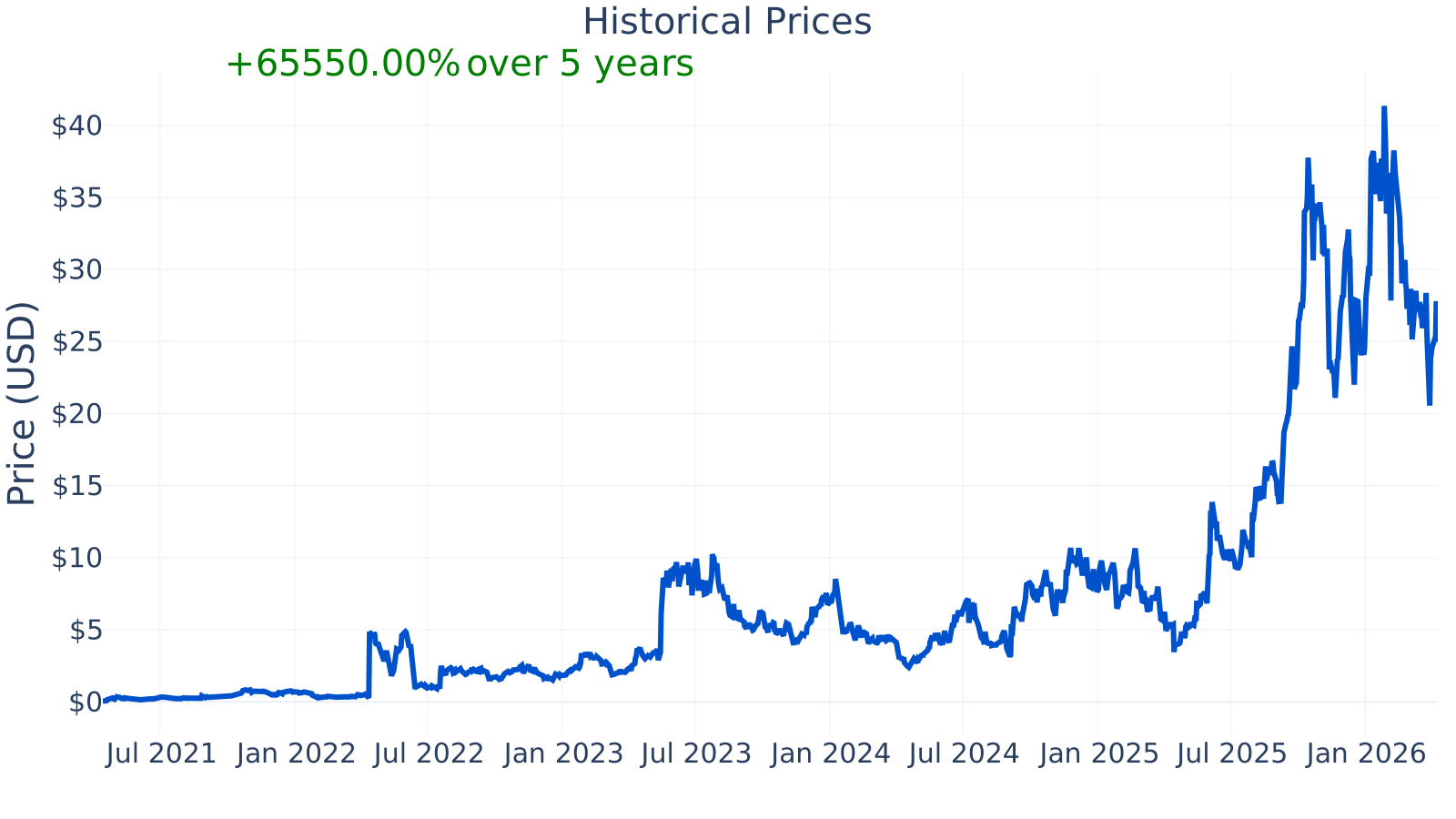
APLD’s market capitalization is about $7.5B. The stock’s beta is about 7.27, which indicates very large price swings relative to the broader market. Revenue growth year-over-year is about 139% versus an industry median around 6%, but profitability is materially weaker: profit margin is about -59% versus an industry median around +5%. Leverage is higher than typical for its peer set, with debt-to-equity around 179% versus an industry median around 53%. Free cash flow over the trailing twelve months is about -$1.81B, highlighting that recent expansion has required significant cash outflows.
Growth (High)
The company operates in a part of the economy that has seen strong structural demand: data centers. More computing needs (cloud services, AI-related workloads, and enterprise digitalization) generally increase demand for power, cooling, space, and connectivity. For a developer-operator like APLD, the growth opportunity depends on securing customers and ramping utilization fast enough to cover fixed costs and the cost of capital used to build facilities.
The revenue growth chart shows that growth has been very strong but also uneven. Some periods show extremely high year-over-year expansion, while others show slower or even negative growth. This kind of volatility is common for companies scaling from a smaller base and changing business mix, but it also means reported growth rates may not follow a smooth path.
The free cash flow trend is a key part of the story. Trailing twelve-month free cash flow has become more negative over time (roughly moving from tens of millions negative to about -$1.81B most recently). For a data center builder, negative free cash flow can be consistent with an investment phase (construction and equipment purchases before revenue fully ramps). The long-term test is whether completed capacity converts into recurring, high-margin cash generation that can service debt and fund maintenance spending without continuous dilution or refinancing.
Potential catalysts typically include (1) large customer agreements that lock in demand for new capacity, (2) facility completion milestones that move projects from construction to revenue-generating operations, and (3) improved unit economics (higher utilization and better margins) as the platform matures. The company’s filings and investor materials are the appropriate place to confirm specific projects, timelines, and contracted capacity.
Risks (Very High)
APLD’s risk profile is elevated because the business combines (a) capital-intensive construction, (b) a need for reliable low-cost power, and (c) customer concentration and technology-cycle exposure. If projects run over budget, take longer than expected, or ramp slower than planned, losses can persist while interest costs and operating expenses continue.
Leverage is notably higher than the industry median. Debt-to-equity is about 179% compared with an industry median near 53%. Higher leverage can amplify results in both directions, but it also raises sensitivity to interest rates, refinancing conditions, and any disruptions in cash generation.
Profitability has been consistently negative, and the most recent profit margin shown is about -52% (with an industry median around +4% to +7% across the period). While early-stage infrastructure scale-ups can have negative margins during buildout, the persistence of negative margins increases execution risk: the business must eventually show it can operate facilities at a margin structure that supports reinvestment and financing costs.
Competitive positioning is another important risk consideration. The broader data center and hosting ecosystem includes very large, well-capitalized operators and infrastructure providers, as well as specialized hosting firms. In many cases, scale, balance sheet strength, power procurement capability, and long-term customer relationships are meaningful advantages. Without framing APLD as a category leader, it is more accurate to view it as a smaller operator competing in an arena where contract wins, power availability, and financing terms can heavily influence outcomes.
Key competitive pressures typically come from:
- Large data center operators with extensive existing capacity and lower funding costs
- Cloud and hyperscale ecosystems that can shape pricing and technical requirements
- Specialized hosting and infrastructure firms competing for similar power-rich sites and customers
Because APLD’s beta is very high, market sentiment shifts (risk-on/risk-off moves) can also strongly affect the share price even when company fundamentals have not changed.
Valuation
For valuation, the price-to-earnings (P/E) ratio is not currently informative here because the company has negative earnings across the period reflected in the profitability metrics (the P/E series is effectively not meaningful and therefore not plotted). In cases like this, investors often look more at operating milestones (contracted capacity, utilization ramp, and margin trajectory) and balance-sheet durability (liquidity, debt terms, and refinancing needs) than at a traditional earnings multiple.
Compared with the industry median P/E (around the high teens in the latest table), APLD cannot be directly compared on that metric today. The more relevant valuation discussion becomes whether the current market capitalization appropriately reflects (1) how quickly revenue can scale into durable operating profit and (2) the financial risk implied by sustained negative free cash flow and above-median leverage.
Conclusion
Applied Digital Corporation is a fast-scaling data center infrastructure and computing-services business, with a recent history of strong top-line growth. At the same time, it currently shows sizable losses, materially negative profit margins, and deeply negative free cash flow, alongside higher-than-typical leverage for its industry group.
For a long-term lens, the central factual trade-off is straightforward: the company appears positioned in a structurally expanding part of the economy, but the financial profile indicates that execution, financing, and profitability improvement are critical. The most important items to track over time are whether new capacity becomes reliably utilized under durable customer agreements, whether margins move toward positive territory, and whether free cash flow trends improve enough to reduce dependence on external funding.
Sources:
- U.S. Securities and Exchange Commission (SEC) EDGAR — Applied Digital Corporation filings (10-K, 10-Q, 8-K)
This article is for informational purposes only and does not constitute financial advice. Some content is AI-generated. See Disclaimer