Stock Analysis · ZoomInfo Technologies Inc (GTM)
Overview
ZoomInfo Technologies Inc is a business-to-business (B2B) software company. Its products are used mainly by sales, marketing, recruiting, and operations teams to identify potential customers, find the right contacts inside companies, and manage outreach workflows. In simple terms, it helps organizations find and engage other organizations more efficiently, using a software platform that combines company/contact information with tools that support prospecting and go-to-market execution.
The company’s revenue is primarily generated from software subscriptions (typical for SaaS businesses), usually sold under contracts to business customers. ZoomInfo describes its offering as a platform that supports multiple go-to-market use cases, with products commonly grouped around sales intelligence and engagement-related workflows. Public filings generally emphasize subscription-based revenue rather than transaction-based sales.
Revenue mix by product line is not provided in the information here as a precise percentage breakdown. In its public filings, ZoomInfo typically discusses revenue largely as subscription revenue from its platform and related modules, rather than reporting a detailed split across product families.
From 2021 to 2025, total revenue increased from about $747 million to about $1.249 billion. Over the same period, gross profit stayed high (roughly $611 million to $1.030 billion), which is consistent with software businesses where delivering the product has relatively low incremental cost. Operating income and net income have been more uneven year to year, reflecting changes in operating expenses and other items like taxes and interest.
Key Figures
| Metric | Value | Industry ⓘ |
|---|---|---|
| Date | May 08, 2026 | |
| Context | ||
| Sector | Technology | |
| Industry | Software - Application | |
| Market Cap ⓘ | $2.02B | |
| Beta ⓘ | 1.04 | |
| Fundamental | ||
| P/E Ratio ⓘ | 17.45 | 26.40 |
| Profit Margin ⓘ | 9.94% | 7.95% |
| Revenue Growth ⓘ | 3.20% | 15.60% |
| Debt to Equity ⓘ | 119.86% | 27.14% |
| PEG ⓘ | N/A | |
| Free Cash Flow ⓘ | $388.80M | |
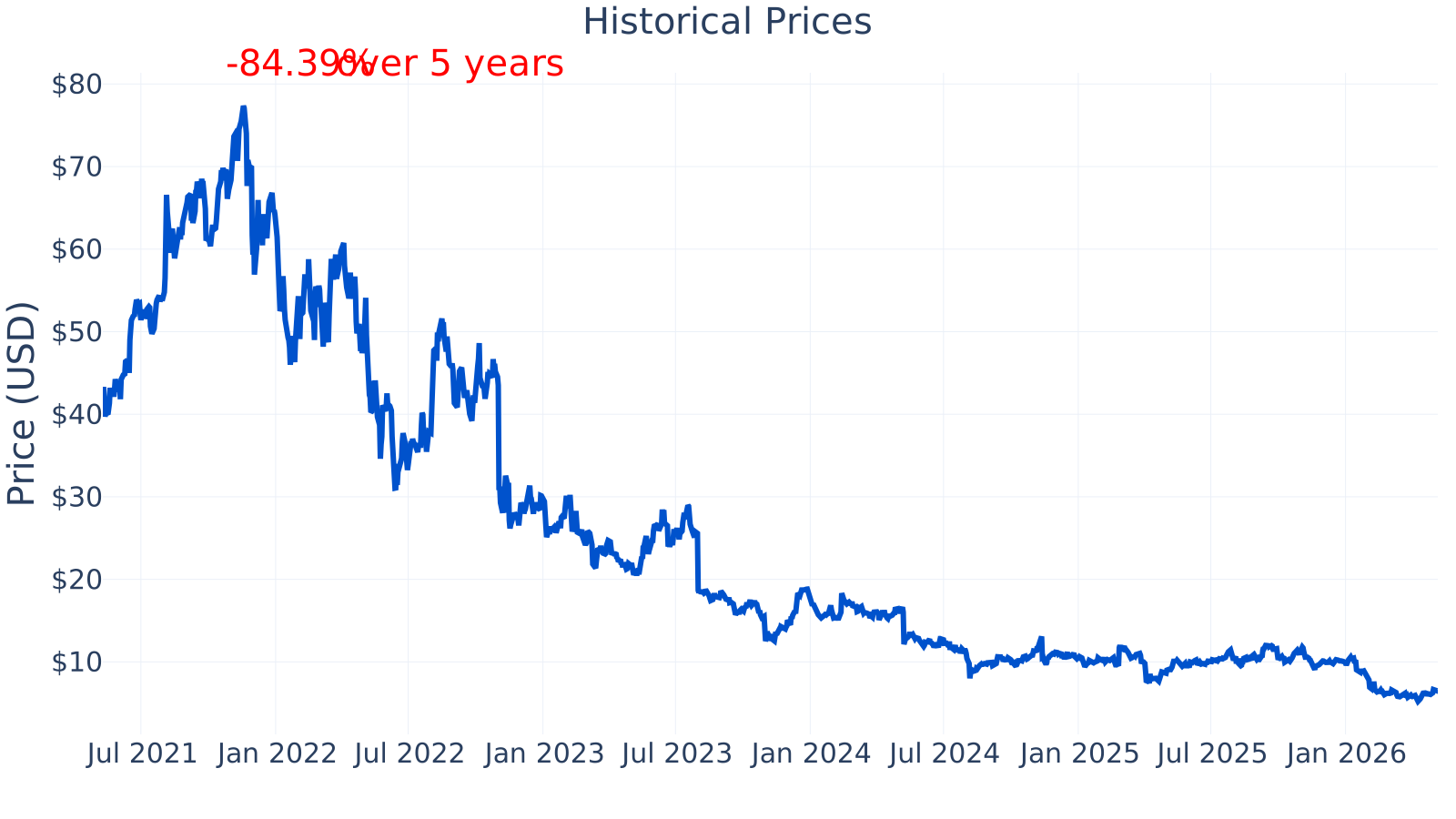
ZoomInfo’s market capitalization is about $2.0 billion, and the stock’s beta is about 1.04, which is close to the broader market’s typical volatility. The P/E ratio is about 17.4 versus an industry median near 26.4, while the net profit margin is about 9.9% versus an industry median around 8.0%.
Growth has been comparatively modest recently: year-over-year revenue growth is about 3.2%, well below the industry median shown here (about 15.6%). Debt-to-equity is about 120% versus an industry median near 27%, indicating meaningfully higher leverage than many peers in the same broad software application category. Trailing twelve-month free cash flow is about $389 million.
Growth (Medium)
ZoomInfo operates in the software application space, where many companies are focused on helping businesses generate demand, improve sales productivity, and automate parts of marketing and sales execution. This is an area that can benefit from long-term trends such as digital sales processes, increasing use of data in customer acquisition, and workflow automation. That said, the company’s recent growth rate suggests it may be operating in a more mature phase of its own expansion cycle, or facing tougher competitive and customer-budget conditions than earlier years.
The revenue growth trend shown moves from very high growth rates in 2021–2022 (above 50% year-over-year in multiple quarters) toward low single digits and even slightly negative growth in parts of 2024, before returning to low single-digit positive growth by late 2025 (around 3%). This pattern matters for long-term holders because a subscription software company’s valuation and business momentum are often closely tied to durable, repeatable growth in revenue.
Free cash flow has remained positive over the period shown, rising from about $286 million (2022) to about $392 million (2023), reaching about $409 million (2024), and then declining to about $302 million (2025). Positive free cash flow can provide flexibility for debt service, reinvestment, and other corporate uses, but the dip in 2025 indicates that cash generation has not moved in a straight line alongside revenue.
Potential long-term catalysts discussed in company communications and filings for businesses like ZoomInfo typically include: improving product capabilities (including automation features), expanding platform adoption within existing customers (selling more modules), and retaining customers through measurable return on investment. Whether these catalysts translate into sustained higher growth depends on execution and overall B2B spending conditions.
Risks (High)
The company’s leverage stands out. The debt-to-equity ratio increased over time and is about 120% in the latest value shown, versus an industry median near 27%. Higher leverage can increase risk because interest costs and repayment obligations reduce flexibility, especially during periods of slower growth. It can also amplify the impact of business downturns on equity holders.
Profitability has also varied. The net profit margin in the most recent point shown is about 9.9%, above the industry median around 7.9%. However, the historical trend indicates periods where margins compressed significantly (near low single digits in parts of 2024) before improving again into 2025. For a subscription software company, profitability can be influenced by sales and marketing intensity, product investment, and customer retention dynamics.
Competition is a central business risk in sales and go-to-market software. In broad terms, ZoomInfo competes with a mix of:
- Customer relationship management (CRM) platforms that add prospecting and data features
- Sales engagement and sequencing tools that can bundle contact discovery and outreach workflows
- Data providers offering company and contact information, sometimes specialized by industry or region
Because vendors frequently expand into adjacent features, differentiation can narrow over time. Competitive advantages for ZoomInfo generally relate to the breadth of its platform use cases, integration into sales workflows, and the perceived quality/coverage of its information. Still, customer willingness to pay is sensitive to budget cycles and to whether users believe the platform produces enough incremental sales productivity compared with alternatives.
Additional risks that are commonly highlighted in company filings for this type of business include customer churn (non-renewals), pressure on pricing during renewals, reliance on third-party data sources or changing data/privacy rules, and execution risk when introducing new products or repositioning offerings.
Valuation
On an earnings multiple basis, the latest P/E ratio shown is about 17.4, below the industry median near 26.4. The historical P/E trend displayed shows substantial fluctuation over earlier periods, which can happen when earnings change materially or when the market reprices growth expectations. By early 2026 in the series shown, the P/E is notably lower than many earlier points and also below the industry median shown at that time.
Whether the current valuation level is “high” or “low” depends largely on how durable future growth and margins prove to be. The recent revenue growth rate (low single digits) is well below the industry median shown here, which can justify a lower multiple versus faster-growing peers. At the same time, the company is profitable and has generated meaningful free cash flow, which can support valuation. The higher leverage profile can also weigh on valuation because it raises the importance of steady cash generation and can limit flexibility.
Conclusion
ZoomInfo is a subscription software company focused on helping businesses identify and reach potential customers more effectively. Over the last several years, revenue expanded materially compared to 2021 levels, and gross profitability has remained consistent with a software model. More recently, revenue growth slowed sharply versus earlier years, while profit margins and free cash flow have shown variability.
The main long-term positives visible here are continued profitability, meaningful free cash flow generation, and a current earnings multiple that is below the industry median shown. The main long-term constraints are the relatively low recent growth rate (compared with the broader software application median shown) and a comparatively high debt-to-equity ratio, which increases dependence on steady operating performance and cash generation.
Sources:
- SEC EDGAR — ZoomInfo Technologies Inc filings (Form 10-K, Form 10-Q, Form 8-K)
- ZoomInfo Investor Relations — SEC filings and investor materials (company-hosted)
- Wikipedia — “ZoomInfo” (basic company background)
This article is for informational purposes only and does not constitute financial advice. Some content is AI-generated. See Disclaimer