Stock Analysis · Pinterest Inc (PINS)
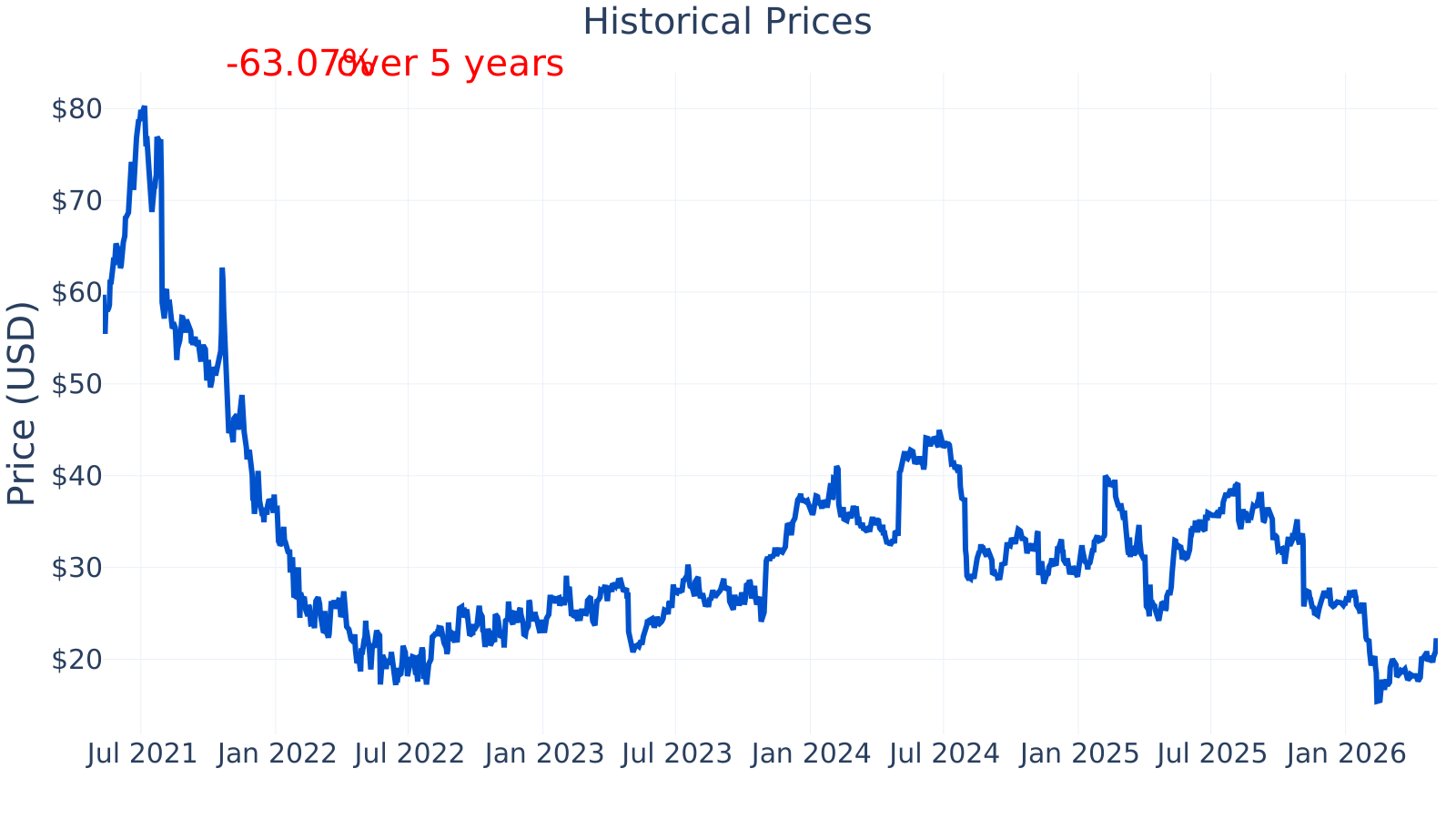
Overview
Pinterest, Inc. operates a visual discovery platform where people search, save, and organize ideas (for example: home decor, recipes, fashion, travel) using “Pins” and “boards.” Unlike many social networks that center on real-time conversation, Pinterest is often used with an intent-driven mindset—people come to plan, shop, or start a project. The company positions the service as a place where users can move from inspiration to action, which matters because advertisers tend to value audiences that are closer to making a purchase decision.
Pinterest’s business model is primarily advertising-based. Brands and merchants pay to show promoted content to Pinterest’s users, and performance is typically linked to outcomes such as clicks, site visits, or conversions. The company also works on making its content more “shoppable” by improving product discovery and measurement tools, aiming to connect user intent with advertisers’ goals more efficiently over time.
Based on company filings, revenue is overwhelmingly driven by advertising. A simple way to think about the mix is:
- Advertising revenue (the vast majority of total revenue; Pinterest reports revenue primarily in this category)
- Other/ancillary revenue (typically immaterial relative to advertising)
Over recent years, total revenue has expanded while operating expenses (notably research and development) remain a large, deliberate investment. Net income has also been volatile year to year, so separating the day-to-day operating performance from one-time or non-operating items can be important when reading results.
Key Figures
| Metric | Value | Industry ⓘ |
|---|---|---|
| Date | May 08, 2026 | |
| Context | ||
| Sector | Communication Services | |
| Industry | Internet Content & Information | |
| Market Cap ⓘ | $12.07B | |
| Beta ⓘ | 0.92 | |
| Fundamental | ||
| P/E Ratio ⓘ | 44.90 | 16.25 |
| Profit Margin ⓘ | 7.64% | 9.94% |
| Revenue Growth ⓘ | 17.80% | 6.40% |
| Debt to Equity ⓘ | 42.27% | 10.97% |
| PEG ⓘ | 0.35 | |
| Free Cash Flow ⓘ | $1.21B | |
Pinterest’s market capitalization is about $12.1B. The stock’s beta of ~0.92 suggests price moves that have been somewhat similar to (or slightly less volatile than) the broader market historically. The latest P/E ratio is ~44.9, notably above the industry median shown (~16.2), which typically implies higher expected growth and/or higher uncertainty priced in. Profit margin is around 7.6% versus an industry median near 9.9%, while year-over-year revenue growth is ~17.8%, higher than the industry median shown (~6.4%). Debt-to-equity is about 42% versus an industry median near 11%. Trailing twelve-month free cash flow is about $1.21B, indicating meaningful cash generation even as accounting profits have varied over time.
Growth (Medium)
Pinterest operates in digital advertising and online commerce discovery—areas that have benefited over the long run from consumer time shifting toward online experiences and from marketers reallocating budgets to measurable, targeted channels. Within that broad market, Pinterest’s differentiation is its “intent-first” usage: many sessions start with planning or searching for ideas, which can align well with advertisers who want to influence shopping decisions earlier in the funnel.
Strategically, the company’s growth efforts described in filings have centered on improving ad performance (better measurement and tools for advertisers), making content easier to shop, and increasing engagement so that the same user base generates more monetization over time. For long-term fundamentals, two recurring goals matter: (1) sustaining user engagement and (2) improving monetization efficiency—earning more per user without damaging the experience.
Revenue growth slowed materially after very high growth rates earlier in the period shown, then re-accelerated. The most recent year-over-year growth rate displayed is about 17.8%, which is higher than the industry median shown on the table and suggests Pinterest has recently been growing faster than many peers in its classification.
Free cash flow has risen over the timeframe shown, reaching about $1.21B on a trailing twelve-month basis. For a platform business, expanding free cash flow can increase flexibility to invest in product improvements, infrastructure, and other strategic priorities while maintaining financial resilience during weaker advertising cycles.
Risks (High)
Pinterest’s core economic engine is advertising, so performance can be sensitive to macro conditions and advertising budget cycles. When marketers reduce spend, pricing and demand for ads can weaken quickly. In addition, changes in privacy rules, platform policies, or measurement limitations can reduce advertisers’ ability to target and measure outcomes—potentially pressuring pricing and returns on ad spend.
Competition is a central risk. Pinterest competes for user attention and advertiser budgets with much larger platforms and ecosystems, including Meta (Facebook/Instagram), Alphabet (YouTube and Google ads), TikTok, Snap, and other digital channels where brands can buy targeted reach. Many competitors have broader social graphs, messaging, or video ecosystems, plus very large advertiser toolsets. Pinterest’s competitive advantage is its distinctive use case (visual discovery and planning) and the commercial intent behind many searches; however, it is not the largest advertising platform, and maintaining differentiation requires continuous product execution.
Debt-to-equity has generally been low in most of the timeline shown, but the latest point displayed rises to about 42%, above the industry median shown (~19% at that date). This kind of step-up can reflect changes in balance sheet structure (for example, new borrowings, equity changes, or accounting impacts). Regardless of cause, higher leverage can reduce flexibility if operating conditions deteriorate, so it is a metric that warrants ongoing monitoring.
Profitability has been uneven across the period shown, including intervals of negative margins and later periods with unusually high margins. The latest profit margin shown is about 7.6%, slightly below the industry median displayed (~8.8%). The earlier spikes suggest that one-time items or non-operating effects may have influenced net income in some quarters, which can make headline profitability less representative of underlying operations.
Valuation
The current P/E ratio of ~44.9 (from the table) is substantially above the industry median shown (~16.2). A higher P/E typically indicates that the market is assigning more value to each dollar of current earnings, often because it expects faster future growth, improving margins, or greater long-term durability of cash flows. It can also reflect that current earnings are not a stable baseline (for example, if earnings were temporarily depressed or boosted in prior periods).
The historical P/E chart shows that valuation has varied widely over time, including periods where P/E is not meaningful (such as when earnings are near zero or negative). In this context, interpreting valuation alongside operating trends—like revenue growth, cash generation, and the stability of profit margins—tends to be more informative than relying on a single-point multiple alone.
Conclusion
Pinterest is a digital platform centered on visual discovery, with revenue that is overwhelmingly tied to advertising. The business has recently shown comparatively strong revenue growth versus the industry median shown and has generated substantial trailing free cash flow, which can support ongoing investment in product and monetization improvements.
At the same time, the company operates in a highly competitive environment where much larger platforms compete for both attention and ad budgets, and results can be sensitive to advertising cycles and changes in measurement or privacy dynamics. Profitability has also been variable over time, making it important to distinguish between underlying operating performance and one-time effects. On valuation, the stock trades at a P/E multiple well above the industry median shown, implying that expectations embedded in the price are meaningfully higher than for many peers.
Sources:
- Pinterest, Inc. — SEC Form 10-K (Annual Report)
- Pinterest, Inc. — SEC Form 10-Q (Quarterly Reports)
- SEC EDGAR Database — Pinterest, Inc. filings
- Pinterest Investor Relations — Shareholder letters / earnings materials (company-hosted)
- Wikipedia — “Pinterest” (basic company background only)
This article is for informational purposes only and does not constitute financial advice. Some content is AI-generated. See Disclaimer


