Stock Analysis · Lennar Corporation (LEN)
Overview
Lennar Corporation is one of the largest homebuilders in the United States. Its core business is building and selling single-family homes, mainly in high-growth and high-demand U.S. markets. Like other homebuilders, Lennar’s results are closely tied to housing affordability and demand, which are influenced by mortgage rates, home prices, and the overall economy.
Beyond selling homes, Lennar also provides services that support a home purchase and ownership experience. This includes financing support through mortgage origination and related services, and in some cases services such as title/closing. The company also has a segment focused on land and land-related activities, which can help manage how it supplies future communities for homebuilding.
In broad terms, Lennar’s main revenue sources typically include:
- Homebuilding (sale of homes) — the largest driver of revenue
- Financial services — mortgage and related services tied to home closings
- Other / land-related activities — smaller and more variable
The business model is relatively straightforward: secure land positions, develop communities, build homes, and sell them—while coordinating financing and closing services that can help the home-buying process run smoothly.
Over recent years, total revenue expanded from about $27.1B (FY2021) to roughly $34.2B (FY2025). Over the same period, profitability shifted lower: net income moved from about $4.4B (FY2021) to about $2.1B (FY2025), reflecting a more challenging housing environment and thinner profitability than the peak period.
Key Figures
| Metric | Value | Industry ⓘ |
|---|---|---|
| Date | Apr 13, 2026 | |
| Context | ||
| Sector | Consumer Cyclical | |
| Industry | Residential Construction | |
| Market Cap ⓘ | $21.91B | |
| Beta ⓘ | 1.49 | |
| Fundamental | ||
| P/E Ratio ⓘ | 12.80 | 11.81 |
| Profit Margin ⓘ | 5.39% | 8.65% |
| Revenue Growth ⓘ | -13.30% | -7.90% |
| Debt to Equity ⓘ | 18.58% | 34.13% |
| PEG ⓘ | 3.11 | |
| Free Cash Flow ⓘ | -$90.23M | |
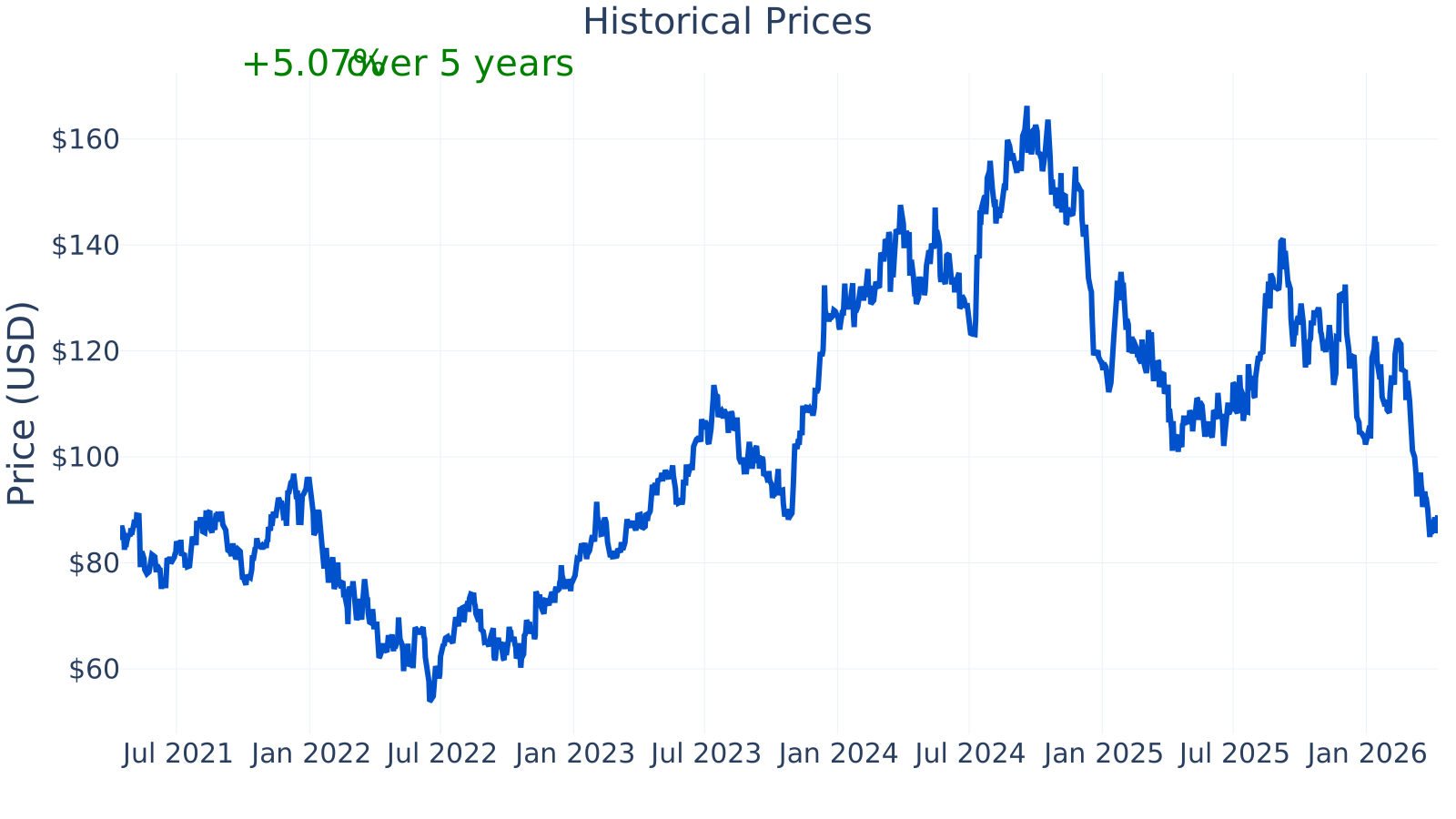
Lennar’s market capitalization is about $21.9B, placing it among the larger public homebuilders. The stock’s beta (~1.49) indicates it has tended to move more than the overall market, which is common for cyclical companies tied to economic conditions.
On valuation, Lennar’s P/E ratio (~12.8) is close to the residential construction industry median (~11.8). On profitability, the company’s latest profit margin (~5.4%) is below the industry median (~8.7%), which suggests current conditions have been less favorable for Lennar than for the typical peer.
On growth, latest year-over-year revenue growth is about -13.3% (industry median about -7.9%), consistent with a cooling phase for the sector. Balance-sheet leverage appears lower than many peers, with debt-to-equity around 18.6% versus an industry median near 34.1%.
Growth (Medium)
Residential construction is a long-term essential industry—people need housing—but it is also highly cyclical. Demand can rise for years and then slow quickly when affordability worsens (often due to higher mortgage rates) or when economic confidence declines. That means “growth” for a homebuilder tends to come in waves rather than in a steady line.
For Lennar specifically, a key long-term driver is its ability to consistently deliver homes buyers can afford in the markets where it operates, while managing land and construction costs. Scale can help: large builders often have more purchasing power with suppliers and more flexibility to adjust incentives and product mix as conditions change.
The recent pattern shows Lennar moving from strong positive growth earlier in the period to negative year-over-year revenue growth more recently, ending near -13%. That shift is consistent with a housing slowdown phase rather than a company-specific one-time event, although company execution (product, pricing, incentives, costs) still matters.
Free cash flow has also been volatile, ranging from strongly positive levels (over $4B in prior periods) to slightly negative in the latest trailing twelve months (about -$90M). For homebuilders, this can happen because land purchases, development spend, and inventory (homes under construction) can absorb cash even when reported earnings remain positive. For long-term analysis, the key is whether cash generation normalizes across the cycle and whether the company maintains enough liquidity and flexibility during weaker periods.
Risks (High)
Lennar’s biggest risk is the housing cycle. When mortgage rates rise or credit availability tightens, monthly payments increase and demand can drop quickly. In those periods, builders may need to use incentives, cut prices, or slow construction starts, which can reduce margins.
Another central risk is cost pressure and execution risk. Construction materials, labor availability, land costs, insurance, and local permitting timelines can all affect delivery pace and profitability. Homebuilders can also face cancellation risk when buyers back out, especially in uncertain economic conditions.
Lennar’s debt-to-equity has generally been below the industry median in recent periods, with the latest reading around 18.6% versus an industry median near 34.1%. Lower leverage can be a helpful cushion in cyclical downturns, though it does not remove exposure to demand shocks.
Profit margins have trended down over time, with the latest profit margin around 5.4%, below the industry median near 8.7%. This matters because small changes in pricing or costs can meaningfully affect results when margins compress.
In terms of competitive positioning, Lennar is widely recognized as one of the large national homebuilders, competing primarily with other scaled U.S. builders. Key competitors include D.R. Horton, PulteGroup, NVR, Toll Brothers, and Taylor Morrison. Competitive advantages in this industry usually come from scale, land strategy, construction efficiency, local market knowledge, and access to capital. Lennar’s large footprint and operating scale are potential strengths, but the company still operates in a market where buyers can compare many similar products and where local competition is intense.
Valuation
Lennar’s current P/E ratio (about 12.8) sits somewhat above the industry median (about 11.8) and higher than many of its own readings from 2021–2024, when the company often traded at single-digit P/E multiples. A rising P/E can happen if the share price increases, if earnings decline, or both; in cyclical industries, earnings swings can make P/E ratios move quickly.
Because recent profitability and revenue growth have weakened (negative year-over-year revenue growth and a lower profit margin versus peers), a higher P/E than earlier years can imply the market is placing more weight on expectations that conditions improve later in the cycle. Whether that valuation level is “high” or “low” cannot be determined from a single metric alone; it depends on how margins, deliveries, and housing demand evolve, and on how consistently the company turns profits into cash over a full cycle.
Conclusion
Lennar is a large U.S. homebuilder whose performance is primarily driven by home sales, with additional contributions from financing-related services and land-focused activities. The company operates in an essential but cyclical industry where results can change quickly with mortgage rates and affordability.
Recent indicators show a softer phase: revenue growth has turned negative and profit margin has moved lower, while free cash flow has been volatile and recently slightly negative—patterns that can occur when demand slows and working capital needs rise. At the same time, Lennar’s leverage (debt-to-equity) appears lower than the industry median, which can be an important stabilizing factor in a downturn.
From a valuation perspective, Lennar’s P/E ratio is near the broader peer range but higher than several years of its own past levels, which suggests the market is looking beyond the current softer period. Assessing the company for long-term ownership typically requires comfort with housing-cycle volatility and attention to whether profitability and cash generation strengthen when market conditions normalize.
Sources:
- SEC EDGAR — Lennar Corporation Form 10-K (Annual Report)
- SEC EDGAR — Lennar Corporation Form 10-Q (Quarterly Report)
- Lennar Corporation Investor Relations — SEC filings and investor materials
- Wikipedia — “Lennar” (basic company background)
This article is for informational purposes only and does not constitute financial advice. Some content is AI-generated. See Disclaimer