Stock Analysis · John Wiley & Sons (WLY)
Overview
John Wiley & Sons (WLY) is a long-established publishing company focused on research, education, and professional learning. Over time, it has shifted from being primarily a print textbook and trade publisher toward more recurring, digital revenue streams such as scientific journals, research platforms, and skills-focused learning products. In practice, the company sits at the intersection of academic research dissemination (journals and related services) and workforce development (training and credentials), with a smaller exposure to traditional books.
In its reporting, Wiley generally groups activities into major business lines that center on Research (scientific, technical, and medical publishing and related services) and Learning (education and professional learning offerings). Its cash generation tends to depend on the resilience of journal subscriptions, licensing, author services, and learning program demand, while print-oriented activities can be more cyclical and competitive.
Main sources of revenue are typically organized around these areas (exact percentages vary by fiscal year and can be found in the company’s annual report segment disclosures):
- Research: journals and related publishing/services (often the largest contributor)
- Learning: professional/skills learning solutions and education offerings
- Other / legacy publishing activities: includes smaller or wind-down lines depending on the year’s reporting
Over the last several fiscal years shown, total revenue declined from about $2.08B (FY2022) to about $1.68B (FY2025), while profitability swung sharply—most notably a loss in FY2024 followed by a return to positive operating income and net income in FY2025. This pattern suggests that, alongside revenue pressure, cost structure and one-time items can materially affect results from year to year.
Key Figures
| Metric | Value | Industry ⓘ |
|---|---|---|
| Date | Feb 16, 2026 | |
| Context | ||
| Sector | Communication Services | |
| Industry | Publishing | |
| Market Cap ⓘ | $1.55B | |
| Beta ⓘ | 0.96 | |
| Fundamental | ||
| P/E Ratio ⓘ | 15.74 | |
| Profit Margin ⓘ | 6.11% | |
| Revenue Growth ⓘ | -1.10% | |
| Debt to Equity ⓘ | 39.11% | |
| PEG ⓘ | 2.48 | |
| Free Cash Flow ⓘ | $148.34M | |
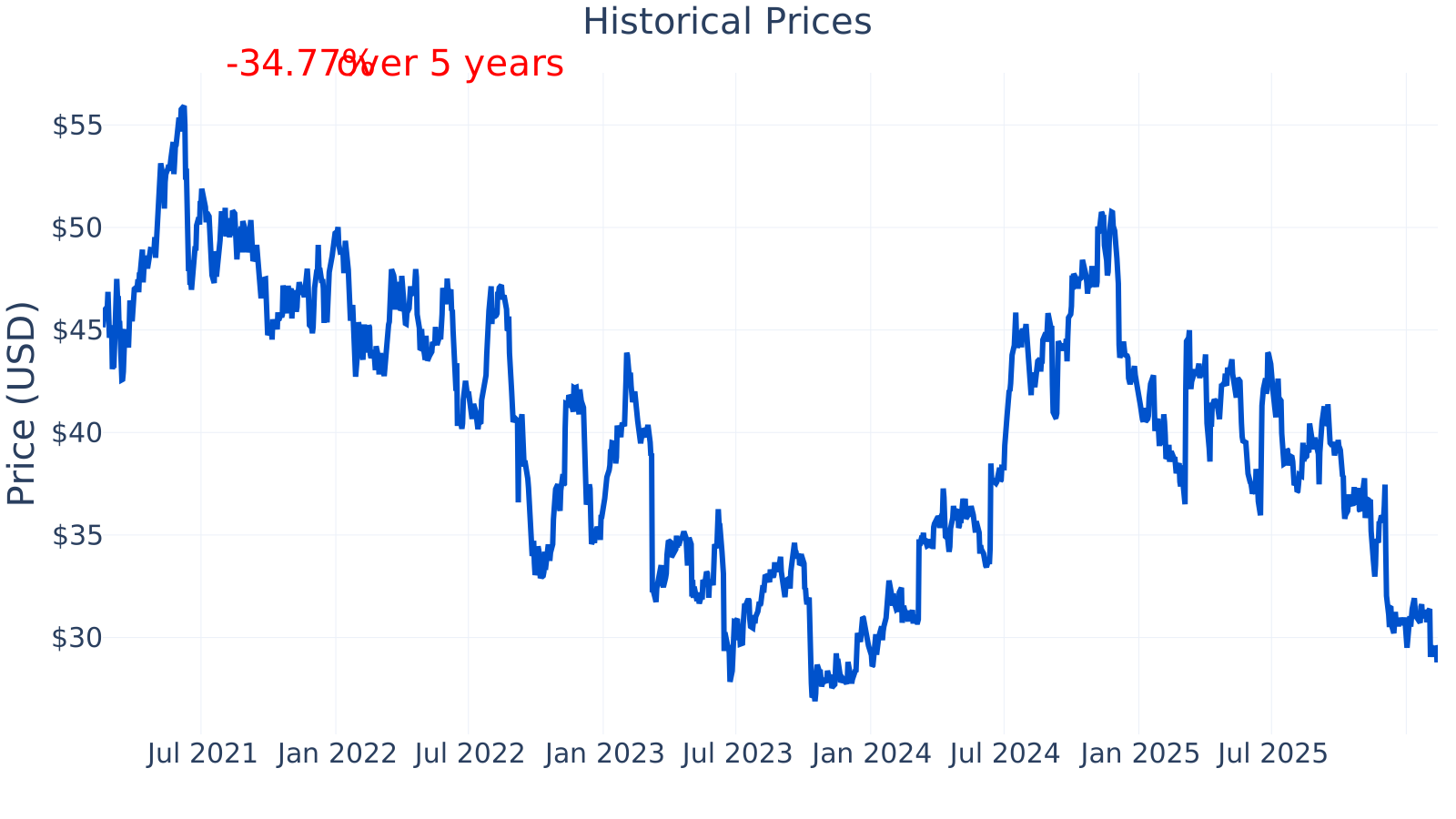
Wiley’s market capitalization is about $1.55B, placing it in the small-cap range. The stock’s beta of ~0.96 suggests its price has historically moved broadly in line with the overall market (though company-specific events can still drive large moves). The latest P/E ratio is ~15.7, while the profit margin is ~6.1% (noting that margins have been volatile in recent years). Revenue growth is slightly negative year over year (about -1.1%), and debt-to-equity is ~39%. Reported trailing twelve-month free cash flow is about $148M, which indicates meaningful cash generation relative to the company’s size.
Growth (Low to Medium)
Wiley participates in end markets that can be structurally durable but not necessarily fast-growing. Demand for scientific publishing and research access is tied to global R&D activity, university and library budgets, and funding cycles. Professional learning and upskilling demand is supported by long-term trends such as digital transformation and the need for continuing education, but this area is competitive and can be sensitive to labor-market conditions and corporate training budgets.
The year-over-year revenue growth trend shown is mostly negative over the period displayed, including double-digit declines in several quarters before moderating to around -1.1% most recently. This points to a business that has been working through revenue headwinds, portfolio changes, and/or demand pressures rather than consistently expanding its top line.
Free cash flow is an important support for long-term business flexibility because it can fund dividends, debt reduction, and reinvestment. The chart shows free cash flow of roughly $239M (FY2022), falling to about $122M (FY2023), then recovering to about $141M (FY2024) and $151M (FY2025). Even with revenue pressure, a rebound in cash generation can matter because it may indicate improved working capital management, cost actions, or mix shift toward higher-cash-yielding activities.
Potential catalysts are generally tied to execution rather than a single external trigger: stabilizing and renewing research subscriptions and publishing agreements, improving product mix toward recurring digital offerings, and maintaining discipline on costs and content investment. Because the company operates in knowledge and learning markets where customer relationships and content portfolios matter, incremental improvements can compound over time—but they often show up gradually.
Risks (Medium)
This article is for informational purposes only and does not constitute financial advice. Some content is AI-generated. See Disclaimer