Stock Analysis · Wix.Com Ltd (WIX)
Overview
Wix.com Ltd provides a software platform that helps individuals and small businesses create and manage an online presence. In simple terms, it offers tools to build websites, sell products online, accept payments, book appointments, and run basic marketing activities (like email campaigns and search advertising). The company’s model is largely subscription-based: users can start for free, then upgrade to paid plans to unlock features such as custom domains, ecommerce capabilities, and additional business tools.
From a business perspective, Wix aims to be an “all-in-one” operating system for small businesses online. That matters for long-term durability because once a business uses Wix for its site, store, bookings, and marketing, switching can become inconvenient (moving content, redesigning pages, changing workflows, and risking downtime).
In its public filings, Wix reports revenue primarily through two categories (as described in its annual report filings):
- Subscriptions (paid website and business plans, including ecommerce and other premium features)
- Partners (revenue share from third-party services sold through Wix, such as domains, payment processing, and other business solutions)
Wix’s revenue is therefore tied mainly to (1) how many users convert to paid plans, (2) how much existing customers expand usage over time, and (3) how well Wix can attach partner services to its customer base.
Over recent years, total revenue increased from about $1.27B (2021) to about $1.76B (2024), while profitability improved materially: net income moved from a loss in 2021 and 2022 to positive results in 2023 and 2024. Operating income also turned positive by 2023 and expanded further in 2024, reflecting a combination of growth and cost discipline.
Key Figures
| Metric | Value | Industry ⓘ |
|---|---|---|
| Date | Mar 02, 2026 | |
| Context | ||
| Sector | Technology | |
| Industry | Software - Infrastructure | |
| Market Cap ⓘ | $3.92B | |
| Beta ⓘ | 1.37 | |
| Fundamental | ||
| P/E Ratio ⓘ | 29.86 | 24.58 |
| Profit Margin ⓘ | 7.20% | 6.79% |
| Revenue Growth ⓘ | 13.60% | 16.35% |
| Debt to Equity ⓘ | -563.56% | 26.59% |
| PEG ⓘ | 0.42 | |
| Free Cash Flow ⓘ | $567.13M | |
Wix’s market capitalization is about $3.9B, and the stock’s beta of ~1.37 indicates it has tended to move more than the overall market (higher volatility than a broad index). The latest profit margin is ~7.2% (vs. an industry median around 6.8%), showing that Wix has recently operated modestly above the median profitability level for its peer set. The latest year-over-year revenue growth is ~13.6% (vs. an industry median around 16.4%), suggesting growth is solid but not leading the peer group at the moment. Free cash flow over the trailing twelve months is about $567M, which is notable in size relative to the company’s market capitalization and indicates meaningful cash generation in the most recent period.
Growth (medium)
Wix operates in a broad, long-running trend: more commerce and business activity moving online, especially among small businesses and independent professionals. Website creation, online stores, scheduling, and marketing tools are not “one-time” needs; they require ongoing updates, new features, and integrated services. This environment can support steady subscription demand over time, rather than relying only on brand-new website creation.
Wix’s strategy is centered on expanding what customers can do inside its platform (site + store + payments + bookings + marketing). For long-term growth, this type of “bundle” approach can increase revenue per customer if it successfully adds more tools that customers adopt. It also potentially improves retention because customers may prefer fewer vendors for essential business tasks.
The revenue growth pattern shows a slowdown from very high growth rates in 2021 to more moderate rates later, followed by a re-acceleration into the low-to-mid teens more recently (around 13–14% in the latest period shown). For long-term readers, this typically frames Wix less as an early-stage hyper-growth story and more as a company working toward scalable, repeatable growth with improving economics.
Cash generation has strengthened significantly over time: trailing twelve-month free cash flow moved from roughly $104M (2021) to a negative period around 2022, then rose to approximately $515M (2025 Q1) and about $567M in the latest metrics snapshot. In many software businesses, rising free cash flow can be a key catalyst because it can support reinvestment, balance sheet flexibility, and resilience during slower economic periods.
Risks (medium to high)
A central risk is competition. The market for building websites and selling online is crowded, and customers can compare options quickly. Wix competes with a mix of “do-it-yourself” website builders and ecommerce-focused platforms. Major competitors commonly discussed in the space include Squarespace, Shopify (more commerce-centered), and WordPress-based solutions (often via hosting providers and page builders). Because many offerings overlap, product differentiation (ease of use, templates/design, reliability, speed, and integrated business tools) can matter more than any single feature.
Wix has competitive advantages, but they are not absolute. Its platform is known for enabling non-technical users to launch quickly and then add business features as needs grow. The “all-in-one” approach can reduce complexity for small businesses. However, customers with more advanced needs can still choose specialist tools (for example, a dedicated ecommerce platform) or open ecosystems (like WordPress). This creates ongoing pressure for Wix to keep improving its product while managing costs.
A second risk relates to profitability durability. Wix’s margins improved meaningfully over time, but software margins can fluctuate with product investment, marketing intensity, and pricing pressure.
The profit margin trend shows a clear turnaround: from deep losses in 2021–2022 to positive profitability by late 2023, reaching roughly 7–9% across the more recent points shown. This is a constructive change, but it also raises expectations—if growth slows or spending rises again, margins can compress.
Balance sheet interpretation is another area to watch.
The debt-to-equity ratio is shown as negative in many recent periods. This often happens when accounting equity becomes negative (for example, due to accumulated losses, share repurchases, or other balance sheet dynamics). A negative ratio can make simple “debt vs. equity” comparisons less intuitive than usual. Separately, Wix’s interest expense in recent years (as seen in its annual results breakdown) appears relatively small compared with revenue, but the broader point remains: readers typically look beyond a single ratio and review liquidity, total debt, and cash generation together.
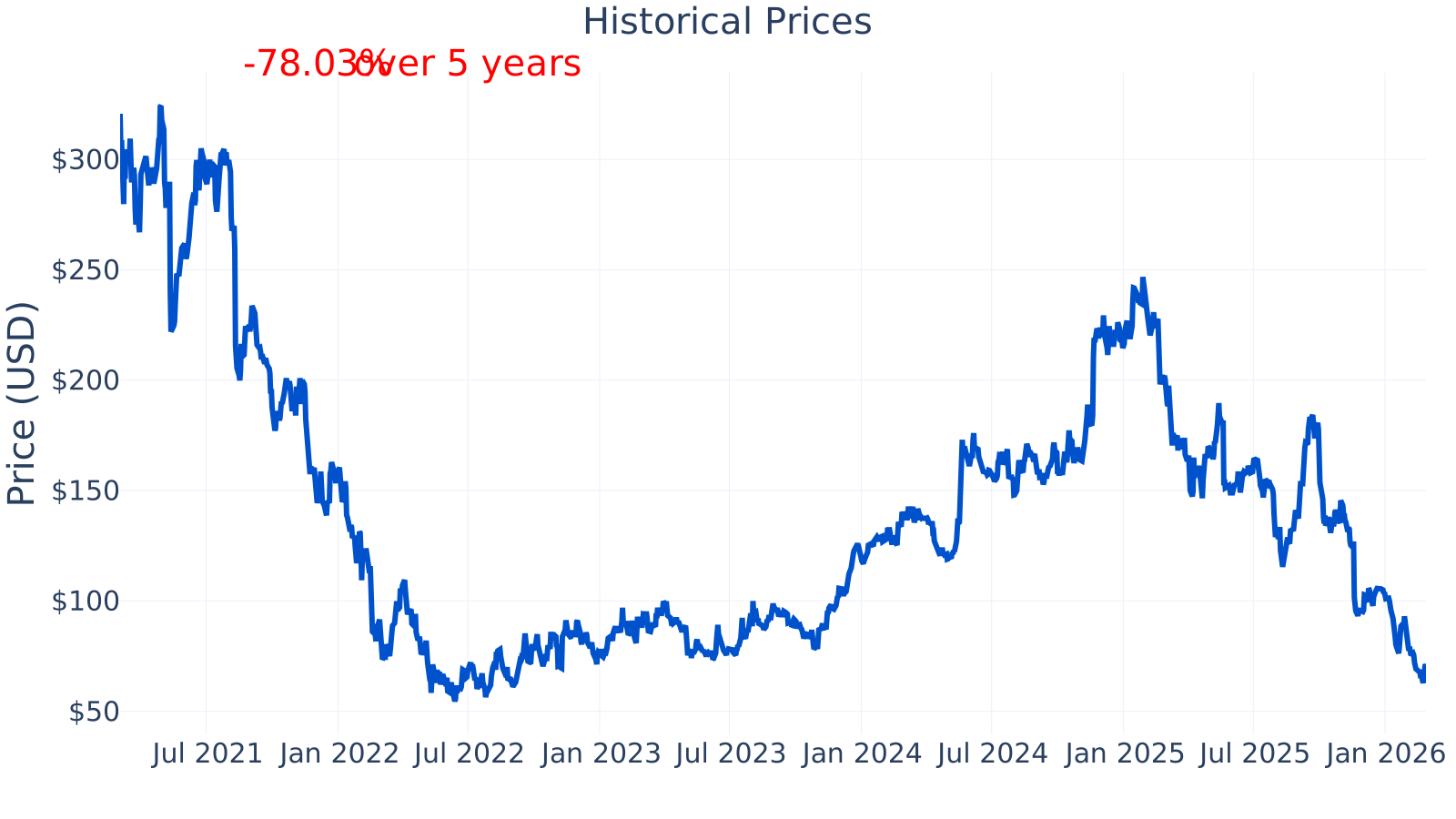
Finally, Wix’s stock price history indicates meaningful swings, which can be a risk for long-term holders who may face periods of large drawdowns even when the business continues operating.
Valuation
Valuation is best understood as “what the market is paying today for the company’s current earnings and expected progress.” One common reference point is the price-to-earnings (P/E) ratio, which can be more meaningful once a company is consistently profitable.
The P/E ratio shown for recent periods trends down sharply from very high levels in 2024 toward lower (though still elevated) levels into 2025, reaching roughly the 40s by late 2025 on the chart. In the latest metrics snapshot, the P/E is about 29.9, compared with an industry median around 24.6. That positioning suggests the market has recently priced Wix at a premium to the median peer, which can be consistent with expectations of continued profit expansion and cash generation.
At the same time, the valuation context includes trade-offs: revenue growth is solid but not the highest versus the median of the peer set, while profit margin is slightly above the peer median and free cash flow is meaningful. In practice, the key question is whether Wix can sustain mid-teens revenue growth while maintaining or expanding profitability; if either part weakens, valuation multiples can compress.
Conclusion
Wix is a subscription-based software company focused on enabling small businesses and individuals to build websites and run online operations through an integrated set of tools. The company has shown a notable financial improvement over the last few years: revenue rose steadily from 2021 through 2024, profitability turned positive, and free cash flow increased substantially in the most recent periods shown.
The long-term outlook is shaped by a large addressable market and ongoing digitization of small businesses, balanced against intense competition and the need to keep innovating to prevent customers from switching to alternatives. From a valuation standpoint, recent P/E levels place Wix somewhat above the industry median, which implies the market is assigning value to its improved earnings profile and cash generation. Whether that pricing remains consistent over time depends heavily on Wix’s ability to sustain growth while preserving the improved margin structure.
Sources:
- U.S. SEC EDGAR — Wix.com Ltd Annual Report (Form 20-F)
- Wix Investor Relations — Annual reports / shareholder materials and earnings materials (company-hosted)
- Wikipedia — “Wix.com” (basic company background)
This article is for informational purposes only and does not constitute financial advice. Some content is AI-generated. See Disclaimer


