Stock Analysis · Lowe's Companies Inc (LOW)
Overview
Lowe’s Companies Inc. is a home improvement retailer that sells products and services used to build, repair, maintain, and improve homes. It serves both “do-it-yourself” customers (people working on their own homes) and professional customers (contractors and tradespeople). Its business is primarily run through a large store network, supported by online sales, delivery capabilities, and installation services coordinated with third parties.
Lowe’s reports that it operates as a single business segment, so revenue is not broken out into official “business lines” with public percentages in the same way some multi-division companies are. In practical terms, sales generally come from a mix of major home-improvement product categories and related services, including:
- Building materials and lumber
- Tools and hardware
- Appliances
- Flooring
- Paint
- Kitchens and baths
- Outdoor and garden products
- Home décor and storage
- Installation and other services (coordinated through third parties)
The company’s results tend to be influenced by home repair/remodel demand, consumer spending, housing turnover, and professional contractor activity, because many purchases are tied to projects that can expand or pause depending on economic conditions.
Across the most recent five fiscal years shown, total revenue moved from about $96.3B (FY2022) to about $86.3B (FY2026), while net income moved from about $8.4B (FY2022) to about $6.7B (FY2026). Over the same period, operating costs (including selling, general, and administrative expenses) and interest costs remained meaningful line items, which matters because retail profitability can be sensitive to expense control and borrowing costs.
Key Figures
| Metric | Value | Industry ⓘ |
|---|---|---|
| Date | Mar 03, 2026 | |
| Context | ||
| Sector | Consumer Cyclical | |
| Industry | Home Improvement Retail | |
| Market Cap ⓘ | $144.26B | |
| Beta ⓘ | 0.98 | |
| Fundamental | ||
| P/E Ratio ⓘ | 21.27 | |
| Profit Margin ⓘ | 7.71% | |
| Revenue Growth ⓘ | 10.90% | |
| Debt to Equity ⓘ | -72.47% | |
| PEG ⓘ | 2.81 | |
| Free Cash Flow ⓘ | $7.65B | |
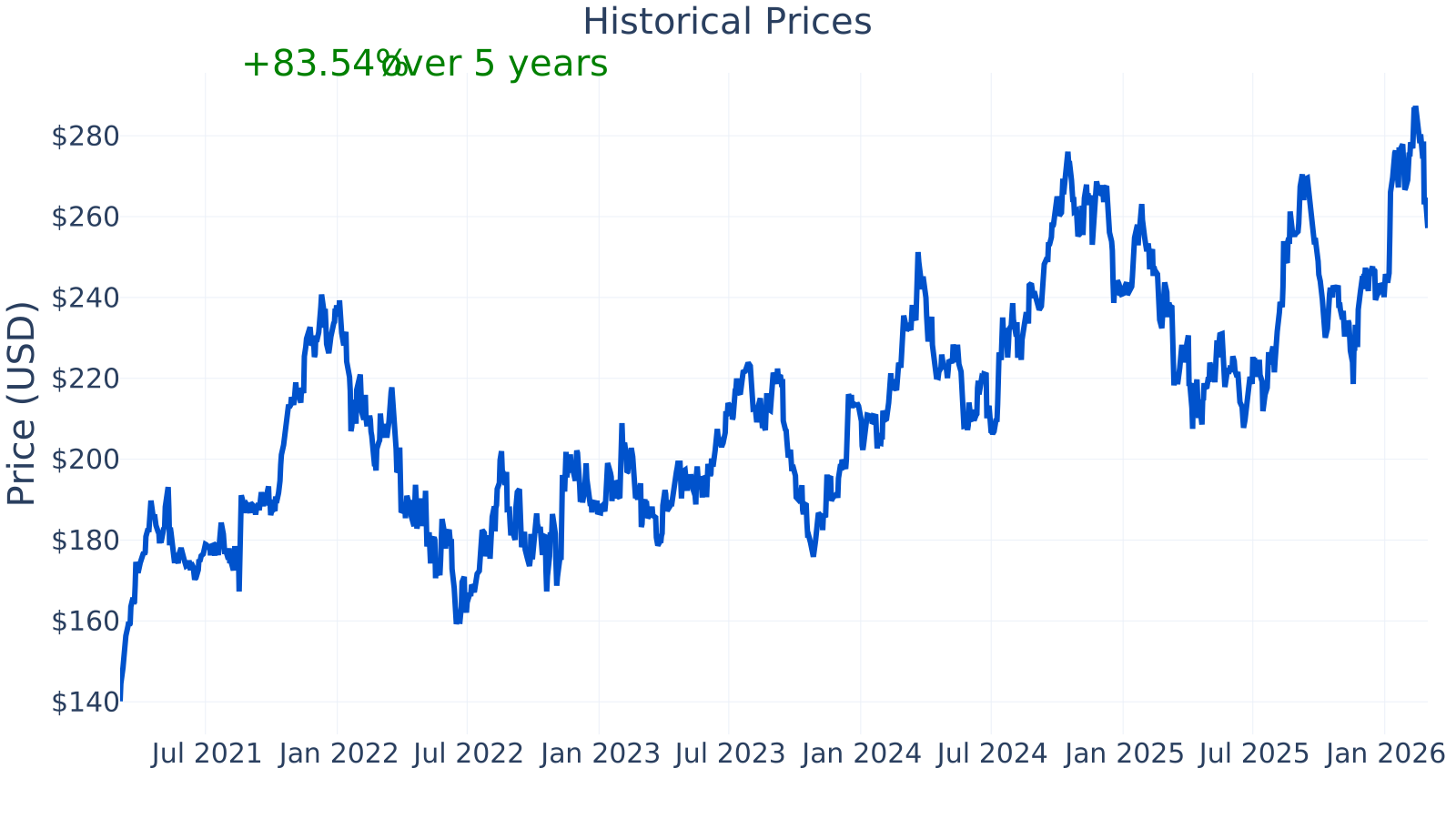
Lowe’s current market capitalization is about $144.3B. The stock’s beta is ~0.98, which indicates price movements that have been roughly in line with the broader market historically (beta is a backward-looking measure and can change over time). The latest P/E ratio is ~21.3 and the PEG ratio is ~2.81 (a ratio that relates P/E to growth expectations; it depends heavily on the growth assumptions used). Reported profit margin is ~7.7% and revenue growth year over year is ~10.9% in the latest period shown. Free cash flow (TTM) is about $7.65B, reflecting the cash the business generated after operating needs and capital spending.
Growth (Medium)
Home improvement retail is often considered a mature industry, but it can still grow over time with household formation, aging housing stock that needs repairs, and long-term spending on remodeling and maintenance. Demand is also shaped by cyclical factors such as interest rates, consumer confidence, and housing market activity. That means growth can be uneven from year to year even for a well-established company.
Lowe’s strategy for growth (as described in its public filings) has typically emphasized improving the customer experience, strengthening its position with professional customers, investing in online capabilities and fulfillment, and driving operating efficiency. For long-term context, these efforts matter because scale retailers compete not only on product selection and price, but also on in-stock reliability, delivery speed, and service quality for larger projects.
Revenue growth has been volatile over the last several years: it was strongly positive in parts of 2021, turned negative across multiple periods in 2023–2025, and most recently improved to about +10.9% year over year (FY2026 period shown). This pattern is consistent with a business tied to project demand that can cool and reaccelerate depending on the macro environment and comparisons to prior high-spending periods.
Free cash flow has remained substantial, ranging from about $6.18B to $8.26B across the periods shown (FY2022–FY2026). In a retail model, durable free cash flow can support reinvestment in stores and supply chain, shareholder returns, and balance-sheet flexibility—though the way it is used (for example, debt repayment versus buybacks) affects risk.
Risks (Medium)
Lowe’s faces several core risks typical of large retailers. Demand can weaken when consumers postpone discretionary projects, especially during periods of higher interest rates or economic uncertainty. Input cost inflation, wage pressures, and promotional competition can also compress profitability if the company cannot offset costs through pricing, productivity, or mix.
Competition is a structural factor. In the U.S. home improvement retail space, the major peer is The Home Depot, and there are additional competitors across hardware chains, regional building-supply distributors, specialty retailers, and online-first sellers. Lowe’s is one of the largest players in its category, and size can be an advantage (purchasing scale, brand awareness, distribution leverage). At the same time, rivalry can be intense because many products are comparable across retailers and customers can be price-sensitive.
The debt-to-equity ratio shown is negative in most periods and is about -72% in the latest point displayed. A negative value often occurs when a company’s accounting “equity” becomes negative, which can happen after large share repurchases and other balance-sheet movements. In that situation, debt-to-equity becomes less intuitive as a risk gauge, so it is typically more informative to also look at items like total debt levels, lease obligations, interest expense, and cash generation in the company’s filings. Interest expense is present in the income statement (for example, above $1B in several of the fiscal years shown), so borrowing costs are a factor to monitor, especially in higher-rate environments.
Profit margin has generally been in the mid-to-high single digits, peaking near ~8.9% in some periods and most recently around ~7.7%. For a high-volume retailer, relatively small margin shifts can have a meaningful impact on earnings, making expense discipline, shrink control, and merchandising execution important ongoing risk areas.
Valuation
The P/E ratio has generally ranged from the mid-teens to low-20s in the periods shown, with a latest value of about 21.3. In descriptive terms, that places the stock in a valuation zone often associated with established, large-cap businesses where the market is pricing in a mix of steady cash generation and moderate long-term growth rather than hyper-growth.
Whether that valuation is “high” or “low” depends on factors that can change over time: the durability of demand for home improvement projects, Lowe’s ability to protect margins through cycles, the path of interest expense and financing conditions, and how consistently the company converts earnings into free cash flow. The recent improvement in year-over-year revenue growth may support a higher valuation multiple than periods of declining sales, but the business remains tied to a cyclical consumer and housing backdrop, which can also limit valuation during uncertain conditions.
Conclusion
Lowe’s is a large, established home improvement retailer with meaningful scale and a business model that can generate substantial free cash flow. The company operates in an industry with long-term demand drivers (ongoing home maintenance and remodeling) but also clear cyclicality linked to consumer spending and housing conditions.
Based on the information reviewed here, the main long-term items to keep tracking are: revenue momentum through economic cycles, the stability of profit margins, and balance-sheet structure (including interest expense and the implications of negative equity for leverage interpretation). Competitive pressure—especially against the other large national home improvement retailer—remains an enduring feature of the landscape, making execution in pricing, service levels, and professional customer penetration central to results.
Sources:
- SEC EDGAR — Lowe’s Companies, Inc. Form 10-K (Annual Report)
- SEC EDGAR — Lowe’s Companies, Inc. Form 10-Q (Quarterly Report)
- Lowe’s Companies, Inc. Investor Relations — Annual Report / 10-K materials
- Wikipedia — “Lowe’s” (basic company background)
This article is for informational purposes only and does not constitute financial advice. Some content is AI-generated. See Disclaimer