Stock Analysis · Sandisk Corp (SNDK)
Overview
Sandisk Corp (SNDK) operates in the digital storage market. In simple terms, it makes products that store data—such as flash memory and storage devices used in consumer electronics, personal computers, and data centers. This type of storage is widely used because it is fast, compact, and has no moving parts compared with older hard-disk technology.
From a business model perspective, revenue is generally tied to (1) how many storage units are shipped and (2) the average selling prices of memory and storage products. Like many hardware-related companies, results can vary significantly over time because pricing and demand for memory can change quickly.
Detailed revenue mix percentages (by product line or end market) are typically disclosed in annual reports and filings. They are not included here because they were not provided in the allowed materials for this draft.
Over the years shown, revenue and profitability appear to swing meaningfully, with a notable improvement in gross profit in the most recent period versus earlier years, while operating expenses (including research and development) remain a major use of funds.
Key Figures
| Metric | Value | Industry ⓘ |
|---|---|---|
| Date | May 11, 2026 | |
| Context | ||
| Sector | Technology | |
| Industry | Computer Hardware | |
| Market Cap ⓘ | $231.37B | |
| Beta ⓘ | N/A | |
| Fundamental | ||
| P/E Ratio ⓘ | 53.47 | 38.73 |
| Profit Margin ⓘ | 34.19% | 5.23% |
| Revenue Growth ⓘ | 251.00% | 39.50% |
| Debt to Equity ⓘ | 7.73% | 5.83% |
| PEG ⓘ | N/A | |
| Free Cash Flow ⓘ | $4.46B | |
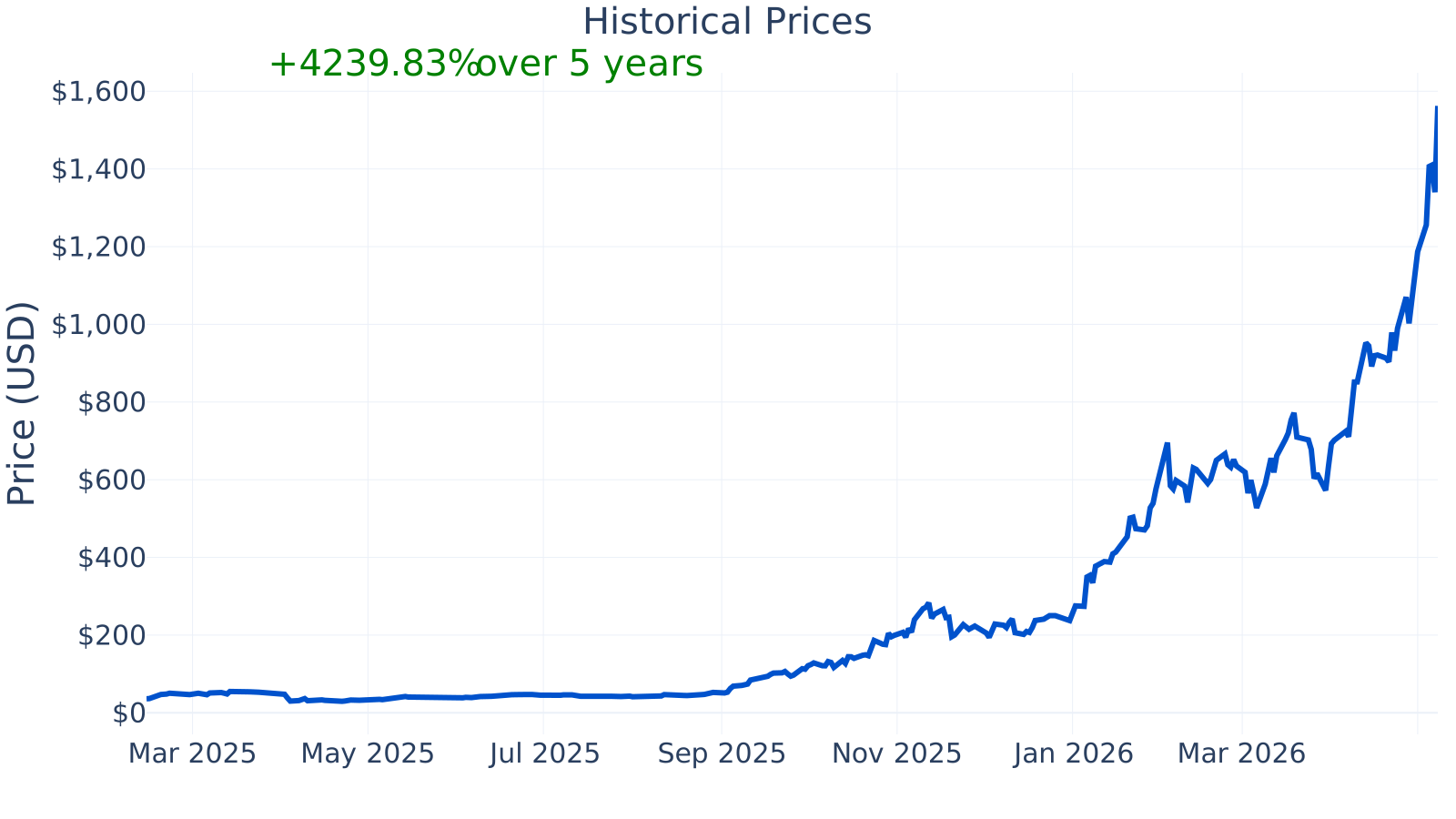
Based on the latest figures shown, Sandisk has a market capitalization of about $231.4B and a P/E ratio of ~53.5, which is above the industry median (~38.7). The latest profit margin is ~34.2%, much higher than the industry median (~5.2%), while debt-to-equity is ~7.7%, slightly above the industry median (~5.8%) but still low in absolute terms. Year-over-year revenue growth is shown at ~251% (versus an industry median near ~39.5%), and trailing twelve-month free cash flow is about $4.46B.
Growth (Medium)
Digital storage is a long-running growth area because the world continues to create, move, and store more data. Key demand drivers typically include cloud computing, data centers, AI-related infrastructure build-outs, and the ongoing expansion of storage needs in phones, PCs, and connected devices. In that sense, Sandisk operates in an industry with durable long-term demand, even if the path can be uneven.
What matters for future growth is not only demand, but also whether the company can sustain competitive products, manage manufacturing/supply effectively, and navigate pricing cycles. Companies in this space often emphasize technology roadmaps, cost efficiency, and product differentiation (performance, endurance, reliability) to defend margins when pricing becomes competitive.
The year-over-year revenue growth trend shown accelerates sharply in the most recent period (from ~22.6% to ~61.2% to ~251%). Large jumps like this can happen in cyclical hardware markets, so the key question for long-term analysis is typically whether growth remains durable across multiple periods rather than in a single spike.
Free cash flow shifts from slightly negative (about -$0.12B) to strongly positive (about $4.46B) in the most recent period shown. For long-term business quality, consistently positive free cash flow can matter because it indicates the company is generating cash after operating needs and capital spending.
Risks (High)
The largest risk for many storage and memory businesses is cyclicality: demand and pricing can rise and fall quickly. Even when long-term demand is strong, short-term oversupply or weaker end-market sales can pressure revenue and margins. This helps explain why profitability can look very different from one period to the next.
Another key risk is competition and technology execution. Storage markets tend to have well-resourced competitors, and leadership can depend on product performance, manufacturing scale, cost structure, and the ability to keep up with rapid technology changes. Competitive advantages, when present, often come from scale, established customer relationships, proven reliability, and strong engineering—yet these advantages can be challenged if rivals achieve better cost or performance.
Balance sheet risk appears more limited than in highly leveraged businesses, but it still matters to track how funding and obligations evolve over time.
Debt-to-equity declines across the periods shown (from about 23.4% to 7.7%), suggesting leverage has been reduced. Even so, the company remains above the industry median in each shown period, meaning peers (as a group) appear to use even less balance sheet leverage.
Profit margin swings sharply: it is negative across several periods shown (around -22% to -12%) before turning strongly positive to about 34.2% in the most recent period. That kind of volatility can signal a business that is sensitive to pricing, utilization, inventory dynamics, or other cycle-related factors, even if recent profitability is strong.
On competitive landscape, Sandisk operates in a space that typically includes large semiconductor and storage vendors. Relative positioning versus specific competitors is usually discussed in company filings (risk factors, competition sections, and customer concentration disclosures). Those details are not included here because they were not provided in the allowed materials for this draft.
Valuation
The P/E ratio shown most recently is about 22.1 versus an industry median near 19.0, indicating the stock trades at a modest premium to the peer median at that point in time. Separately, the latest snapshot in the table shows a higher P/E (~53.5) than the industry median (~38.7), which suggests valuation can move materially depending on the time period and earnings level.
For a company with large swings in profitability, valuation ratios based on earnings (like P/E) can change quickly because earnings can rise or fall sharply. In practice, long-term assessment often pairs valuation multiples with cycle awareness (where the industry is in supply/demand) and with cash-flow durability (whether free cash flow stays positive through weaker periods).
Conclusion
Sandisk operates in a digital storage market with long-term demand tailwinds tied to data creation, cloud infrastructure, and ongoing device storage needs. The figures shown suggest a period of strong improvement in revenue growth, margins, and free cash flow, alongside relatively low leverage.
At the same time, the financial history displayed also highlights substantial volatility—particularly in profit margins—which is consistent with a business exposed to pricing and demand cycles. Valuation indicators shown are sometimes above industry medians, and they appear sensitive to shifts in earnings. A long-term view commonly depends on whether improved profitability and cash generation can persist across different parts of the cycle, not only in the strongest periods.
Sources:
- U.S. SEC EDGAR — Company filings (10-K, 10-Q, 8-K) for Sandisk Corp (SNDK)
- Sandisk Corp — Investor Relations materials and SEC-filed annual reports (as applicable)
- Wikipedia — “SanDisk” (company background and general description)
This article is for informational purposes only and does not constitute financial advice. Some content is AI-generated. See Disclaimer