Stock Analysis · Flex Ltd (FLEX)
Overview
Flex Ltd (FLEX) is a global manufacturing and supply chain partner. In simple terms, it helps other companies design, build, and deliver physical products at scale. Flex operates factories and logistics capabilities across multiple regions, and it supports customers from early product stages (design and engineering support) through manufacturing, assembly, testing, and after-market services.
In its SEC filings, Flex describes its activities as providing advanced manufacturing services and supply chain solutions across a range of end markets. Revenue is largely generated through manufacturing programs for customers (typically recognized as products are shipped), along with related services such as engineering, supply chain management, and other lifecycle support.
Public filings commonly describe Flex’s business using operating segments (rather than a simple “product A vs product B” revenue split). Because exact percentages can vary by year and are disclosed within filings, it is generally most accurate to think of revenue as coming from a mix of customer programs across industrial, cloud/data infrastructure, communications, consumer-related products, and other diversified end markets.
Over the last several fiscal years shown, revenue has stayed in the mid‑$20B range while costs make up the majority of sales (typical for contract manufacturing). Operating income and net income have fluctuated year to year, which is common in a high-volume, relatively low-margin business where execution, customer mix, and input costs can meaningfully affect results.
Key Figures
| Metric | Value | Industry ⓘ |
|---|---|---|
| Date | Feb 07, 2026 | |
| Context | ||
| Sector | Technology | |
| Industry | Electronic Components | |
| Market Cap ⓘ | $23.93B | |
| Beta ⓘ | 1.23 | |
| Fundamental | ||
| P/E Ratio ⓘ | 28.69 | 41.23 |
| Profit Margin ⓘ | 3.18% | 6.11% |
| Revenue Growth ⓘ | 7.70% | 12.20% |
| Debt to Equity ⓘ | 109.37% | 39.00% |
| PEG ⓘ | 0.97 | |
| Free Cash Flow ⓘ | $1.16B | |
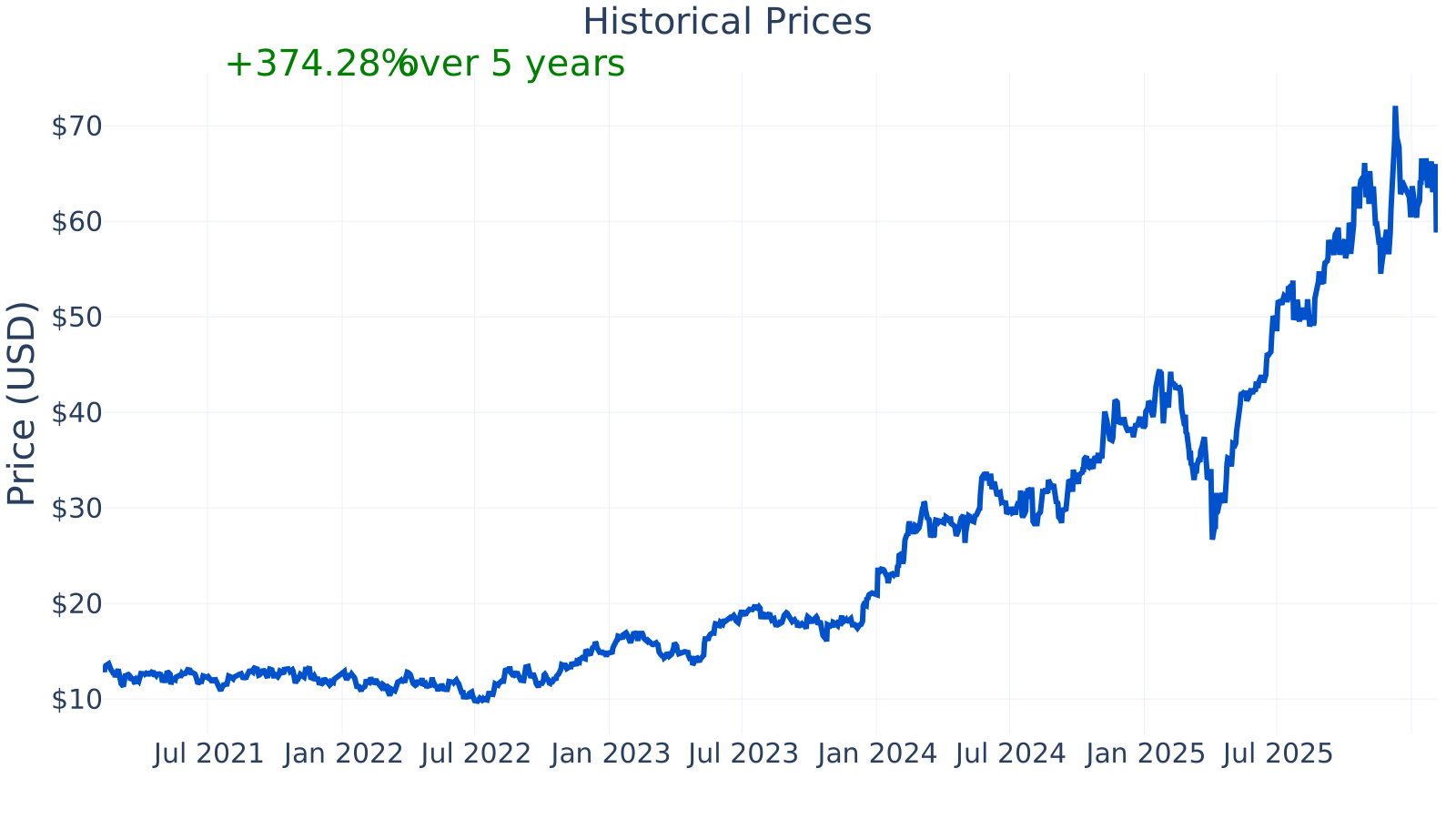
Flex’s market capitalization is about $23.9B, and the stock has a beta of 1.23 (historically more volatile than the broader market). The P/E ratio is about 28.7 versus an industry median near 41.2, meaning the stock is priced at a lower earnings multiple than the typical peer in its listed industry group. Profit margin is about 3.2% versus an industry median around 6.1%, reflecting the reality that large-scale manufacturing services often run on thinner margins. Year-over-year revenue growth is about 7.7% versus an industry median near 12.2%. Debt-to-equity is about 109% versus an industry median around 39%, indicating higher leverage than many peers. Free cash flow over the last twelve months is about $1.162B, which is a key support for reinvestment, debt service, and other corporate uses.
Growth (Medium)
Flex operates in the broad electronics manufacturing and components ecosystem, which is tied to long-term trends such as data center build-outs, increased electronics content in industrial systems, and ongoing product complexity that encourages outsourcing to specialized manufacturers. These trends can be supportive, but they do not guarantee steady growth because demand can be cyclical and dependent on customers’ product cycles and capital spending.
Revenue growth has been uneven across the periods shown: strong growth in parts of 2021–2022, followed by multiple quarters of contraction through 2023–2024, and then a return to positive growth in 2025 (including a notably strong rebound in early 2025). This pattern fits an industry that can swing with inventory corrections, end-demand changes, and shifting customer order patterns.
Free cash flow improved materially over time in the periods shown, moving from negative in 2021 to meaningfully positive in subsequent years and reaching about $1.067B (TTM) by 2025-03-31. For a manufacturing services business, sustained free cash flow is an important indicator of operational discipline because it reflects not only profitability but also working-capital management (inventory, receivables, and payables) and capital spending needs.
From a strategy perspective, Flex’s positioning as a diversified manufacturing and supply chain partner can make sense for long-term resilience: serving multiple end markets can reduce reliance on a single product category. Potential catalysts typically discussed in company materials for this type of business include ramping new customer programs, improving factory utilization, shifting toward more complex programs with better economics, and ongoing optimization of the supply chain footprint.
Risks (Medium-High)
Flex’s business model tends to produce relatively thin margins, which means execution risk matters: changes in product mix, labor and logistics costs, warranty/quality issues, and customer pricing pressure can have an outsized impact on profitability. The company is also exposed to demand swings—when customers reduce orders or work through excess inventory, revenue can decline quickly, as seen in the negative growth periods in the chart.
Leverage is a notable risk point. Debt-to-equity has generally been above the industry median across the time series and ends around 109% (versus an industry median near 39%). That does not automatically indicate financial stress, but it does mean the company’s capital structure relies more on debt than many peers, which can reduce flexibility if operating conditions weaken or borrowing costs rise.
Profit margin has typically been below the industry median for much of the timeline and is about 3.2% at the latest point (versus ~6.1% industry median). Even though margins improved at points (notably around parts of 2024), the overall picture remains that this is a lower-margin business, so consistent cost control and program execution are important to maintain earnings stability.
Competition is intense in electronics manufacturing services and related supply chain solutions. Flex competes with other global contract manufacturers and supply chain providers, as well as with in-house manufacturing efforts at some large customers. Competitive advantages in this field usually come from scale, global footprint, engineering and process know-how, quality track record, and the ability to manage complex supply chains reliably. Flex’s diversified footprint and broad customer/end-market exposure can be strengths, but the sector is not winner-take-all; pricing pressure and customer concentration are common structural risks across the industry.
Valuation
On an earnings-multiple basis, Flex’s P/E ratio has risen meaningfully over the periods shown (from mid-single digits in 2022 to the high‑20s by late 2025), reflecting a combination of stock price performance and changes in earnings over time. Even at roughly 28.7 currently, the P/E is still below the industry median shown (roughly 41.2), which indicates the market is valuing Flex at a lower multiple than the typical peer group company.
Whether that lower multiple is “justified” can be discussed in terms of fundamentals visible in the other metrics: Flex shows lower profit margins than the median peer and higher leverage, both of which can warrant more conservative valuation. At the same time, the company generates substantial free cash flow and has returned to positive year-over-year revenue growth in the most recent periods shown, which can support higher valuation compared with weaker phases of the cycle. The PEG ratio listed (about 0.97) suggests the current earnings multiple is roughly in line with the growth rate assumptions embedded in that metric, though PEG ratios depend heavily on the particular growth estimates used.
Conclusion
Flex is a large, diversified manufacturing and supply chain services company with revenue in the mid‑$20B range and business exposure to multiple end markets. The financial profile shown is consistent with the realities of contract manufacturing: high revenue volume, relatively thin margins, and results that can vary with customer demand cycles and execution.
The recent picture includes a rebound in revenue growth and strong free cash flow generation, which are important indicators of operating momentum and financial capacity. Key points to monitor over time include margin stability (given the low-margin nature of the business), leverage (which is higher than the industry median), and whether revenue growth remains positive beyond the recent recovery phase.
Sources:
- SEC EDGAR — Flex Ltd filings (Form 10-K, Form 10-Q)
- Flex Ltd Investor Relations — Annual Report (company-hosted)
- Flex Ltd Investor Relations — Quarterly Results Press Releases (company-hosted)
- Wikipedia — “Flex (company)”
This article is for informational purposes only and does not constitute financial advice. Some content is AI-generated. See Disclaimer