Stock Analysis · Yum! Brands Inc (YUM)
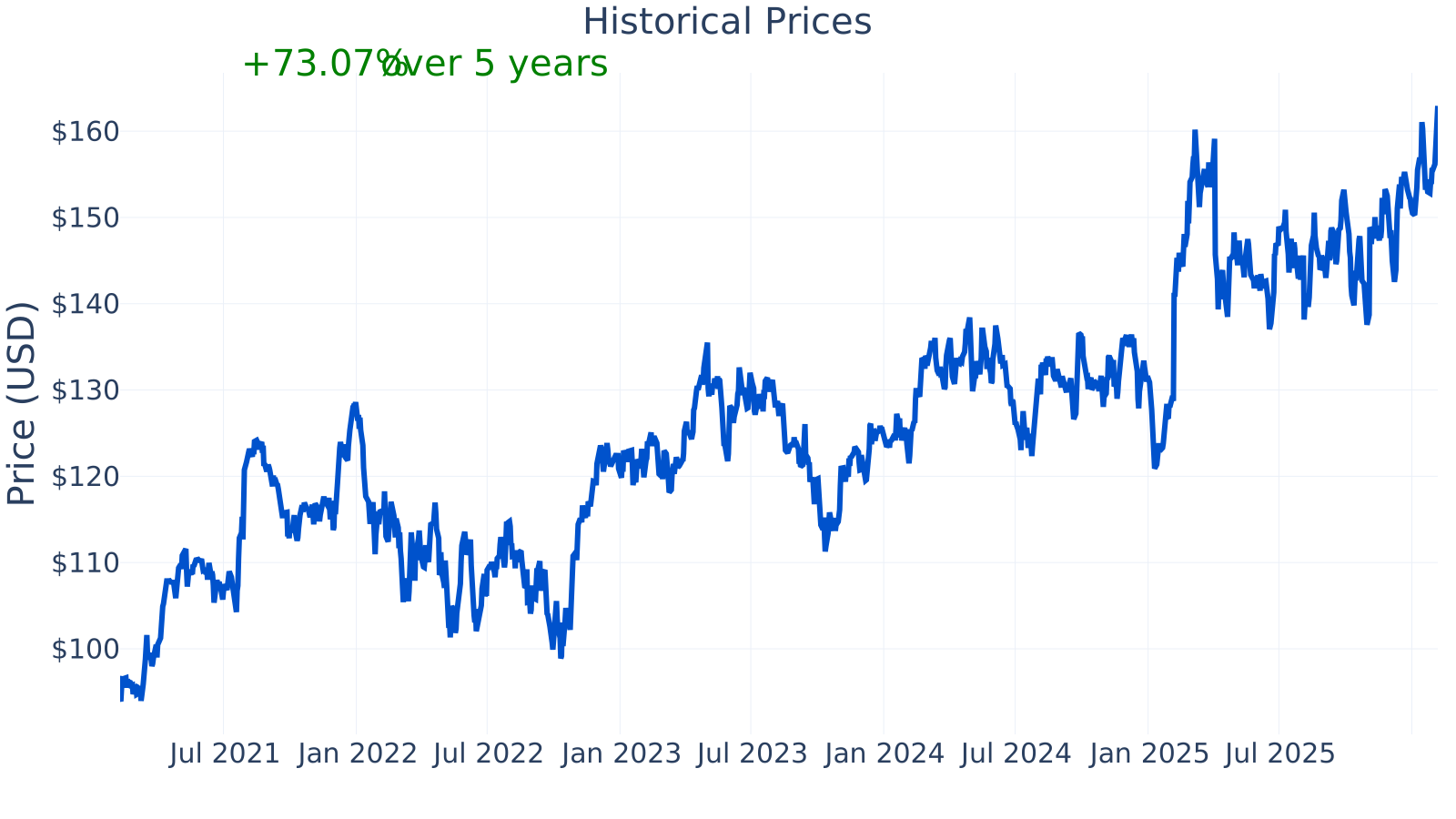
Overview
Yum! Brands Inc is a global restaurant company best known for its portfolio of quick-service brands: KFC, Taco Bell, and Pizza Hut. The company’s business model is largely “asset-light,” meaning it relies heavily on franchised restaurants rather than owning and operating most locations itself. In this structure, independent franchisees run many of the restaurants while Yum! provides brand standards, marketing, product innovation, and digital/technology platforms.
Because of this franchise-focused approach, Yum!’s revenue is typically driven more by fees and royalties than by selling food directly to customers. In its reporting, Yum! organizes results mainly by brand segments (KFC, Taco Bell, Pizza Hut) plus corporate and other items, with revenue largely tied to franchise revenues, company-operated restaurant sales (where applicable), and supplier-related revenues in certain markets. Percentages can shift year to year depending on franchising mix and geography.
In simple terms, the biggest economic engines tend to be the brands with the largest global restaurant footprint and strong franchise royalty streams. Many long-term business questions therefore come down to: how fast each brand can grow restaurant count, how resilient customer demand is, and whether franchisees can keep investing in new stores and remodels.
Across recent years shown, total revenue rises from about $6.6B (2021) to about $8.2B (2025). Operating income also increases over that span (about $2.2B to about $2.6B), while interest expense stays meaningful at roughly $0.5B per year—an important ongoing claim on profits for a highly leveraged, shareholder-return-focused business model.
Key Figures
| Metric | Value | Industry ⓘ |
|---|---|---|
| Date | Feb 07, 2026 | |
| Context | ||
| Sector | Consumer Cyclical | |
| Industry | Restaurants | |
| Market Cap ⓘ | $45.24B | |
| Beta ⓘ | 0.66 | |
| Fundamental | ||
| P/E Ratio ⓘ | 29.30 | 29.16 |
| Profit Margin ⓘ | 18.98% | 7.98% |
| Revenue Growth ⓘ | 6.40% | 6.90% |
| Debt to Equity ⓘ | -162.59% | 69.29% |
| PEG ⓘ | 2.02 | |
| Free Cash Flow ⓘ | $1.64B | |
Yum! Brands has a market capitalization of about $45.2B and a beta of ~0.66, which indicates the stock has historically moved less than the overall market on average (though that can change). The current P/E ratio is ~29.3, close to the restaurant industry median (~29.2). Profitability stands out: Yum!’s profit margin is ~19.0% versus an industry median near 8.0%, reflecting the economics of a franchise-heavy model. Year-over-year revenue growth is about 6.4%, roughly in line with the industry median (~6.9%). Reported debt-to-equity is negative here (around -163%), which usually happens when a company has negative shareholders’ equity—often linked to large buybacks and leverage—so it should be interpreted differently than a typical positive debt-to-equity ratio. Trailing twelve-month free cash flow is about $1.64B.
Growth (medium)
Quick-service restaurants are a mature but resilient category, supported by convenience, value offerings, and global expansion opportunities. For a franchise-driven company like Yum!, long-term growth often comes from a combination of (1) opening net new restaurants through franchise partners, (2) improving same-store sales through menu innovation and marketing, and (3) increasing digital ordering, delivery, and loyalty engagement to raise visit frequency and average ticket.
The year-over-year revenue growth pattern is uneven (common in restaurants due to consumer cycles, pricing, and currency effects), but the more recent points shown are positive, including mid-to-high single digit growth and periods above 10%. This suggests the company has been able to re-accelerate from slower growth periods, although the path is not smooth.
Free cash flow over the trailing twelve months shown trends upward over the longer run (from roughly $1.22B in 2021 to about $1.45B by 2025, with the latest listed TTM value at about $1.64B). For long-term business durability, this matters because free cash flow is what can fund dividends, share repurchases, debt servicing, and reinvestment in brand-building and technology.
Potential catalysts for future growth are typically tied to continued international unit expansion (especially for KFC and Pizza Hut), brand-specific innovation (menu and new formats), and execution on digital channels (apps, loyalty programs, and delivery partnerships). Franchise economics are also critical: if franchisees generate attractive returns, they tend to open more locations, which can expand Yum!’s royalty base over time.
Risks (medium)
Restaurants face ongoing risks tied to consumer spending, food and labor cost inflation, and intense competition. Even for a franchisor, cost pressures can indirectly matter because franchisees’ profitability influences their willingness and ability to grow, remodel, and market aggressively. In addition, global brands carry geopolitical and foreign-currency exposure: results can be influenced by currency swings and local regulatory conditions.
The negative debt-to-equity values shown across multiple periods are consistent with negative shareholders’ equity. This often reflects a capital structure with significant leverage and substantial share repurchases over time. While negative equity does not automatically mean near-term distress for a stable franchisor, it can reduce balance-sheet flexibility and makes traditional leverage ratios harder to compare directly with peers that have positive equity. Interest expense is also a recurring cost (around $0.5B annually in the multi-year income flow shown), which is a reminder that debt servicing remains an important use of operating profits.
Profit margin remains well above the industry median across the periods shown, generally clustering around the high teens to low-to-mid 20% range. This is a competitive advantage signal for the business model: franchise royalties and fees can be structurally higher-margin than operating a large base of company-owned restaurants. That said, the margin trend also shows some variation over time, and maintaining premium profitability depends on brand strength and franchisee health.
Competition is intense across all Yum! brands. In chicken, KFC competes with large global and regional players (for example, Popeyes and Chick-fil-A in the U.S., and many strong local chicken concepts internationally). Taco Bell competes with a wide set of quick-service and fast-casual options, including Mexican-inspired chains and broader value-oriented QSR menus. Pizza Hut competes with global pizza chains (such as Domino’s and Papa Johns) and with a fragmented field of local delivery and dine-in operators. Yum!’s main competitive advantages tend to be brand recognition, global scale, marketing capabilities, franchise systems, and digital platforms—but none of these eliminate the need for continuous product and value innovation.
Valuation
The P/E ratio has generally moved in a band from the low 20s to around 30 over the period shown. The latest value (~28.9) is close to the restaurant industry median (~30.4) at that point in time, and the most recent snapshot in the metrics table (~29.3) is also near the industry median (~29.2). In other words, based on P/E alone, the market is valuing Yum! broadly in line with the typical restaurant peer group.
Two fundamentals are helpful context for interpreting that multiple. First, Yum!’s profit margin is materially higher than the industry median, which can justify a higher valuation than slower, lower-margin operators. Second, the PEG ratio shown (~2.0) suggests the valuation may be demanding relative to expected growth (PEG is a rough indicator and depends heavily on growth assumptions). The mixed but positive recent revenue growth and the presence of meaningful leverage (including negative equity) both matter when considering how much valuation cushion exists if industry conditions weaken.
Conclusion
Yum! Brands is a global quick-service restaurant operator with an asset-light, franchise-oriented model that has historically supported strong profitability and solid free cash flow generation. Revenue has increased over the multi-year period shown, and profit margins have stayed well above the industry median, consistent with the economics of franchising and brand scale.
At the same time, the business operates in a highly competitive category exposed to consumer cycles and cost pressures, and the company’s balance-sheet presentation (including negative shareholders’ equity) highlights a leveraged capital structure that can reduce flexibility during tougher periods. On valuation, the stock’s P/E has been broadly similar to the industry median, so the current pricing appears to reflect a peer-like multiple while the company shows above-median margins and mid-single-digit growth.
Sources:
- SEC EDGAR — Yum! Brands Inc filings (Form 10-K, Form 10-Q)
- Yum! Brands Investor Relations — Annual Report materials and investor presentations (company-hosted)
- Wikipedia — “Yum! Brands” (basic company background)
This article is for informational purposes only and does not constitute financial advice. Some content is AI-generated. See Disclaimer


