Stock Analysis · Ingram Micro Holding Corporation (INGM)
Overview
Ingram Micro Holding Corporation is a large technology distributor and services provider. In simple terms, it sits between technology makers (such as hardware and software vendors) and the businesses that buy technology (often through resellers, retailers, systems integrators, and managed service providers). The company helps move large volumes of products through the supply chain, and it also provides operational services that make it easier for partners to sell, deploy, and manage technology.
Its business model is typically built on high sales volumes and relatively low profit per dollar of revenue, which is common for distribution-based businesses. That makes efficiency, scale, purchasing terms, logistics execution, and working-capital management especially important.
Based on company disclosures commonly used in filings for businesses like this, revenue is generally driven by a mix of technology product distribution (hardware/software/cloud-related) and service offerings (such as lifecycle, fulfillment, and cloud enablement services). Percentages by revenue source are not included in the information provided here.
Main sources of revenue (from largest to lowest, typical for this model):
- Technology product distribution (physical and digital technology products sold through partner channels)
- Cloud-related and other technology services (enablement, subscriptions facilitation, and related partner services)
- Lifecycle / supply-chain services (configuration, staging, returns, and other logistics-adjacent services)
One notable pattern in the company’s multi-year income flow is how closely costs track revenue. For example, in 2025 total revenue was about $52.6B while cost of revenue was about $49.1B, leaving gross profit around $3.5B. This “thin spread on very large volume” structure helps explain why small changes in pricing, vendor incentives, mix, or operating costs can have an outsized impact on bottom-line results.
Key Figures
| Metric | Value | Industry ⓘ |
|---|---|---|
| Date | May 11, 2026 | |
| Context | ||
| Sector | Technology | |
| Industry | Information Technology Services | |
| Market Cap ⓘ | $6.30B | |
| Beta ⓘ | N/A | |
| Fundamental | ||
| P/E Ratio ⓘ | 17.89 | 16.33 |
| Profit Margin ⓘ | 0.66% | 5.86% |
| Revenue Growth ⓘ | 13.70% | 6.60% |
| Debt to Equity ⓘ | 29.76% | 43.45% |
| PEG ⓘ | N/A | |
| Free Cash Flow ⓘ | $1.36M | |
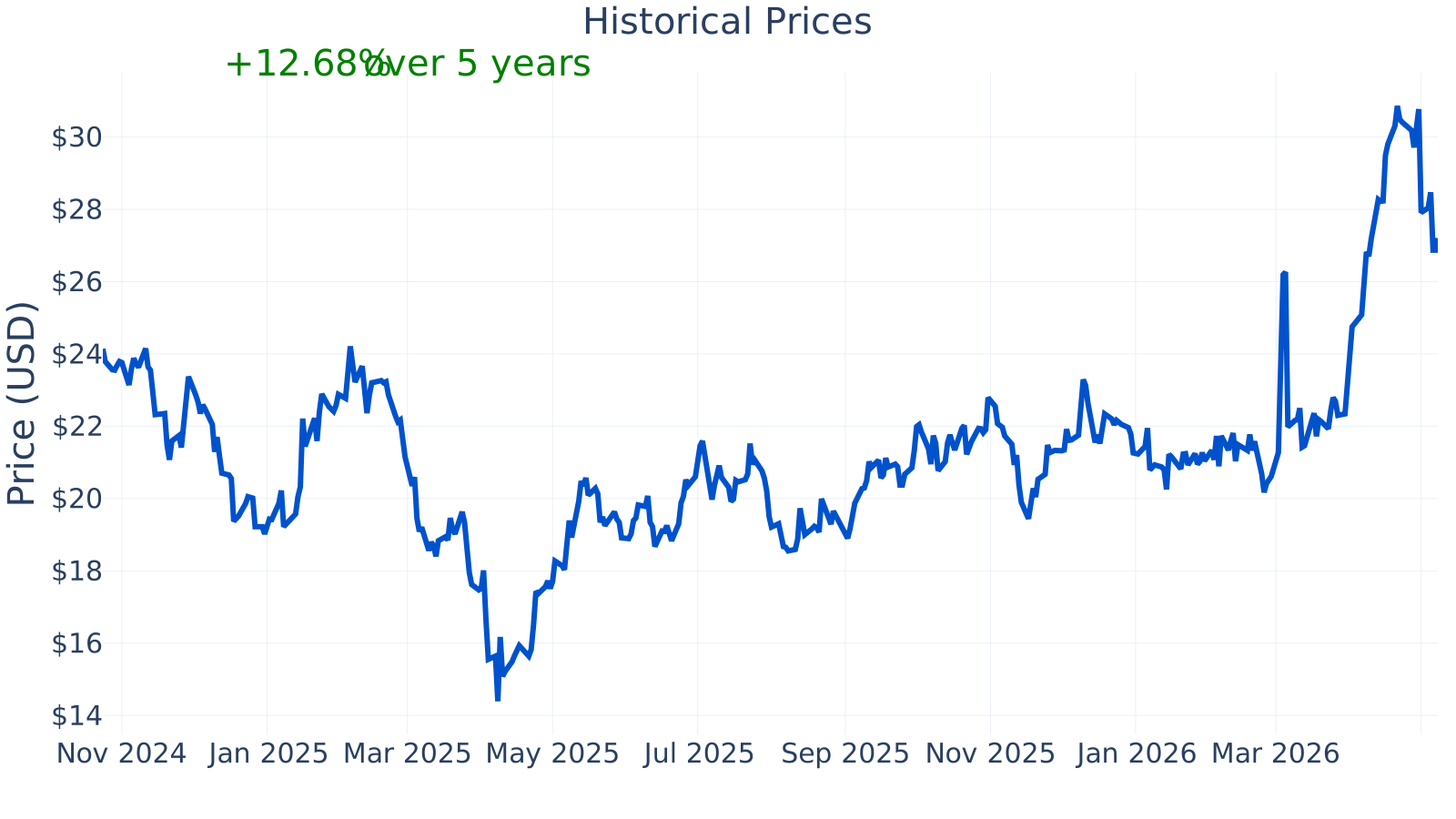
In the latest snapshot, Ingram Micro’s market capitalization is about $6.3B. The company’s P/E ratio is ~17.9, slightly above the industry median (~16.3). Profitability (net profit margin) is ~0.66%, which is far below the industry median (~5.86%), consistent with a distribution-heavy model. Year-over-year revenue growth is ~13.7% versus an industry median of ~6.6%. Leverage (debt-to-equity) is ~29.8%, below the industry median (~43.4%). Trailing twelve-month free cash flow is shown at ~$1.36M, which is very small relative to the revenue scale and is an item that typically warrants careful context from filings (for example: working-capital swings, one-time items, or timing effects).
Growth (Medium)
Ingram Micro operates in the broad technology supply chain and IT services ecosystem, which is supported over time by ongoing digitization, cloud adoption, cybersecurity needs, device refresh cycles, and the outsourcing of IT operations by many organizations. These are long-running themes, but they are also cyclical: demand can rise and fall with business confidence, enterprise spending, and hardware refresh timing.
A key part of the company’s growth logic is scale: large global distribution networks can become more valuable as vendors and channel partners look for fewer, more capable intermediaries. Another potential tailwind is the continued shift toward recurring, services-enabled models (including cloud-related motions), where distributors can add value through billing support, partner enablement, and lifecycle services.
The recent revenue growth trend shown here is positive, moving from roughly 7.2% to about 13.7% across the displayed periods. While that indicates improving top-line momentum, revenue growth alone is not the whole story for a low-margin distributor; the mix of revenue and the ability to protect gross profit dollars matter just as much as the headline growth rate.
The trailing free cash flow shown declines sharply (from about $96.8M to about $1.36M). For distribution businesses, free cash flow can swing significantly because cash can be temporarily tied up in inventory and receivables when sales volumes rise, or released when volumes fall. This makes cash generation a key point to track over multiple periods, not just one snapshot.
Risks (High)
Ingram Micro’s core model is exposed to several structural risks. Because margins are thin, execution mistakes (logistics disruption, pricing pressure, mix shifts, credit losses, or cost inflation) can materially affect profitability. The company can also face demand cyclicality tied to IT spending trends and product cycles, which may cause uneven results across quarters or years.
Competitive dynamics are another central risk. Technology distribution and related services are competitive markets where large players compete on vendor relationships, partner reach, financing terms, and operational excellence. In such environments, competitive advantages often come from scale, breadth of vendor portfolio, geographic footprint, and embedded partner workflows—advantages that are meaningful but can be challenged if competitors match capabilities or if vendors change routes-to-market.
Financial structure and funding conditions matter as well. Distributors commonly rely on financing and efficient working-capital management. Changes in interest rates, credit availability, or customer payment behavior can affect profits and cash flow. Vendor concentration and partner concentration can also be important: if a major vendor changes terms, or a major customer/reseller relationship weakens, results can be impacted.
Debt-to-equity drops markedly in the later periods shown: from about ~102%–103% in mid-2025 to roughly ~21%–30% from late 2025 into early 2026, which is also below the industry median in those periods. If this reflects a durable balance-sheet change (rather than a temporary accounting or timing effect), it can reduce financial risk; the underlying drivers would typically be clarified in filings.
Net profit margin remains very low but trends slightly upward in the periods shown (roughly 0.53%–0.66%). Even with that improvement, margins remain far below the industry median (roughly 4.4%–5.7% across the same timeline), reinforcing that earnings are sensitive to small operational changes.
In terms of positioning, the company participates in a space with several large global and regional competitors (other broadline IT distributors and channel-services firms). Leadership can vary by geography, vendor line, and customer segment, and it is common for no single company to dominate every area. Assessing whether Ingram Micro has defensible advantages typically depends on partner stickiness, scale benefits, vendor program access, and the ability to attach higher-value services to product flows.
Valuation
Valuation for a business like Ingram Micro is often interpreted alongside margin stability, cash generation, and balance-sheet efficiency (not just revenue growth). The company’s current P/E ratio in the table is about 17.9, which is slightly above the industry median (~16.3). That places the stock in a range that does not appear extremely far from peers on this single metric, but it also does not, by itself, explain whether earnings are durable given the low-margin structure.
The displayed P/E history shows the company moving in a range roughly from the mid-teens to the high-teens over the period shown, while the industry median trends higher for much of that window before moving closer more recently. Interpreting this requires context: if earnings are volatile (which can happen in distribution), P/E ratios can change quickly even without major changes in the underlying business.
A key valuation question for long-term analysis is whether the company can sustain (or expand) profit margins and convert earnings into consistent free cash flow across cycles. With a net margin around 0.66% and very low trailing free cash flow in the latest period shown, the market’s multiple can be sensitive to small changes in execution and working-capital needs.
Conclusion
Ingram Micro is a scaled technology distribution and services business where the investment narrative typically depends on operational efficiency, partner ecosystem strength, and disciplined balance-sheet and working-capital management. The company shows stronger recent year-over-year revenue growth than the industry median, while profit margins remain very low versus peers, meaning results can be highly sensitive to small shifts in pricing, costs, or mix.
From a fundamentals perspective, the key long-term issues to monitor are (1) whether margin improvements are sustainable, (2) whether free cash flow normalizes across multiple periods, and (3) how resilient the business is through IT spending cycles and competitive pressure. The valuation level indicated by the P/E ratio is relatively close to the industry median, so the long-term picture is likely to be shaped more by durability of earnings and cash generation than by a single-period multiple comparison.
Sources:
- U.S. Securities and Exchange Commission (SEC) EDGAR — Company filings for Ingram Micro Holding Corporation
- Ingram Micro — Investor Relations materials and press releases (as available on the company’s IR website)
- Wikipedia — “Ingram Micro” (general background only)
This article is for informational purposes only and does not constitute financial advice. Some content is AI-generated. See Disclaimer