Stock Analysis · Urban Outfitters Inc (URBN)
Overview
Urban Outfitters, Inc. is a specialty retailer focused on lifestyle apparel, accessories, footwear, beauty, home products, and food and beverage concepts. The company operates through a portfolio of consumer brands rather than a single store chain. Its best-known banners are Anthropologie, Free People, Urban Outfitters, and Nuuly. It sells through physical stores, direct-to-consumer websites and apps, wholesale channels, and a fast-growing rental subscription business.
This brand structure matters because Urban Outfitters is not tied to one customer segment. Anthropologie targets a more premium fashion and home customer, Free People is centered on women’s apparel and movement-related products, Urban Outfitters serves a younger fashion consumer, and Nuuly adds a recurring-revenue model through apparel rental. That mix gives the company several ways to grow beyond opening more stores.
Based on the latest annual filing for fiscal 2026, revenue is mainly split across the following sources:
- Retail segment: about 92% of total revenue. This includes sales from stores and direct-to-consumer operations across Anthropologie, Free People, Urban Outfitters, Menus & Venues, and Nuuly.
- Subscription segment: about 5% of total revenue. This is primarily Nuuly’s monthly rental service, where customers pay recurring fees to rent apparel.
- Wholesale segment: about 3% of total revenue. This mainly comes from Free People and FP Movement products sold to department stores, specialty retailers, and other third-party partners.
Within the brand portfolio, Anthropologie and Free People are the largest engines of the business, while Urban Outfitters remains meaningful but has been less consistent. Nuuly is still smaller in absolute size, yet it is strategically important because it adds subscription economics and a differentiated offer in fashion retail.
The company’s income profile has improved meaningfully over the last few years. Revenue has climbed from roughly $4.5 billion in fiscal 2022 to more than $6.1 billion in fiscal 2026, while net income has recovered strongly after a weaker fiscal 2023. Gross profit has expanded faster than revenue over that period, showing better merchandise margins and pricing discipline, even though operating expenses also rose.
The broader picture is one of a retailer that has become larger and more profitable, with a healthier balance between sales growth and earnings conversion than it had a few years ago.
Key Figures
| Metric | Value | Sector ⓘ |
|---|---|---|
| Date | Sep 12, 2026 | |
| Context | ||
| Sector | Consumer Cyclical | |
| Industry | Apparel Retail | |
| Market Cap ⓘ | $6.73B | |
| Beta ⓘ | 1.26 | |
Value (Cheapness) | ||
| P/E Ratio ⓘ | 11.83 | 17.10 |
| FCF Yield ⓘ | 4.39% | 8.53% |
| EBIT / EV ⓘ | 8.63% | 6.46% |
| PEG ⓘ | 1.26 | |
Growth (Business expansion) | ||
| Revenue Growth ⓘ | 10.40% | 5.75% |
| RPS Growth (5Y CAGR) ⓘ | 10.03% | 9.14% |
| EPS Growth (5Y CAGR) ⓘ | 17.67% | -18.21% |
| Margin Growth (5Y Trend) ⓘ | 0.76% | -0.23% |
| FCF Growth (5Y CAGR) ⓘ | 34.28% | 4.91% |
Quality (Business durability) | ||
| ROIC (Latest) ⓘ | 17.64% | 12.61% |
| ROIC (5Y Median) ⓘ | 17.59% | 10.72% |
| Net Debt / EBIT (Latest) ⓘ | 1.49 | 2.10 |
| Net Debt / EBIT (5Y Median) ⓘ | 2.31 | 2.32 |
| Operating Margin (Latest) ⓘ | 9.58% | 9.25% |
| Operating Margin (5Y Median) ⓘ | 8.92% | 9.64% |
| Debt to Equity (Latest) ⓘ | 42.51% | 75.78% |
| Profit Margin (Latest) ⓘ | 8.79% | 5.33% |
| Free Cash Flow (Latest) ⓘ | $295.21M | |
Momentum (Price trend) | ||
| 3Y Return ⓘ | +134.71% | +14.53% |
| 12M Return (excl. last month) ⓘ | -0.92% | +3.08% |
| 6M Return ⓘ | +23.26% | +0.55% |
| Price vs. 200-Day MA ⓘ | +8.70% | -0.54% |
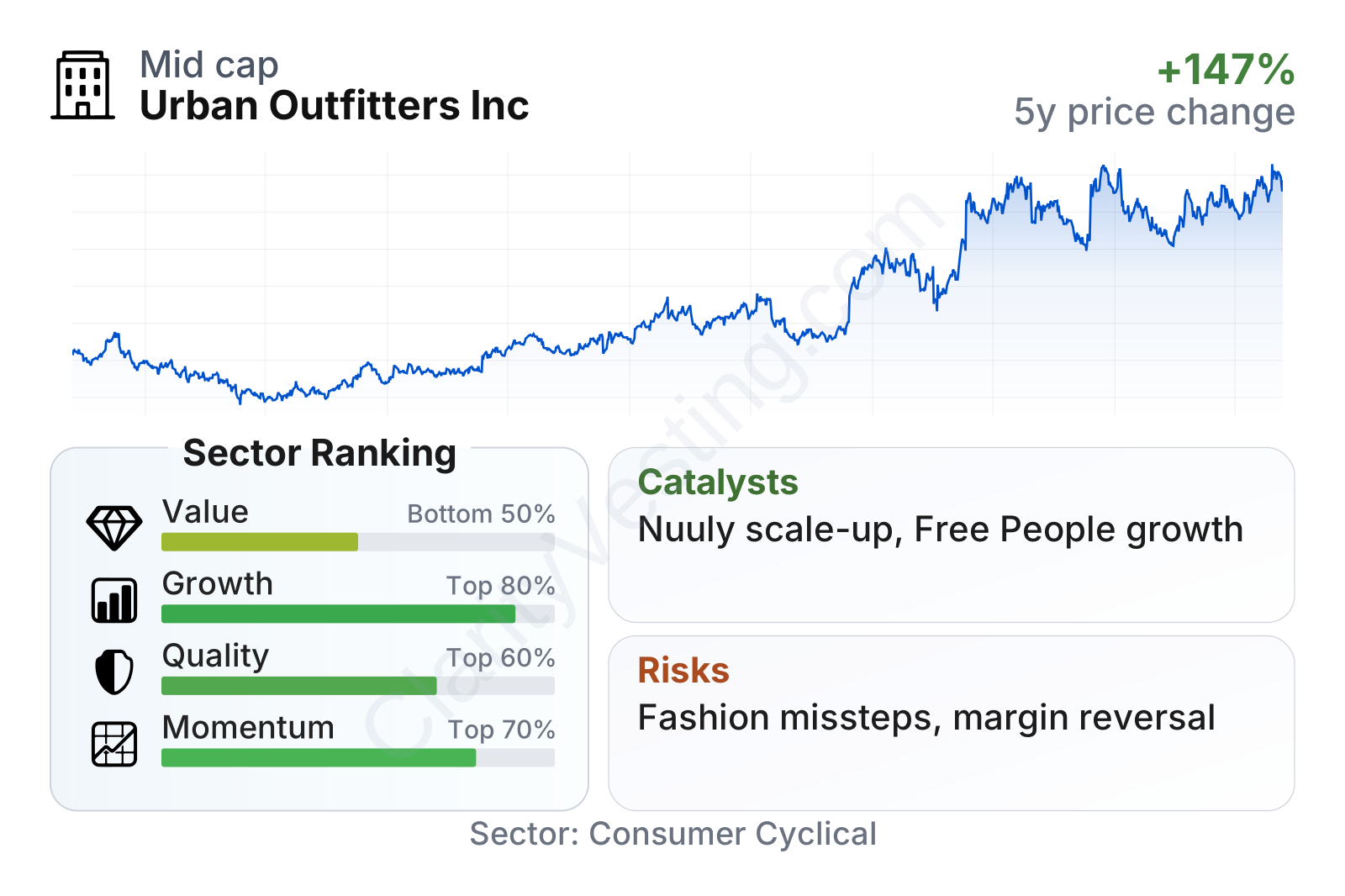
Urban Outfitters is a mid-sized public retailer with a market value in the multi-billion-dollar range, so it is large enough to have national scale but still small enough for individual brands or initiatives to noticeably affect results. The metrics point to a business with above-average growth, decent quality, and solid recent market performance, while the value profile is mixed rather than clearly cheap across every measure.
Growth stands out the most. Revenue growth is running above the sector median, earnings per share have compounded well over five years, and free cash flow has expanded much faster than many peers. Quality is also respectable, with return on invested capital in the high teens and leverage below sector norms. On valuation, the earnings multiple sits below the sector median, but cash flow yield is not especially low-cost relative to peers, which suggests the market is giving some credit for the company’s stronger recent execution.
Growth
Urban Outfitters operates in apparel and lifestyle retail, a sector that does not usually deliver rapid industry-wide growth on its own. It is a mature and highly competitive market. That means company-specific execution matters more than broad sector tailwinds. In this case, Urban Outfitters has several credible growth levers: brand mix, digital sales, international expansion, wholesale partnerships, and especially Nuuly.
One of the clearest positives is that growth has been fairly steady rather than driven by a single rebound quarter. Year-over-year revenue gains have remained around the low-double-digit range recently, which is stronger than many apparel retailers have been able to sustain in a tougher consumer environment.
The stronger brand portfolio is central to this trend. Anthropologie and Free People have been the company’s most reliable growth brands, supported by product breadth, better full-price selling, and customer loyalty. Free People also benefits from wholesale distribution, which gives it exposure beyond the company’s own stores and websites. That creates another path for scale without requiring the same level of capital as store expansion.
Nuuly is the most distinct catalyst. Apparel rental remains a niche within fashion, but it offers recurring revenue, higher customer engagement, and a different relationship with inventory than standard retail. Management has continued to highlight subscriber growth and investments in fulfillment capacity. If Nuuly keeps scaling while maintaining healthy unit economics, it could become more than a side business and gradually change how the market views the company.
Cash generation adds another important layer to the growth case. After a negative period in fiscal 2023, free cash flow rebounded sharply and has remained around the $300 million level. That gives the company flexibility to invest in technology, logistics, new stores, distribution capacity, and shareholder returns without relying heavily on debt.
A recent strategic development is the announced acquisition of Liberated Brands’ North America wholesale and e-commerce operations for brands including Volcom, Billabong, and Quiksilver. Urban Outfitters said the business will operate under its Nuuly segment. This is notable because it can increase Nuuly’s access to product, support resale and rental economics, and broaden its operating capabilities. It also shows management is willing to use targeted deals to strengthen newer business lines instead of relying only on traditional store growth.
Overall, the company appears to be growing through a combination of strong brand execution and newer models that fit changing consumer behavior, especially around digital engagement, flexibility, and reuse.
Risks
This article is for informational purposes only and does not constitute financial advice. Some content is AI-generated. See Disclaimer


