Stock Analysis · Upwork Inc (UPWK)
Overview
Upwork Inc operates an online marketplace that connects businesses with independent professionals for project-based, hourly, and longer-term work. Companies use the platform to find talent in areas such as software development, design, writing, marketing, customer support, and administrative services. Freelancers use it to win work, manage contracts, track time, communicate with clients, and receive payments. In simple terms, Upwork is a digital middleman that helps organize remote work between clients and skilled workers around the world.
The business model is mainly based on taking a share of activity that happens on the platform and charging for related services. Based on company filings, revenue is centered on marketplace activity, with smaller contributions from premium and ancillary offerings.
- Marketplace revenue: approximately 85% to 90% of total revenue. This includes service fees tied to freelancer-client contracts and other monetization linked to gross services volume on the platform.
- Managed services and enterprise-related offerings: approximately 5% to 10%. This includes solutions for larger organizations that want more hands-on support, compliance, sourcing, and workforce management.
- Ads, subscriptions, and other services: approximately 5%. This includes freelancer memberships, connects, and promotional tools that help users improve visibility or access more opportunities.
Over the last several years, the company’s revenue has grown from a little above $500 million to nearly $800 million annually, while gross profit has expanded faster than direct costs. Another notable change is profitability: the business moved from operating losses in 2021 and 2022 to positive operating income and net income in 2023 through 2025. That shift matters because it suggests Upwork is no longer relying only on scale hopes; it has also shown it can turn platform activity into earnings and cash flow.
Key Figures
| Metric | Value | Sector ⓘ |
|---|---|---|
| Date | Sep 12, 2026 | |
| Context | ||
| Sector | Communication Services | |
| Industry | Internet Content & Information | |
| Market Cap ⓘ | $1.09B | |
| Beta ⓘ | 1.01 | |
Value (Cheapness) | ||
| P/E Ratio ⓘ | 10.77 | 18.61 |
| FCF Yield ⓘ | 18.29% | 13.68% |
| EBIT / EV ⓘ | 17.25% | 4.54% |
| PEG ⓘ | 0.98 | |
Growth (Business expansion) | ||
| Revenue Growth ⓘ | -1.70% | 5.40% |
| RPS Growth (5Y CAGR) ⓘ | 9.34% | 4.62% |
| EPS Growth (5Y CAGR) ⓘ | N/A | -18.01% |
| Margin Growth (5Y Trend) ⓘ | 28.62% | 1.10% |
| FCF Growth (5Y CAGR) ⓘ | 168.02% | 5.88% |
Quality (Business durability) | ||
| ROIC (Latest) ⓘ | 10.56% | 8.38% |
| ROIC (5Y Median) ⓘ | 6.05% | 8.32% |
| Net Debt / EBIT (Latest) ⓘ | -0.72 | 1.99 |
| Net Debt / EBIT (5Y Median) ⓘ | 0.68 | 2.94 |
| Operating Margin (Latest) ⓘ | 17.81% | 14.89% |
| Operating Margin (5Y Median) ⓘ | 7.09% | 12.96% |
| Debt to Equity (Latest) ⓘ | 61.36% | 59.59% |
| Profit Margin (Latest) ⓘ | 12.94% | 8.77% |
| Free Cash Flow (Latest) ⓘ | $199.23M | |
Momentum (Price trend) | ||
| 3Y Return ⓘ | -36.30% | +46.64% |
| 12M Return (excl. last month) ⓘ | -38.55% | +2.16% |
| 6M Return ⓘ | -26.48% | +5.05% |
| Price vs. 200-Day MA ⓘ | -31.19% | +2.88% |
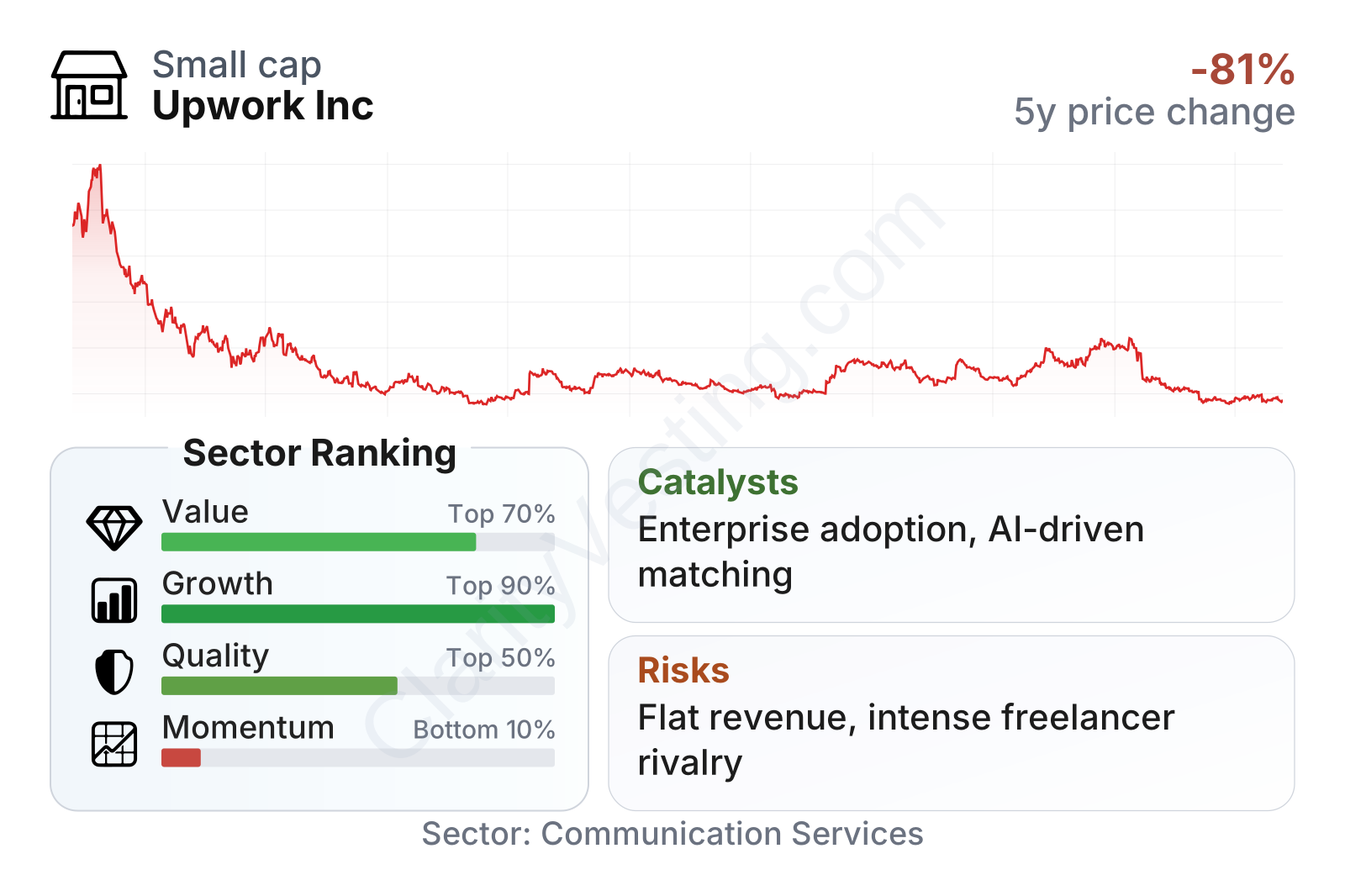
Upwork sits in the small-cap range, with share-price behavior that has been volatile rather than defensive. The stock has fallen sharply from its 2021 highs and recent momentum is weak versus much of its sector, even though the underlying business has become more profitable. The latest factor snapshot points to an unusual mix: value metrics look comparatively strong, growth metrics are helped by longer-term improvement in revenue per share, margins, and free cash flow, while quality is more mixed and recent market sentiment remains clearly soft.
Growth
Upwork operates in a sector with long-term structural support. Remote work, digital collaboration, flexible staffing, and global access to talent have all become more normal for companies of different sizes. Even if hiring cycles fluctuate, the broader direction still favors platforms that reduce friction between businesses and independent workers. This does not mean growth will be smooth every quarter, but it does mean the company is positioned in a market that is likely to remain relevant for years.
The recent growth profile is more complicated. Revenue growth was very strong in 2021 and 2022, then slowed materially, and the latest year-over-year comparison turned slightly negative. That slowdown shows the platform is no longer in its easy expansion phase. However, a softer top line has been paired with major improvement in operating discipline, which has allowed earnings and free cash flow to rise much faster than revenue.
One of the more encouraging features is cash generation. Free cash flow has improved from negative territory to well above $200 million on a trailing basis. For a platform business, that is important because it shows the company can convert a large share of its gross profit into cash after operating needs and capital spending.
Management’s strategy for future growth appears to center on three areas: expanding adoption among larger enterprise customers, improving matching and workflow tools with artificial intelligence, and increasing monetization per user through premium products and advertising features. This approach is logical. Enterprise clients can bring larger and more repeatable spending, AI tools can make it easier to match talent with projects and increase conversion, and additional paid features can raise revenue without depending only on overall marketplace volume.
A meaningful catalyst is the continued shift toward outcome-based and flexible work arrangements. As companies try to control labor costs and access specialized skills faster, platforms like Upwork can become part of standard workforce planning rather than an occasional hiring tool. Another important opportunity is AI-related demand itself: many businesses need freelancers for AI model support, data work, prompt engineering, software integration, and related digital services. If that demand remains active, Upwork could benefit both from direct project volume and from using AI internally to improve the user experience.
Risks
This article is for informational purposes only and does not constitute financial advice. Some content is AI-generated. See Disclaimer