Stock Analysis · Unusual Machines Inc (UMAC)
Overview
Unusual Machines Inc is a small technology company focused on the drone market. Based on its public filings and investor materials, the company is building a business around drone components, drone-related equipment, and branded consumer and enterprise drone products. Its strategy is tied to the idea that demand for unmanned aerial systems should expand over time across recreation, industrial inspection, public safety, and defense-related uses.
The company’s revenue base is still relatively small, but recent filings show a clear shift from a very early-stage operation toward a more commercial business with real product sales. For the fiscal year ended September 30, 2025, revenue was a little above $11 million, up from about $5.6 million in fiscal 2024. Public disclosures indicate that the business is mainly product-driven rather than subscription-based or service-heavy.
The available filings do not provide a highly detailed public revenue split by product line that is consistent enough to assign precise percentages across all categories. Still, the business can be described through its main economic activities:
- Drone components and electronics: the core activity appears to center on parts and systems used in drones, including flight-related electronics and hardware sold into the drone ecosystem.
- Branded drone products and equipment: sales also include finished or packaged drone-related products sold under company-owned or controlled brands.
- Other accessory and related sales: a smaller share likely comes from complementary accessories and adjacent hardware offerings tied to drone use.
One notable point in the company’s cost structure is that revenue has been rising faster than gross profit in absolute terms, but gross margin improved materially from fiscal 2024 to fiscal 2025. At the same time, operating expenses expanded sharply, especially selling, general, and administrative costs, which means scale has not yet translated into profitability.
The business has clearly moved beyond a pre-revenue stage, but it is still in the phase where commercial expansion and corporate buildout are consuming far more resources than the current revenue base can support.
Key Figures
| Metric | Value | Sector ⓘ |
|---|---|---|
| Date | Nov 16, 2026 | |
| Context | ||
| Sector | Technology | |
| Industry | Computer Hardware | |
| Market Cap ⓘ | $585.56M | |
| Beta ⓘ | 14.97 | |
Value (Cheapness) | ||
| P/E Ratio ⓘ | N/A | 26.57 |
| FCF Yield ⓘ | -15.43% | 3.74% |
| Dividend Yield ⓘ | N/A | 1.36% |
| EBIT / EV ⓘ | -9.82% | 3.90% |
| PEG ⓘ | N/A | |
Growth (Business expansion) | ||
| Revenue Growth ⓘ | 551.30% | 17.65% |
| RPS Growth (5Y CAGR) ⓘ | 403.27% | 8.55% |
| EPS Growth (5Y CAGR) ⓘ | -20.27% | -6.27% |
| Margin Growth (5Y Trend) ⓘ | N/A | 0.58% |
| FCF Growth (5Y CAGR) ⓘ | N/A | 9.93% |
| DPS Growth (5Y CAGR) ⓘ | N/A | 8.22% |
Quality (Business durability) | ||
| ROIC (Latest) ⓘ | -7.97% | 10.26% |
| ROIC (5Y Median) ⓘ | N/A | 8.26% |
| Net Debt / EBIT (Latest) ⓘ | N/A | 0.63 |
| Net Debt / EBIT (5Y Median) ⓘ | N/A | 0.51 |
| Net Debt / EBITDA (Latest) ⓘ | N/A | 0.36 |
| Net Debt / Assets ⓘ | -41.46% | 3.99% |
| EBITDA / Interest ⓘ | N/A | 13.53 |
| Operating Margin (Latest) ⓘ | -74.02% | 10.51% |
| Operating Margin (5Y Median) ⓘ | -224.59% | 8.51% |
| Debt to Equity (Latest) ⓘ | 1.01% | 34.34% |
| Profit Margin (Latest) ⓘ | -75.91% | 7.49% |
| Free Cash Flow (Latest) ⓘ | -$90.33M | |
Momentum (Price trend) | ||
| 3Y Return ⓘ | +272.28% | +41.26% |
| 12M Return (excl. last month) ⓘ | +16.57% | +11.56% |
| 6M Return ⓘ | -33.37% | +0.13% |
| Price vs. 200-Day MA ⓘ | -40.57% | +0.19% |
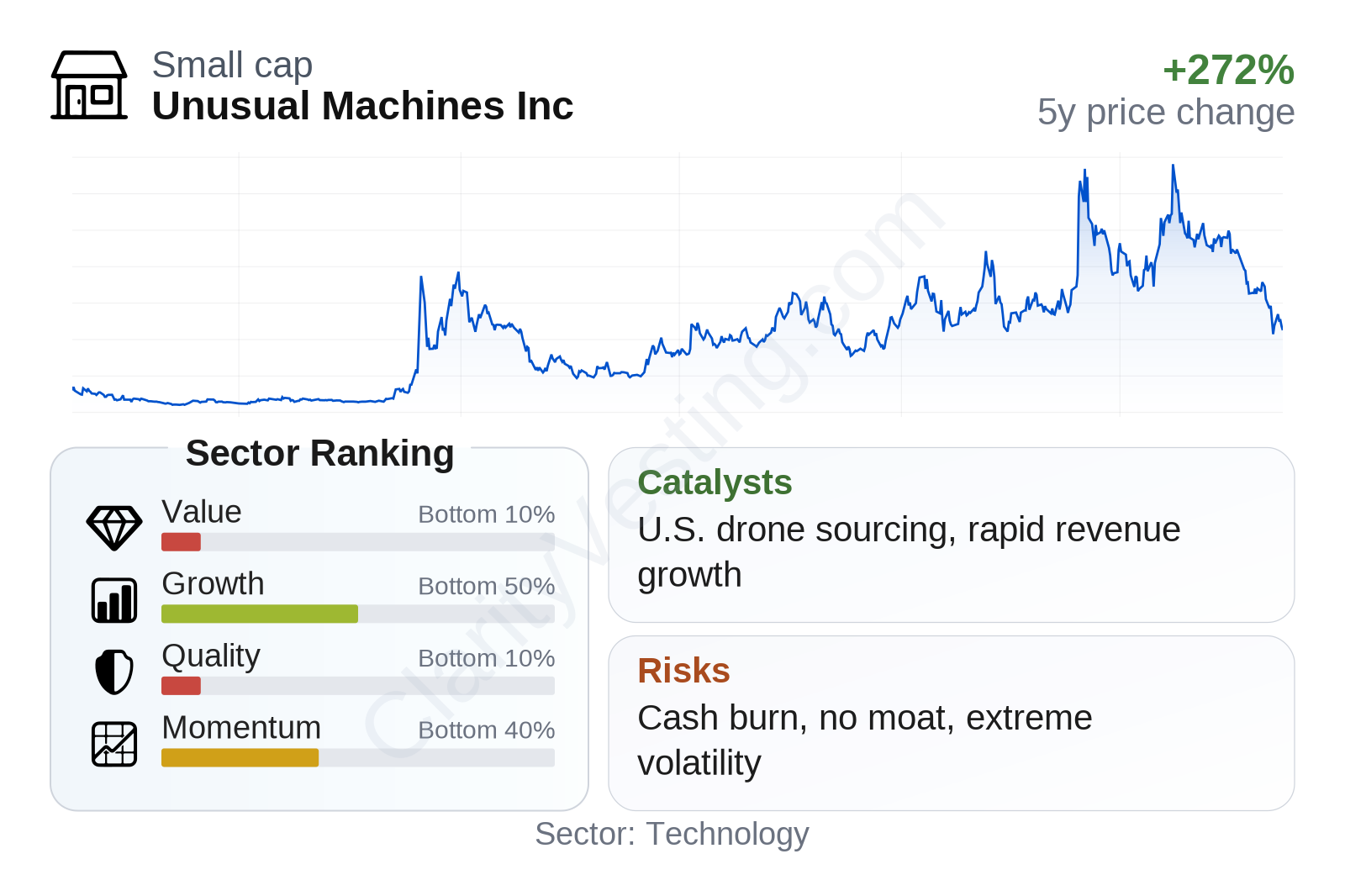
The table presents a mixed profile. Growth has been unusually strong on the top line, well above the sector median, but value and quality metrics rank near the bottom of the technology sector because the company remains loss-making and cash flow is negative. The company is also very small by market capitalization standards and the stock has shown exceptional volatility, with a beta near 15, which is far outside the range of a typical hardware business.
The share-price history reflects that instability. The stock moved from very low single digits in 2024 to much higher levels in 2025 and 2026, with large swings along the way. That kind of movement usually signals a company whose market value is being driven not only by business progress, but also by changing sentiment, expectations, and liquidity conditions.
Growth
Unusual Machines operates in a market with real long-term expansion potential. Drones are gradually becoming more useful in infrastructure inspection, agriculture, mapping, security, logistics testing, and defense-linked applications. That creates room for suppliers of hardware, electronics, and related systems, especially if customers increasingly look for domestic or non-Chinese supply options in sensitive categories.
The company’s strategy broadly makes sense within that backdrop. Rather than trying to compete immediately as a large-scale full-platform manufacturer, it is positioning itself around components, equipment, and drone-adjacent hardware where a smaller company may have a clearer path to niche relevance. For a business of this size, targeting selected parts of the value chain can be more realistic than trying to dominate the entire drone stack.
The strongest part of the current profile is revenue growth. Year-over-year growth has remained extremely high through 2026, even after earlier surges created difficult comparisons. That suggests the company is still adding customers, products, acquisitions, or channels at a rapid pace. However, investors looking at long-term durability would need to separate acquisition-driven expansion from organic demand, because very fast growth at a small base can look dramatic without yet proving that the business model is mature.
Free cash flow tells a much less favorable story. Cash burn has worsened sharply, moving from a few million dollars negative to tens of millions negative on a trailing basis. That indicates the company is funding expansion well ahead of operating self-sufficiency. In other words, growth is real, but it is currently expensive growth.
A potentially important catalyst is the broader policy and industry push toward U.S.-based drone supply chains. If regulation, procurement preferences, or security concerns increasingly favor American-made components and systems, a company like Unusual Machines could find itself in a better competitive position than its current size would normally suggest. Recent public communications from the company have emphasized domestic drone capability and expansion efforts, which aligns with that industry trend.
Another positive sign is that the company has been able to scale revenue quickly in a short period. In small hardware businesses, commercial traction often matters more at this stage than polished profitability metrics. The key question is whether this early demand can eventually support healthier margins and recurring customer relationships.
Risks
This article is for informational purposes only and does not constitute financial advice. Some content is AI-generated. See Disclaimer