Stock Analysis · Ultra Clean Holdings Inc (UCTT)
Stock Analysis · Ultra Clean Holdings Inc (UCTT)

Overview

Ultra Clean Holdings is a supplier to the semiconductor manufacturing industry. In simple terms, it helps chipmakers and semiconductor equipment companies build and run the highly specialized systems used to make advanced chips. Its products and services support critical parts of the production chain, including subsystems, precision parts, fluid delivery systems, and outsourced tool assembly, as well as services used to clean, refurbish, and maintain manufacturing equipment.

The company mainly serves large semiconductor equipment manufacturers and chip fabrication customers. That means Ultra Clean is tied closely to the health of the chip industry rather than consumer demand directly. When chipmakers and equipment makers expand capacity, launch more advanced process technologies, or invest in new fabrication plants, Ultra Clean typically benefits through higher demand for components, assemblies, and related services.

Based on company filings, revenue is primarily generated from two broad segments.

  • Products – roughly the large majority of revenue, around 80% to 85%. This includes gas and chemical delivery modules, precision components, and outsourced subsystem and tool assembly used by semiconductor equipment manufacturers.
  • Services – roughly 15% to 20% of revenue. This includes cleaning, coating, refurbishment, analytical, and tool chamber services that support semiconductor manufacturing operations.

Geographically, the business is also global, with meaningful exposure to Asia, where much of the semiconductor manufacturing supply chain is concentrated. That international footprint is useful because major chip investment is spread across the U.S., Taiwan, South Korea, China, and Southeast Asia.

One notable feature of the business model is that Ultra Clean sits in an important middle layer of the semiconductor ecosystem. It is not the most famous name in chips, but it supplies the infrastructure behind leading-edge manufacturing. That positioning can create long-run opportunity, although it also makes results cyclical and heavily dependent on a relatively small number of very large customers.

The business has shown that it can scale to more than $2 billion in annual revenue during stronger parts of the semiconductor cycle, but recent years also show how quickly profitability can swing when volumes soften. Revenue recovered in 2024 after a 2023 downturn, yet the latest annual profile still points to a company with high production costs and earnings that remain sensitive to utilization and customer spending patterns.

Key Figures

MetricValueSector
DateJul 18, 2026
Context
SectorTechnology
IndustrySemiconductor Equipment & Materials
Market Cap $4.15B
Beta 1.83
Value
(Cheapness)
P/E Ratio N/A31.76
FCF Yield -1.06%4.18%
EBIT / EV -2.20%2.56%
PEG 1.21
Growth
(Business expansion)
Revenue Growth 2.90%13.50%
RPS Growth (5Y CAGR) -1.07%8.57%
EPS Growth (5Y CAGR) -51.81%-21.87%
Margin Growth (5Y Trend) -13.72%0.41%
FCF Growth (5Y CAGR) -44.26%9.76%
Quality
(Business durability)
ROIC (Latest) -24.79%8.54%
ROIC (5Y Median) 4.35%8.12%
Net Debt / EBIT (Latest) N/A0.38
Net Debt / EBIT (5Y Median) 2.560.38
Operating Margin (Latest) -5.35%9.58%
Operating Margin (5Y Median) 5.15%8.25%
Debt to Equity (Latest) 124.29%33.52%
Profit Margin (Latest) -9.38%6.96%
Free Cash Flow (Latest) -$44.00M
Momentum
(Price trend)
3Y Return +142.85%+30.91%
12M Return (excl. last month) +450.89%+28.90%
6M Return +113.17%+5.38%
Price vs. 200-Day MA +60.09%+7.61%
Better than sector median
Slightly worse than sector median
More than 20% worse than sector median

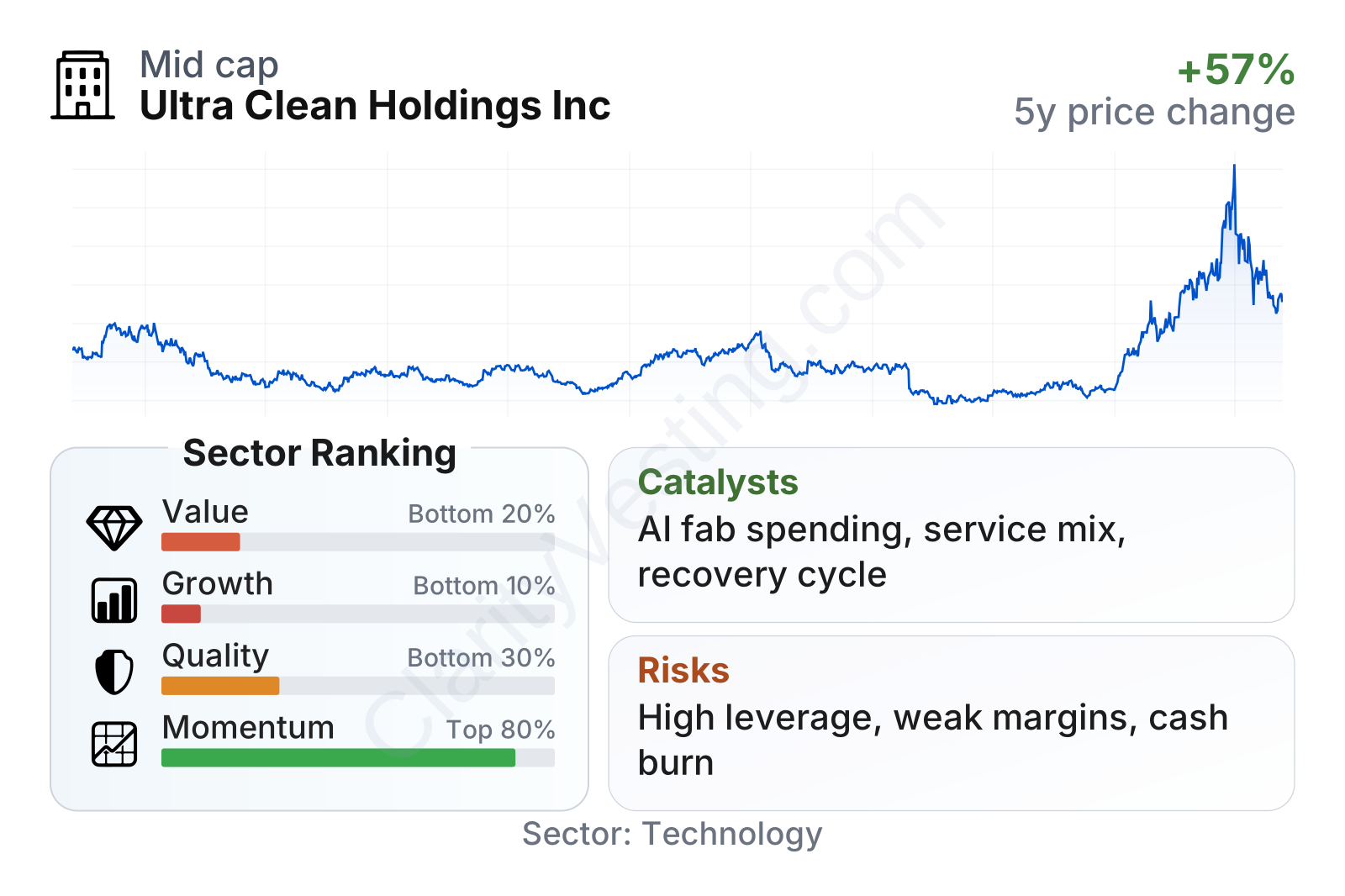
Ultra Clean currently sits in an unusual position: market momentum has been exceptionally strong, but most underlying business factors still rank below much of the broader technology sector. Growth and quality metrics remain weak relative to peers, while leverage is elevated and free cash flow has turned negative. In other words, the share price has improved far faster than the company’s recent operating profile, which raises the importance of watching whether fundamentals begin catching up.

With a market value around the mid-single-digit billions and a beta close to 2, the stock has historically been more volatile than the overall market. That is consistent with a supplier exposed to semiconductor capital spending, one of the more cyclical parts of technology.

Growth

The good news for Ultra Clean is that it operates in a sector with strong long-term demand drivers. Semiconductor content continues to rise across artificial intelligence infrastructure, cloud computing, automotive electronics, industrial automation, smartphones, and data centers. That does not guarantee smooth year-to-year results, but it supports a long runway for companies involved in semiconductor equipment and manufacturing support.

Ultra Clean’s strategy also makes industrial sense. Large equipment makers increasingly rely on specialized suppliers that can deliver complex subsystems, precision manufacturing, and global support services. As chipmaking becomes more advanced, contamination control, fluid handling accuracy, and manufacturing reliability become more important. These are areas where Ultra Clean has established capabilities and customer relationships.

Recent revenue trends show the main challenge clearly: the company has participated in the industry recovery, but the rebound has not been especially strong lately. Revenue growth was very high during the post-pandemic expansion, then turned sharply negative during the industry slowdown, recovered in 2024, and has since moderated again to low single digits. That pattern suggests the company is still tied closely to the cycle rather than yet showing a durable acceleration above it.

Cash generation tells a similar story. Free cash flow was healthy in earlier periods, then weakened materially and most recently moved back into negative territory. For a company in a capital-intensive and customer-concentrated industry, that matters because consistent cash generation is often what helps convert industry opportunity into durable shareholder value over time.

As for catalysts, the most important ones are tied to semiconductor equipment demand. Continued investment in advanced logic and memory, expansion of AI-related chip capacity, and new fab construction in the U.S. and Asia can all support higher demand for Ultra Clean’s products and services. The company has also emphasized operational improvements, manufacturing efficiency, and broadening customer engagement, which could help margins recover if volumes improve.

Recent company updates in 2026 have continued to frame demand around advanced-node and AI-related semiconductor spending. That is significant because Ultra Clean does not need to dominate the entire chip market to benefit; it mainly needs key customers to keep increasing equipment complexity and production activity.

Risks

The biggest risk is cyclicality. Ultra Clean depends heavily on semiconductor capital spending, which tends to move in waves. Customers can cut orders quickly when memory pricing weakens, fab utilization falls, or macro conditions become uncertain. That can lead to abrupt changes in revenue, margins, and cash flow.

Another major risk is customer concentration. The company’s own filings have long indicated that a limited number of large customers account for a substantial portion of revenue. This is common in the semiconductor equipment supply chain, but it means a design loss, a sourcing shift, or a slowdown at one major customer can have an outsized effect on results.

Balance-sheet risk has also increased. Debt to equity has climbed well above the sector norm and has risen sharply in the most recent periods. For a cyclical manufacturer, that is not ideal because weaker earnings can make leverage feel heavier very quickly. It does not automatically signal distress, but it reduces flexibility if the downturn lasts longer than expected.

Profitability is another pressure point. Net margin has deteriorated from modestly positive levels a few years ago to clearly negative territory recently, while the sector median has remained positive. That gap matters because it suggests Ultra Clean is not just facing a soft patch in demand; it is also dealing with a business mix and cost structure that have recently struggled to preserve earnings.

On competitive positioning, Ultra Clean has real strengths but is not the dominant leader across the full semiconductor equipment supply chain. Its advantages include long-standing customer relationships, process know-how in contamination-sensitive environments, global manufacturing and service capabilities, and a role embedded in customers’ production ecosystems. Those are meaningful barriers, since reliability matters greatly in semiconductor manufacturing. However, the company competes in specialized areas rather than owning the broadest or most defensible platform in the industry.

Main competitors vary by product and service line, but they include other semiconductor subsystem, precision component, fluid handling, and manufacturing service providers. In different niches, competition can come from companies such as Enpro, Ichor Holdings, MKS Instruments, VAT Group, and in-house capabilities at major customers. Compared with larger diversified peers, Ultra Clean is smaller, more concentrated, and more exposed to execution swings, though it can still be relevant where customers value specialized support and established integration experience.

No major public scandal or governance event stands out as a defining near-term reputation issue from recent company disclosures. The more important near-term risk appears operational and financial rather than reputational: weak profitability, negative free cash flow, and higher leverage arriving at a time when the industry recovery still looks uneven.

Valuation

Valuation is difficult to read cleanly right now because earnings have been weak or negative in several recent periods, which makes the price-to-earnings measure unstable and, at times, not very meaningful. That is why the stock can appear optically cheap in one period and impossible to judge by P/E in another. For cyclical companies like Ultra Clean, valuation often depends less on recent earnings and more on whether the market believes margins and cash flow will recover in the next upcycle.

The broader picture is mixed. On one hand, the stock’s recent price performance has been extremely strong, indicating the market is already anticipating a better future than the latest operating metrics show. On the other hand, the company’s value and quality measures still rank in the lower part of the sector, and free cash flow remains negative. That combination usually means the current valuation is leaning on recovery expectations rather than present-day business strength.

In that context, the current price looks easier to justify if one assumes a meaningful normalization in semiconductor equipment demand and a return to healthier margins. It looks harder to justify if revenue remains sluggish and profitability stays under pressure. So the valuation case depends heavily on execution and cycle recovery, not on already-established financial strength.

Conclusion

Ultra Clean Holdings operates in an attractive long-term industry and occupies a useful position inside the semiconductor manufacturing supply chain. The company benefits from exposure to chip fabrication complexity, advanced-node investment, and the rising need for specialized subsystems and contamination-sensitive services. Those are credible long-run positives, and they help explain why the market has recently become more optimistic.

At the same time, the business is still showing clear signs of strain. Revenue growth has slowed again after a recovery phase, free cash flow has turned negative, margins are under pressure, and leverage has moved up well above typical sector levels. That leaves the company looking more like a recovery candidate tied to a favorable industry backdrop than a financially solid compounder at this stage.

The overall picture is constructive on the industry opportunity but more cautious on current fundamentals. Ultra Clean appears well placed to participate if semiconductor equipment spending strengthens further, yet the recent stock rebound already reflects a meaningful amount of that hope. The central question now is not whether the company has exposure to a promising market, but whether it can translate that exposure into steadier margins, stronger cash generation, and a more resilient financial profile.

Sources:

  • Ultra Clean Holdings, Inc. – Annual Report on Form 10-K for fiscal year 2025
  • Ultra Clean Holdings, Inc. – Quarterly Report on Form 10-Q for quarter ended March 27, 2026
  • Ultra Clean Holdings, Inc. – Investor Relations press releases and earnings materials published in 2026
  • SEC EDGAR – Ultra Clean Holdings, Inc. filings database
  • Wikipedia – Ultra Clean Holdings basic company background

This article is for informational purposes only and does not constitute financial advice. Some content is AI-generated. See Disclaimer


Sign up for exclusive research and insights.

Unsubscribe anytime.
