Stock Analysis · Under Armour Inc A (UAA)
Overview
Under Armour is a global athletic apparel and footwear company. It designs, markets, and distributes performance clothing, shoes, and accessories aimed at athletes and active consumers. The brand is best known for compression apparel, training gear, and sports-focused products sold through wholesale partners, its own stores, and e-commerce platforms.
The business is mainly driven by product sales, with apparel still representing the largest category. Based on the company’s latest fiscal year disclosures, revenue is roughly split as follows:
- Apparel: about 65% — shirts, compression wear, outerwear, team sports gear, and other clothing.
- Footwear: about 20% — athletic shoes, especially training, running, and basketball products.
- Accessories: about 10% — bags, gloves, headwear, and similar items.
- Licensing and connected fitness/other: about 5% — royalty income and smaller non-core activities.
Revenue also comes from a mix of channels and regions. Wholesale remains the largest route to market, while direct-to-consumer sales through stores and digital channels are strategically important because they usually offer better margins and tighter control over branding. Geographically, North America is still the core market, but international operations remain meaningful, especially in EMEA, Asia-Pacific, and Latin America.
What stands out in recent years is that the company is in the middle of a reset rather than an expansion phase. Revenue has moved down from earlier peaks, gross profit has compressed, and operating income has turned negative. The business still has meaningful scale, but its current profile reflects a brand rebuilding effort rather than a smooth growth cycle.
The operating picture has weakened noticeably over the last few fiscal years. Sales have fallen from the upper-$5 billion range toward about $5 billion, while gross profit has declined faster than revenue. Cost controls helped in some periods, but they have not been enough to prevent operating losses more recently.
Key Figures
| Metric | Value | Sector ⓘ |
|---|---|---|
| Date | Sep 19, 2026 | |
| Context | ||
| Sector | Consumer Cyclical | |
| Industry | Apparel Manufacturing | |
| Market Cap ⓘ | $2.13B | |
| Beta ⓘ | 1.62 | |
Value (Cheapness) | ||
| P/E Ratio ⓘ | N/A | 17.10 |
| FCF Yield ⓘ | -3.80% | 8.82% |
| EBIT / EV ⓘ | N/A | 6.54% |
| PEG ⓘ | 1.26 | |
Growth (Business expansion) | ||
| Revenue Growth ⓘ | -3.20% | 6.00% |
| RPS Growth (5Y CAGR) ⓘ | -1.79% | 9.17% |
| EPS Growth (5Y CAGR) ⓘ | -52.71% | -17.84% |
| Margin Growth (5Y Trend) ⓘ | -12.70% | -0.42% |
| FCF Growth (5Y CAGR) ⓘ | -6.39% | 4.86% |
Quality (Business durability) | ||
| ROIC (Latest) ⓘ | N/A | 12.15% |
| ROIC (5Y Median) ⓘ | 13.25% | 10.76% |
| Net Debt / EBIT (Latest) ⓘ | N/A | 2.10 |
| Net Debt / EBIT (5Y Median) ⓘ | 2.23 | 2.31 |
| Operating Margin (Latest) ⓘ | N/A | 9.12% |
| Operating Margin (5Y Median) ⓘ | 4.60% | 9.57% |
| Debt to Equity (Latest) ⓘ | 96.36% | 75.99% |
| Profit Margin (Latest) ⓘ | -9.99% | 5.30% |
| Free Cash Flow (Latest) ⓘ | -$81.12M | |
Momentum (Price trend) | ||
| 3Y Return ⓘ | -31.65% | +12.81% |
| 12M Return (excl. last month) ⓘ | +3.35% | +2.42% |
| 6M Return ⓘ | -20.13% | +1.10% |
| Price vs. 200-Day MA ⓘ | -18.19% | -2.66% |
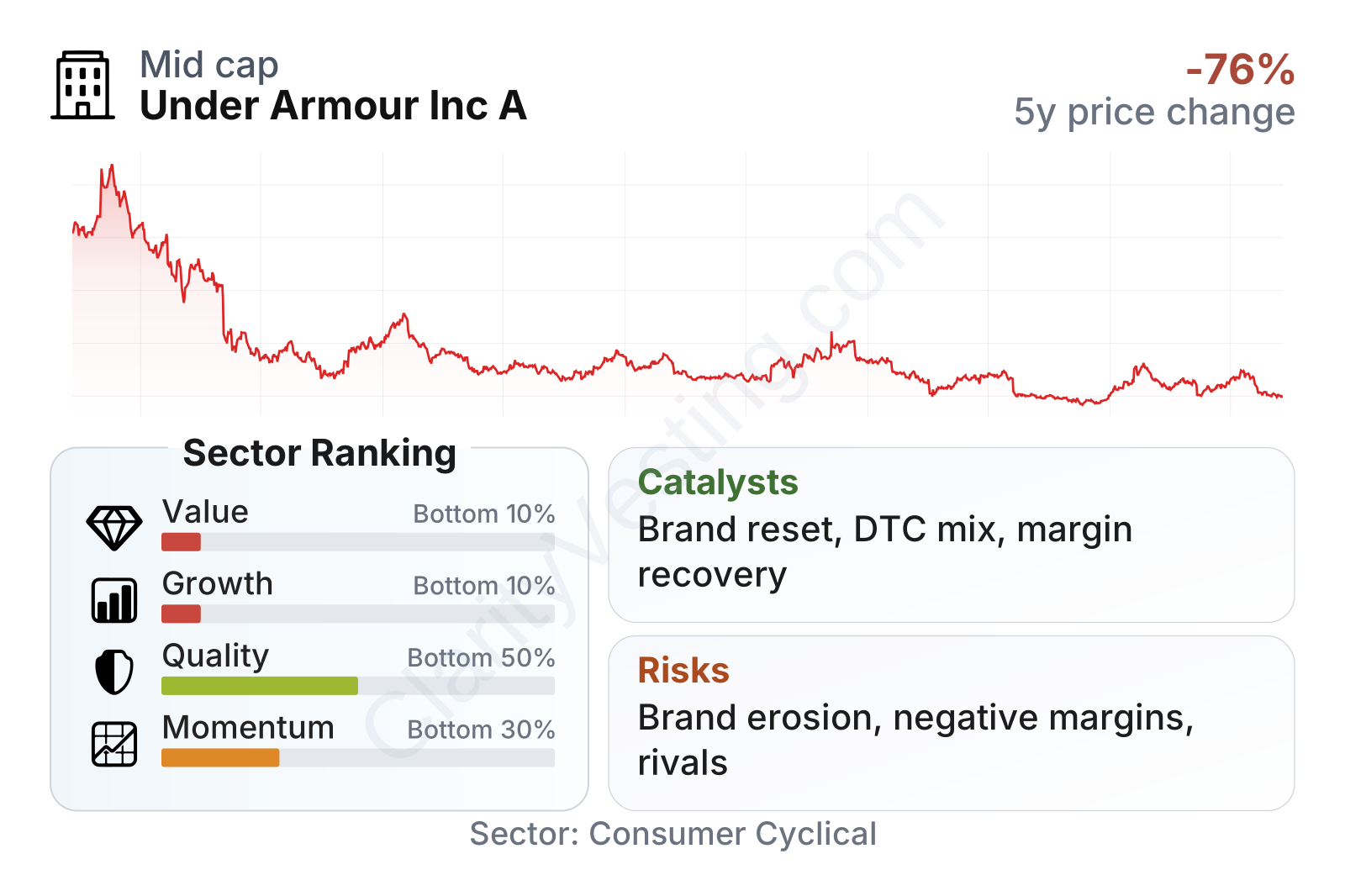
Under Armour is a mid-sized public company with a stock that has been more volatile than the broader market, as shown by its beta above 1.5. The broader factor profile is weak: value and growth both rank near the bottom of the sector, momentum is also below average, and quality is only around the lower half. One of the clearest pressure points is cash generation, with free cash flow currently negative and profitability metrics trailing the sector by a wide margin.
The stock price history reflects that unstable operating backdrop. Shares have fallen sharply from 2021 levels and have remained choppy, which is typical of companies going through a turnaround where confidence depends heavily on execution.
Growth
The athletic apparel and footwear market is still attractive over the long term. Health, fitness, athleisure, women’s sports, and global sports participation remain supportive industry trends. In that sense, Under Armour operates in a sector with durable demand drivers. The challenge is not whether the category can grow, but whether the company can reclaim relevance and profitable market share within it.
Management’s current strategy is centered on brand elevation, tighter product focus, cleaner inventory, reduced discounting, and sharper distribution discipline. That approach makes strategic sense for a sportswear brand that had seen margin pressure and inconsistent positioning. In simple terms, the company appears to be trying to sell fewer, better-positioned products rather than chase revenue at the expense of brand value.
Recent revenue trends show why this remains a rebuilding case. Year-over-year sales growth has been negative in most recent periods, often by low- to mid-single-digit percentages and at times worse. That suggests the company is still shrinking while it reorganizes the business. For long-term analysis, the key question is whether this contraction is temporary and intentional, or a sign of deeper brand weakness.
Cash generation has also been uneven. Free cash flow swung from strongly positive to negative, then briefly recovered, and has turned negative again. That pattern matters because a turnaround is much easier when a company consistently funds itself internally. Until free cash flow stabilizes, future progress depends more heavily on disciplined execution and balance sheet management.
A potentially important catalyst is leadership and operational reset. Under Armour has been refining its restructuring efforts, including cost actions and a stronger focus on premium brand presentation. If that leads to better full-price selling, improved product appeal, and healthier wholesale relationships, margins could recover faster than revenue. Another opportunity is international expansion, where the brand still has room to improve penetration compared with larger rivals.
Recent company updates have also emphasized restructuring and transformation efforts rather than aggressive expansion. That is significant: near-term upside depends less on opening a new growth engine and more on restoring the economics of the existing business.
Risks
This article is for informational purposes only and does not constitute financial advice. Some content is AI-generated. See Disclaimer