Stock Analysis · Under Armour Inc C (UA)
Overview
Under Armour is a sportswear company that designs, markets, and sells performance apparel, footwear, and accessories. Its products target athletes and active consumers, with a brand built around training, running, team sports, and fitness. The company sells through wholesale partners such as sporting goods retailers and department stores, and also through its own direct-to-consumer channels, including stores and e-commerce.
Its revenue mix is primarily driven by product category, with apparel still the largest business even as footwear and direct sales remain important to the brand’s long-term positioning. Based on recent annual filings, the revenue base can be summarized approximately as follows:
- Apparel: about 63% of revenue. This includes shirts, hoodies, shorts, outerwear, and other performance clothing.
- Footwear: about 23% of revenue. This covers athletic shoes for training, running, basketball, and cleated sports.
- Accessories: about 9% of revenue. This includes bags, headwear, gloves, and related gear.
- Licensing and other: about 5% of revenue. This generally includes brand licensing and smaller ancillary activities.
Revenue can also be viewed by channel. Wholesale remains the larger source, while direct-to-consumer is strategically important because it typically offers better control over pricing, customer relationships, and brand presentation. In recent periods, wholesale represented roughly 60% to 65% of sales, direct-to-consumer roughly 30% to 35%, and licensing plus other revenue the remainder.
Geographically, North America is still the largest market, but the company also operates internationally across EMEA, Asia-Pacific, and Latin America. That international presence gives Under Armour room to grow, although it is still much smaller globally than the largest athletic brands.
Operationally, the recent picture is weaker than it was a few years ago. Annual revenue has fallen from around $5.7 billion to just under $5.0 billion over the latest trailing period, while gross profit has also declined. The business is still large and globally recognized, but it is in the middle of a reset rather than a smooth expansion phase.
The financial profile has become less favorable over time: revenue and gross profit have both contracted since their earlier highs, and operating income has shifted from positive levels to a loss. That matters because the brand still carries substantial operating costs, especially selling and administrative expenses.
Key Figures
| Metric | Value | Sector ⓘ |
|---|---|---|
| Date | Sep 12, 2026 | |
| Context | ||
| Sector | Consumer Cyclical | |
| Industry | Apparel Manufacturing | |
| Market Cap ⓘ | $2.14B | |
| Beta ⓘ | 1.62 | |
Value (Cheapness) | ||
| P/E Ratio ⓘ | N/A | 17.10 |
| FCF Yield ⓘ | -3.78% | 8.53% |
| EBIT / EV ⓘ | N/A | 6.46% |
| PEG ⓘ | 1.22 | |
Growth (Business expansion) | ||
| Revenue Growth ⓘ | -3.20% | 5.75% |
| RPS Growth (5Y CAGR) ⓘ | -2.84% | 9.14% |
| EPS Growth (5Y CAGR) ⓘ | -52.71% | -18.21% |
| Margin Growth (5Y Trend) ⓘ | -8.23% | -0.23% |
| FCF Growth (5Y CAGR) ⓘ | -6.39% | 4.91% |
Quality (Business durability) | ||
| ROIC (Latest) ⓘ | N/A | 12.61% |
| ROIC (5Y Median) ⓘ | 4.01% | 10.72% |
| Net Debt / EBIT (Latest) ⓘ | N/A | 2.10 |
| Net Debt / EBIT (5Y Median) ⓘ | N/A | 2.32 |
| Operating Margin (Latest) ⓘ | N/A | 9.25% |
| Operating Margin (5Y Median) ⓘ | 0.58% | 9.64% |
| Debt to Equity (Latest) ⓘ | 96.36% | 75.78% |
| Profit Margin (Latest) ⓘ | -9.99% | 5.33% |
| Free Cash Flow (Latest) ⓘ | -$81.12M | |
Momentum (Price trend) | ||
| 3Y Return ⓘ | -24.51% | +14.53% |
| 12M Return (excl. last month) ⓘ | +4.92% | +3.08% |
| 6M Return ⓘ | -20.67% | +0.55% |
| Price vs. 200-Day MA ⓘ | -13.79% | -0.54% |
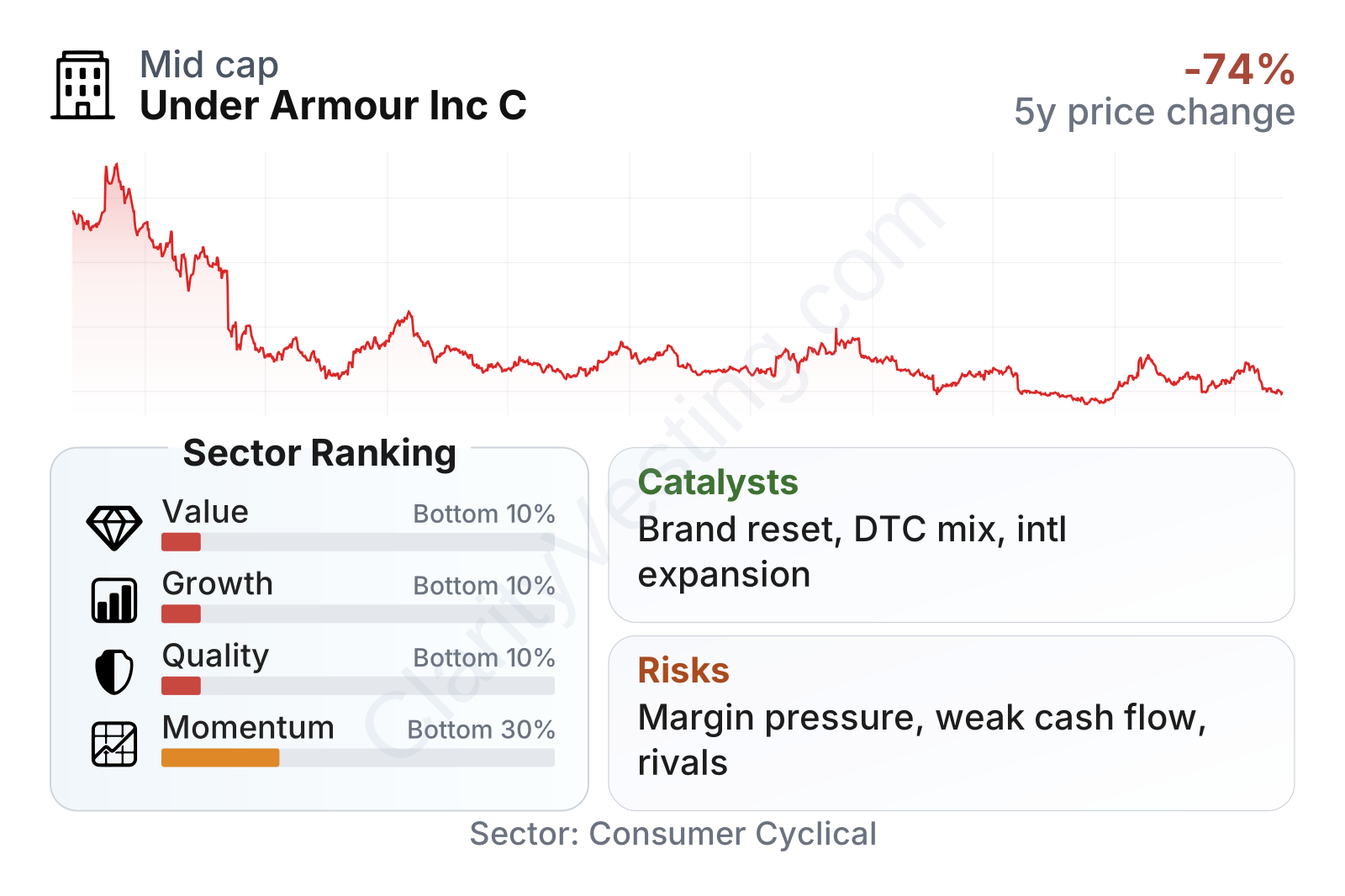
Under Armour currently screens weak on value, growth, and quality relative to most companies in its sector, while recent share-price momentum has improved. The company is now a mid-sized consumer brand with above-average stock volatility, negative free cash flow, and profitability metrics that sit well below sector norms. The recent rebound in the share price looks more like a recovery attempt than proof that the underlying business has fully stabilized.
Growth
The sporting goods and athletic apparel market is still an attractive sector over the long run. Consumers continue to spend on health, fitness, casual sportswear, and performance products, and these trends are supported by lifestyle shifts that extend beyond professional athletes. In that sense, Under Armour operates in a category with durable demand. The problem is not the sector itself, but the company’s recent execution within it.
Recent revenue trends show a business that has been shrinking rather than expanding. Year-over-year sales growth has been negative in most recent quarters, although the rate of decline has recently become less severe. That can be an early sign that the business is moving toward a more stable base, but it is not yet the same as clear renewed growth.
Management has been emphasizing a brand reset focused on tighter product assortments, less promotional activity, cleaner inventory, and stronger positioning in performance sports. That strategy makes sense in principle. For apparel brands, chasing revenue through discounting can hurt brand perception and margins, so a more disciplined approach can improve the business over time even if it weighs on short-term sales.
A potential catalyst is the effort to rebuild premium positioning in North America while expanding more selectively in international markets. Another is product execution: if new footwear franchises or refreshed apparel lines gain traction, Under Armour could improve both sales mix and pricing power. The company also benefits from broad consumer recognition, which means it does not need to build awareness from scratch.
Cash generation, however, remains a weak point. Free cash flow has been volatile and recently negative, which limits flexibility while the turnaround is underway.
The cash flow pattern suggests the business has not yet converted restructuring efforts into consistent financial improvement. A return to sustained positive free cash flow would be one of the clearest signs that the company’s strategy is translating into a healthier operating model.
Recent company updates have centered on restructuring, cost actions, and efforts to strengthen the brand under renewed leadership. The broader opportunity is real: if Under Armour can reconnect product, marketing, and distribution around a more distinctive performance identity, it still has a path to becoming a stronger player again. At this stage, though, that remains more of an operational objective than an accomplished result.
Risks
This article is for informational purposes only and does not constitute financial advice. Some content is AI-generated. See Disclaimer


