Stock Analysis · Texas Roadhouse Inc (TXRH)
Overview
Texas Roadhouse is a casual dining restaurant company best known for its Texas Roadhouse steakhouse chain, but it also operates the Bubba’s 33 sports bar and casual dining concept and the smaller Jaggers fast-casual brand. The business combines company-owned restaurants with a franchising model, although the great majority of sales come from locations the company operates itself. Its positioning is straightforward: large portions, value-oriented steak and American comfort food, and a lively in-restaurant experience built around traffic rather than premium pricing.
Revenue mainly comes from restaurant food and beverage sales, with a much smaller contribution from franchise and licensing fees. Based on recent annual reporting, the mix is approximately:
- Company restaurant sales: about 98% — food and beverage sales from company-owned Texas Roadhouse, Bubba’s 33, and Jaggers locations.
- Franchise royalties and fees: about 1% to 2% — royalties, initial fees, and other payments from franchised restaurants, mainly within the Texas Roadhouse system.
- Other revenue: less than 1% — smaller items such as certain licensing or ancillary income.
The business is still heavily centered on the Texas Roadhouse brand, while Bubba’s 33 is the main newer growth vehicle. That matters for long-term analysis because it means the company is not a broad restaurant conglomerate; it is a focused operator whose results depend mainly on brand strength, restaurant traffic, labor execution, food costs, and disciplined site expansion.
The long-term direction has been favorable: revenue has expanded materially over the last several years, operating income has also grown, and the company has converted that scale into stronger net income. One odd 2025 gross profit reading suggests a reporting classification issue or a temporary cost mix distortion, but the broader picture still points to a business that has been able to grow sales while staying profitable.
Key Figures
| Metric | Value | Sector ⓘ |
|---|---|---|
| Date | Sep 12, 2026 | |
| Context | ||
| Sector | Consumer Cyclical | |
| Industry | Restaurants | |
| Market Cap ⓘ | $11.90B | |
| Beta ⓘ | 0.79 | |
Value (Cheapness) | ||
| P/E Ratio ⓘ | 28.95 | 17.10 |
| FCF Yield ⓘ | 3.42% | 8.53% |
| EBIT / EV ⓘ | 3.81% | 6.46% |
| PEG ⓘ | 1.80 | |
Growth (Business expansion) | ||
| Revenue Growth ⓘ | 11.10% | 5.75% |
| RPS Growth (5Y CAGR) ⓘ | 15.64% | 9.14% |
| EPS Growth (5Y CAGR) ⓘ | -1.84% | -18.21% |
| Margin Growth (5Y Trend) ⓘ | -0.42% | -0.23% |
| FCF Growth (5Y CAGR) ⓘ | 6.28% | 4.91% |
Quality (Business durability) | ||
| ROIC (Latest) ⓘ | 27.69% | 12.61% |
| ROIC (5Y Median) ⓘ | 28.14% | 10.72% |
| Net Debt / EBIT (Latest) ⓘ | 1.82 | 2.10 |
| Net Debt / EBIT (5Y Median) ⓘ | 1.75 | 2.32 |
| Operating Margin (Latest) ⓘ | 7.81% | 9.25% |
| Operating Margin (5Y Median) ⓘ | 8.18% | 9.64% |
| Debt to Equity (Latest) ⓘ | 69.78% | 75.78% |
| Profit Margin (Latest) ⓘ | 6.63% | 5.33% |
| Free Cash Flow (Latest) ⓘ | $406.38M | |
Momentum (Price trend) | ||
| 3Y Return ⓘ | +88.31% | +14.53% |
| 12M Return (excl. last month) ⓘ | +23.30% | +3.08% |
| 6M Return ⓘ | +8.30% | +0.55% |
| Price vs. 200-Day MA ⓘ | +1.49% | -0.54% |
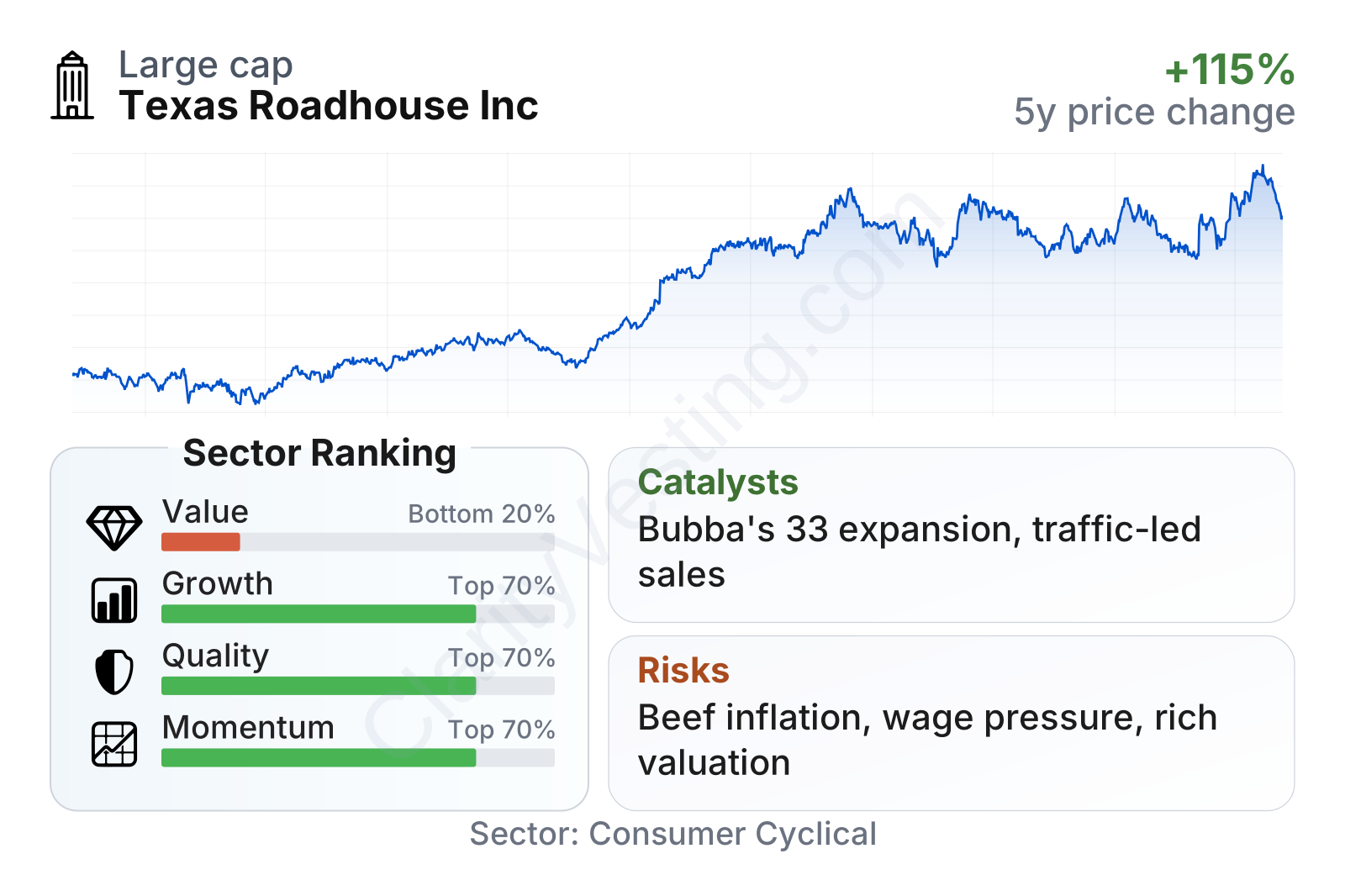
Texas Roadhouse is a mid-to-large public restaurant company with a market value in the low teens of billions of dollars and a stock that has been less volatile than the broader market, reflected in a beta below 1. In the factor breakdown, the business looks strong on quality, above average on growth, and solid on momentum, while valuation is the weakest area. In simple terms, the market is paying a premium for a company that has executed well operationally and financially.
The share price trend over the last several years has been strong despite periodic pullbacks, which fits with the company’s durable traffic, restaurant expansion, and profit growth. The table also shows a meaningful contrast: returns on invested capital are far above the sector median and leverage is lower than many restaurant peers, yet the earnings multiple and cash flow yield are less favorable than sector norms. That combination often describes a high-quality operator that already has a lot of good news reflected in the stock.
Growth
The restaurant industry is mature, but Texas Roadhouse operates in a part of the market that can still grow through unit expansion, market share gains, and consistent guest traffic. Casual dining has been a difficult category for many chains, yet Texas Roadhouse has stood out by keeping its value perception strong and maintaining demand even when consumers have become more selective. That makes the company’s growth profile more attractive than the category headline might suggest.
Recent revenue growth has remained above the sector median, with year-over-year gains still running around the low double digits lately. Over a five-year period, revenue per share growth has also outpaced much of the restaurant group. This suggests growth is not coming from financial engineering alone; it is being supported by real business expansion, including new restaurant openings and positive same-store sales trends.
The company’s strategy for future growth is coherent. Texas Roadhouse continues opening new restaurants under its main banner, while Bubba’s 33 appears to be an important second leg of expansion. Bubba’s 33 gives the company another concept that can use similar operating know-how while addressing a somewhat different dining occasion. Jaggers is still much smaller, so it is not yet a major earnings driver, but it gives management an additional option over time.
Cash generation supports that expansion plan. Free cash flow has improved meaningfully from earlier levels, even with normal fluctuations, which gives the company room to fund new units, invest in operations, and return capital to shareholders without depending heavily on debt. For a restaurant company, that is an important advantage because store growth can be expensive and consumer demand can change quickly.
A notable catalyst in recent company updates has been continued restaurant development and ongoing comparable sales momentum. In a sector where many brands rely mostly on menu price increases, Texas Roadhouse has generally been seen as a traffic-driven operator, which is usually a healthier sign for long-term brand strength. If the company keeps balancing pricing, guest traffic, and labor productivity better than peers, that could remain a significant opportunity.
Risks
This article is for informational purposes only and does not constitute financial advice. Some content is AI-generated. See Disclaimer


