Stock Analysis · Texas Instruments Incorporated (TXN)
Overview
Texas Instruments is a semiconductor company that designs and sells chips used to sense, manage, and move electronic signals and power inside everyday products. Unlike companies that are heavily exposed to smartphones or data center processors, Texas Instruments is focused mainly on the broad industrial and automotive markets. Its chips are found in factory equipment, cars, power systems, medical devices, building automation, personal electronics, and communications infrastructure.
The business is centered on analog semiconductors and embedded processing. Analog chips convert real-world signals such as sound, temperature, pressure, or power into electronic information, while embedded processors act as the control brains inside machines and devices. This positioning matters because these categories usually have long product life cycles, sticky customer relationships, and a very wide customer base spread across thousands of products.
Based on the company’s recent reporting structure, revenue comes mainly from the following areas:
- Analog semiconductors: about 78% of revenue. This is the core business and includes power management chips and signal chain products used in industrial equipment, vehicles, and many other electronic systems.
- Embedded processing: about 17% of revenue. This includes microcontrollers and processors that help devices perform control, sensing, and communication tasks.
- Other: about 5% of revenue. This category includes items such as DLP products and certain legacy or smaller product lines.
Texas Instruments also stands out for its manufacturing model. It produces a large share of its chips in-house rather than relying mainly on outside foundries. That gives it more control over cost, capacity, and supply over time, although it also requires heavy upfront investment. The financial flow over the last several years shows a business that remains highly profitable even after a cyclical downturn, but with lower earnings than the 2022 peak as the company kept spending on manufacturing capacity and research.
One notable pattern is that revenue and operating income peaked in 2022, fell meaningfully through 2023 and 2024, and then began to recover in 2025. Even during that weaker phase, Texas Instruments remained solidly profitable, which says a lot about the resilience of its business model.
Key Figures
| Metric | Value | Sector ⓘ |
|---|---|---|
| Date | Sep 12, 2026 | |
| Context | ||
| Sector | Technology | |
| Industry | Semiconductors | |
| Market Cap ⓘ | $245.39B | |
| Beta ⓘ | 1.31 | |
Value (Cheapness) | ||
| P/E Ratio ⓘ | 39.40 | 29.51 |
| FCF Yield ⓘ | 2.18% | 4.25% |
| EBIT / EV ⓘ | 2.45% | 2.85% |
| PEG ⓘ | 0.92 | |
Growth (Business expansion) | ||
| Revenue Growth ⓘ | 22.80% | 15.40% |
| RPS Growth (5Y CAGR) ⓘ | -0.30% | 8.56% |
| EPS Growth (5Y CAGR) ⓘ | -23.22% | -11.88% |
| Margin Growth (5Y Trend) ⓘ | -14.26% | 0.46% |
| FCF Growth (5Y CAGR) ⓘ | -19.81% | 9.80% |
Quality (Business durability) | ||
| ROIC (Latest) ⓘ | 19.14% | 9.44% |
| ROIC (5Y Median) ⓘ | 25.02% | 8.30% |
| Net Debt / EBIT (Latest) ⓘ | 1.57 | 0.54 |
| Net Debt / EBIT (5Y Median) ⓘ | 1.13 | 0.44 |
| Operating Margin (Latest) ⓘ | 36.36% | 9.58% |
| Operating Margin (5Y Median) ⓘ | 41.85% | 8.25% |
| Debt to Equity (Latest) ⓘ | 78.04% | 33.33% |
| Profit Margin (Latest) ⓘ | 31.11% | 7.14% |
| Free Cash Flow (Latest) ⓘ | $5.36B | |
Momentum (Price trend) | ||
| 3Y Return ⓘ | +79.09% | +45.48% |
| 12M Return (excl. last month) ⓘ | +47.05% | +23.48% |
| 6M Return ⓘ | +42.83% | +20.93% |
| Price vs. 200-Day MA ⓘ | +12.13% | +7.43% |
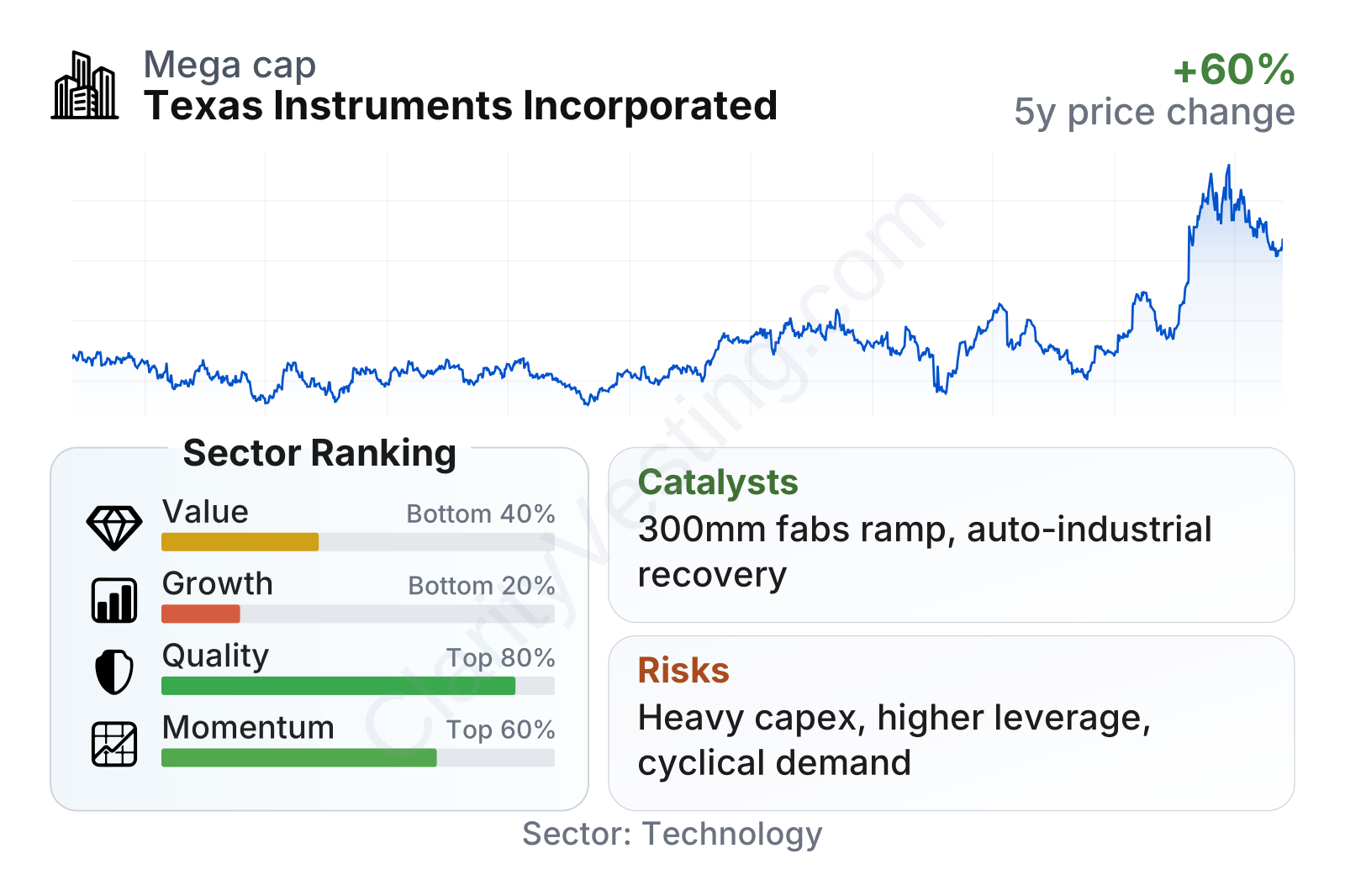
Texas Instruments is a very large semiconductor company with above-average share price volatility for a mature industrial chipmaker, though still within a normal range for the sector. The most striking feature in the metrics is the contrast between excellent business quality and weaker recent valuation and multi-year growth measures. Profitability remains far ahead of the sector median, especially in operating margin, profit margin, and return on invested capital. At the same time, the stock trades on a richer earnings multiple than the typical semiconductor company, while free cash flow yield looks less generous. Growth metrics have improved recently, but the longer five-year record still reflects the recent downturn and a period of heavy investment.
Growth
Texas Instruments operates in a sector with durable long-term demand. Semiconductor content keeps rising in cars, factory automation, energy systems, robotics, medical devices, and connected infrastructure. These are not short-lived trends. Vehicles need more sensors and power management, factories are becoming more automated, and power conversion is increasingly important as electrification expands. All of these areas play directly into Texas Instruments’ strengths in analog and embedded chips.
The company’s strategy is built around three ideas: focus on industrial and automotive markets, expand its own manufacturing base, and keep a broad catalog of products that can be sold for many years. That strategy is logical for long-range growth because customers in these end markets often value reliability, long supply commitments, and engineering support more than chasing the newest bleeding-edge chip node.
The revenue trend suggests that the downcycle has likely moved past its worst point. Sales growth turned negative during 2023 and much of 2024, then returned to positive territory and accelerated into 2025 and 2026. That does not erase the earlier weakness, but it does indicate improving demand and easier comparisons. It also helps explain why the market has recently rewarded the shares.
Cash generation tells a similar story, but with an important nuance. Free cash flow dropped sharply from 2022 levels as the company went through the cyclical slowdown while continuing to invest heavily in new manufacturing capacity. More recently, free cash flow has recovered to several billion dollars on a trailing basis. For a company like Texas Instruments, this is a key point: management is willing to absorb short-term pressure in order to build capacity that could support many years of future production.
A major catalyst is the company’s ongoing buildout of 300-millimeter wafer fabrication capacity in the United States, including large investments in Texas and Utah. Management has argued that these larger wafers can reduce production cost per chip versus older manufacturing formats. If that cost advantage is realized at scale, it could strengthen margins and reinforce the company’s position in analog chips over the next decade. Another supportive element is domestic semiconductor policy in the United States, which encourages more local manufacturing and may improve long-term supply chain resilience.
Recent company updates have also pointed to improving industrial and automotive demand patterns after an inventory correction that weighed on results. For a business with long customer relationships and broad product exposure, normalization after an inventory reset can create a meaningful rebound even without requiring explosive end-market growth.
Risks
This article is for informational purposes only and does not constitute financial advice. Some content is AI-generated. See Disclaimer