Stock Analysis · Taylor Wimpey PLC (TWODY)
Overview
Taylor Wimpey PLC is a large U.K. homebuilder focused on building and selling residential properties, mainly new-build homes for private buyers and affordable housing for housing associations or local-authority-related partners. The group operates through a broad network of local businesses across the United Kingdom and also manages a strategic land pipeline, which is important in housebuilding because controlling land early can support future projects and protect profitability.
The company’s revenue is heavily concentrated in home completions and related land activity. Based on recent annual reporting, the business mix is approximately the following:
- U.K. private homes: about 78% to 82% of revenue. This is the core activity: building homes sold to individual buyers, including first-time buyers, movers, and existing homeowners.
- U.K. affordable housing: about 15% to 20% of revenue. These are homes sold in bulk to housing associations or similar counterparties, usually with lower margins but better volume visibility.
- Land and other revenue: about 1% to 4% of revenue. This includes land sales and smaller miscellaneous items.
Taylor Wimpey is therefore not a diversified global construction group. It is primarily a focused U.K. residential developer, and that makes the investment case closely tied to U.K. housing demand, mortgage affordability, planning conditions, and build-cost discipline.
Over the last few years, revenue and profit have clearly come off the strong post-pandemic highs. Even so, the business still converts a meaningful share of sales into operating profit, and its cost structure has remained relatively controlled. The most notable feature is that lower revenue has had a much larger impact on net income than on gross profit, showing how sensitive housebuilders can be to volume changes, pricing pressure, and overhead absorption.
The overall flow shows a business that remains profitable but has moved from the exceptionally strong 2021-2022 period into a more normal and more pressured earnings environment. Revenue has stabilized better than net income, which suggests that margins and below-the-line items matter a great deal when the housing cycle softens.
Key Figures
| Metric | Value | Sector ⓘ |
|---|---|---|
| Date | Sep 12, 2026 | |
| Context | ||
| Sector | Consumer Cyclical | |
| Industry | Residential Construction | |
| Market Cap ⓘ | $3.73B | |
| Beta ⓘ | 1.30 | |
Value (Cheapness) | ||
| P/E Ratio ⓘ | 11.34 | 17.10 |
| FCF Yield ⓘ | 6.82% | 8.53% |
| EBIT / EV ⓘ | N/A | 6.46% |
| PEG ⓘ | 0.62 | |
Growth (Business expansion) | ||
| Revenue Growth ⓘ | 1.70% | 5.75% |
| RPS Growth (5Y CAGR) ⓘ | -2.53% | 9.14% |
| EPS Growth (5Y CAGR) ⓘ | N/A | -18.21% |
| Margin Growth (5Y Trend) ⓘ | -5.77% | -0.23% |
| FCF Growth (5Y CAGR) ⓘ | -24.63% | 4.91% |
Quality (Business durability) | ||
| ROIC (Latest) ⓘ | 13.26% | 12.61% |
| ROIC (5Y Median) ⓘ | 9.91% | 10.72% |
| Net Debt / EBIT (Latest) ⓘ | -0.17 | 2.10 |
| Net Debt / EBIT (5Y Median) ⓘ | -1.07 | 2.32 |
| Operating Margin (Latest) ⓘ | 10.34% | 9.25% |
| Operating Margin (5Y Median) ⓘ | 14.20% | 9.64% |
| Debt to Equity (Latest) ⓘ | 3.06% | 75.78% |
| Profit Margin (Latest) ⓘ | 6.43% | 5.33% |
| Free Cash Flow (Latest) ⓘ | $254.05M | |
Momentum (Price trend) | ||
| 3Y Return ⓘ | -7.06% | +14.53% |
| 12M Return (excl. last month) ⓘ | -8.00% | +3.08% |
| 6M Return ⓘ | -12.15% | +0.55% |
| Price vs. 200-Day MA ⓘ | -12.56% | -0.54% |
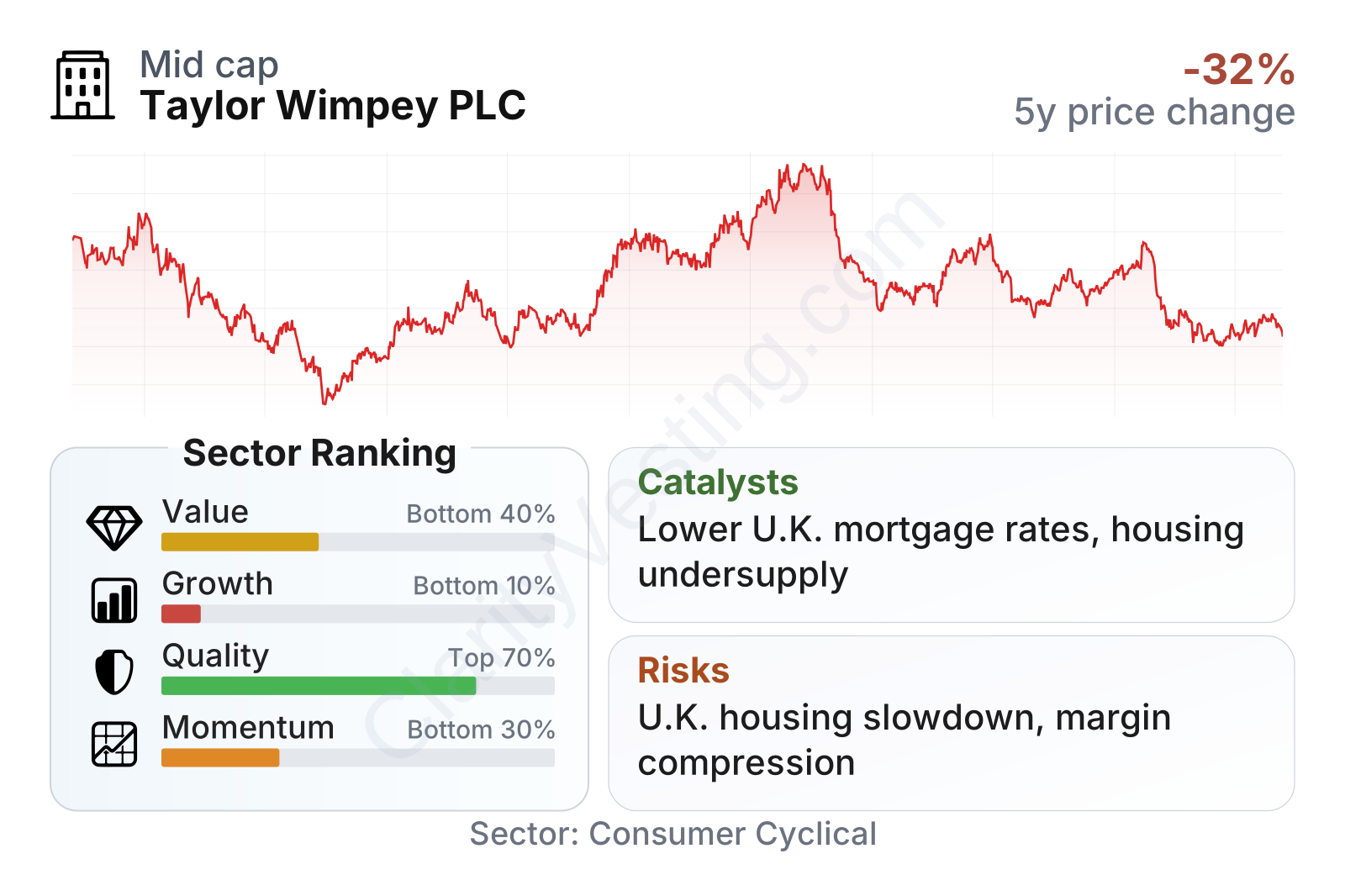
Taylor Wimpey sits in the mid-cap range and has a stock that has been noticeably volatile, which fits a cyclical homebuilder. The recent share-price path has been uneven, with a strong rebound during 2024 followed by renewed weakness into 2025 and early 2026. That pattern reflects how quickly sentiment can shift when investors reassess interest rates, housing demand, and earnings expectations.
The latest metrics suggest a mixed profile. Valuation multiples are not demanding relative to the broader sector, with earnings-based valuation below the sector median and a low PEG ratio hinting that the market is not paying a premium for expected growth. Quality looks better than growth: profitability remains decent, returns on invested capital are slightly above sector median levels, and balance-sheet leverage is exceptionally low. The weak point is growth, where revenue, cash flow, and margin trends have lagged most peers over recent years. Momentum is also soft, meaning the stock has not recently had the market’s support.
Growth
The company operates in a sector that has durable long-term demand drivers. The U.K. continues to face structural housing undersupply, and that supports the need for new homes over time. Population trends, household formation, and the age of the existing housing stock all support the broader market. In that sense, Taylor Wimpey is in a sector with long-run relevance.
The challenge is that residential construction is highly cyclical in the short and medium term. Demand depends heavily on mortgage rates, consumer confidence, employment conditions, and affordability. Taylor Wimpey’s recent trajectory reflects that reality: after a sharp contraction in 2023, revenue growth improved through 2024 and turned positive again more recently. That does not erase the slowdown, but it does suggest the worst part of the volume correction may have passed.
The revenue trend points to a business coming out of a difficult reset rather than one delivering fast expansion. Compared with the broader sector, growth has been weak, but the direction has improved from negative territory toward modest recovery. For a housebuilder, that change in direction matters because volume recovery can support operating leverage if selling conditions continue to normalize.
Taylor Wimpey’s strategy for future growth is straightforward and sensible for its industry: maintain a large land bank, preserve balance-sheet strength, manage build rates carefully, and stay active across multiple local markets. That approach may not look exciting, but it is practical in a cyclical sector where overexpansion can destroy value. A builder with financial flexibility can restart projects faster when demand improves.
One of the stronger catalysts is the possibility of easing mortgage conditions. If borrowing costs continue to moderate, affordability can improve and reservation rates can recover. Another support factor is public policy pressure in the U.K. to increase housing supply. A favorable planning environment or faster approvals would be meaningful because scale builders such as Taylor Wimpey are positioned to convert land into housing more efficiently than smaller operators.
Cash generation is still positive, even though it has fallen materially from earlier levels.
Free cash flow remains positive, which is important because it shows the business is not relying on heavy borrowing to stay operational during a slower part of the cycle. The decline from earlier periods is significant, but positive cash generation combined with low leverage gives the company room to navigate the market and keep investing in land and development opportunities.
Recent company updates have also emphasized outlet growth, land discipline, and returning to higher completion levels over time. Those are not immediate game changers, but they are the types of operational levers that can matter a lot when the market backdrop improves.
Risks
This article is for informational purposes only and does not constitute financial advice. Some content is AI-generated. See Disclaimer