Stock Analysis · Twilio Inc (TWLO)
Overview
Twilio is a cloud communications software company. In simple terms, it provides the tools that let businesses add messaging, voice calls, email, verification, customer data, and contact center functions into their own apps and workflows. When a company sends a text confirmation, routes a support call, verifies a login code, or tracks customer interactions across channels, Twilio is often working behind the scenes.
Its business is built mainly on usage-based software and communications services. Revenue tends to rise when customers send more messages, make more calls, use more email capacity, or expand customer-engagement tools across their organizations. That model gives Twilio exposure to long-term digital communication trends, but it also means results can move with customer activity and pricing conditions.
Based on company disclosures, Twilio’s main revenue sources can be summarized as follows:
- Communications products and services: roughly 85% to 90%. This is the core business and includes messaging, voice, email through SendGrid, user authentication, and related programmable communication tools used by developers and enterprises.
- Data & Applications: roughly 10% to 15%. This includes customer data platform capabilities, marketing and customer engagement software, and contact-center related applications. This area is strategically important because it typically carries a more software-oriented profile than basic communications traffic.
Over the last several years, Twilio has grown from a fast-scaling communications platform into a broader customer engagement platform. Revenue has continued to expand, while operating losses have narrowed sharply and turned into positive operating income more recently. That shift matters because it suggests the company is no longer focused only on growth, but also on making that growth financially durable.
The business mix shows a company still spending heavily on product development, but the direction has improved: revenue and gross profit have risen steadily, while operating expenses have become much better controlled. The biggest change is that Twilio moved from large operating losses a few years ago to positive operating income in 2025, which marks an important transition in its maturity.
Key Figures
| Metric | Value | Sector ⓘ |
|---|---|---|
| Date | Sep 12, 2026 | |
| Context | ||
| Sector | Technology | |
| Industry | Software - Infrastructure | |
| Market Cap ⓘ | $35.50B | |
| Beta ⓘ | 1.41 | |
Value (Cheapness) | ||
| P/E Ratio ⓘ | 31.97 | 29.51 |
| FCF Yield ⓘ | 3.13% | 4.25% |
| EBIT / EV ⓘ | 0.51% | 2.85% |
| PEG ⓘ | 0.36 | |
Growth (Business expansion) | ||
| Revenue Growth ⓘ | 22.00% | 15.40% |
| RPS Growth (5Y CAGR) ⓘ | 18.07% | 8.56% |
| EPS Growth (5Y CAGR) ⓘ | N/A | -11.88% |
| Margin Growth (5Y Trend) ⓘ | N/A | 0.46% |
| FCF Growth (5Y CAGR) ⓘ | N/A | 9.80% |
Quality (Business durability) | ||
| ROIC (Latest) ⓘ | 12.79% | 9.44% |
| ROIC (5Y Median) ⓘ | -6.98% | 8.30% |
| Net Debt / EBIT (Latest) ⓘ | 1.40 | 0.54 |
| Net Debt / EBIT (5Y Median) ⓘ | N/A | 0.44 |
| Operating Margin (Latest) ⓘ | 3.10% | 9.58% |
| Operating Margin (5Y Median) ⓘ | -23.99% | 8.25% |
| Debt to Equity (Latest) ⓘ | 11.87% | 33.33% |
| Profit Margin (Latest) ⓘ | 20.62% | 7.14% |
| Free Cash Flow (Latest) ⓘ | $1.11B | |
Momentum (Price trend) | ||
| 3Y Return ⓘ | +245.52% | +45.48% |
| 12M Return (excl. last month) ⓘ | +158.97% | +23.48% |
| 6M Return ⓘ | +81.14% | +20.93% |
| Price vs. 200-Day MA ⓘ | +37.46% | +7.43% |
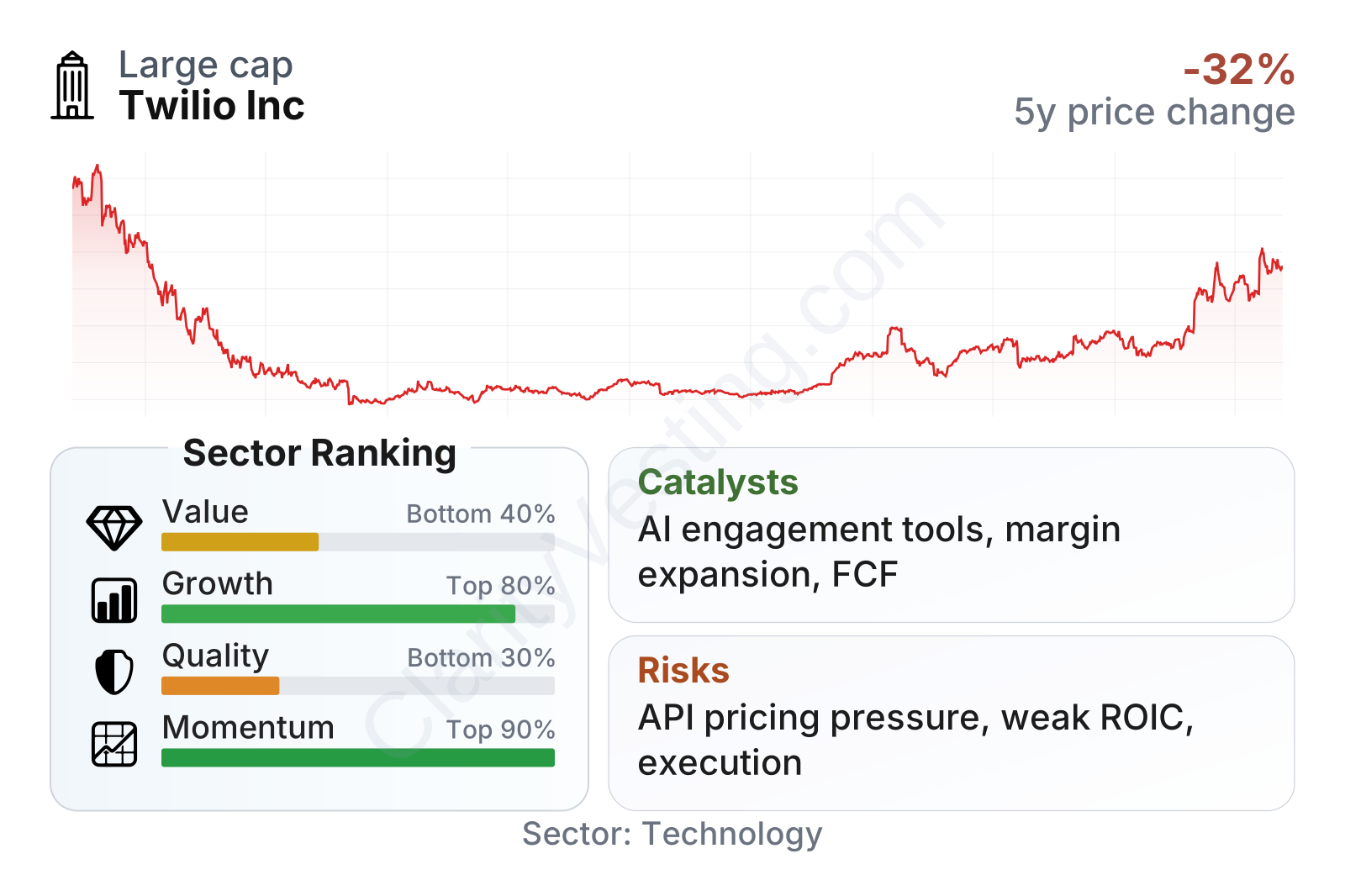
Twilio is now a large software infrastructure company with above-average share price volatility. The factor profile is mixed but readable: growth and market momentum rank well versus the sector, while value and business quality still trail many peers. That combination fits a company in transition—stronger expansion and sentiment, but profitability efficiency still not fully caught up with top software names.
The stock price history highlights how dramatic that transition has been. Shares fell sharply after the 2021 peak, then spent a long period rebuilding credibility. More recently, price performance has improved materially, reflecting the market’s response to better growth, improving margins, and sustained cash generation.
Growth
Twilio operates in a sector with durable structural demand. Businesses continue moving customer interactions toward digital channels such as text, chat, email, voice, and app-based verification. That creates long-term demand for communications APIs, identity tools, and software that can unify customer data across channels. Twilio sits directly in that flow.
The company’s strategy also makes industrial sense. Its communications platform gives it broad customer reach, often starting with a narrow technical use case like SMS alerts or one-time-password verification. From there, Twilio tries to expand into higher-value software such as customer data, marketing personalization, and contact center capabilities. That progression matters because the software-heavy layers can deepen customer relationships and improve economics over time.
Growth slowed sharply after the company’s earlier hyper-growth phase, but the trend has turned upward again. Recent year-over-year revenue growth has climbed back into the low-20% range, which is comfortably above the sector median shown in the metrics table. That reacceleration suggests Twilio is not simply benefiting from cost cuts; it is also regaining business momentum.
Cash generation has improved even more clearly than accounting profit. Free cash flow moved from negative territory in 2022 and 2023 to strongly positive levels, approaching $1.0 billion on a trailing basis by early 2026. For a company that once drew criticism for growing without enough financial discipline, this is one of the strongest changes in the investment case.
Recent company updates have also pointed to opportunities around artificial intelligence. Twilio’s platform is well positioned for AI-enabled customer service, smarter routing, personalization, and automated engagement because it already handles communications flows and customer context. AI by itself does not guarantee faster growth, but it can make Twilio’s platform more useful and stickier for enterprise customers that want digital interactions to feel more responsive and efficient.
Another useful catalyst is the company’s scale. Twilio serves a wide range of industries and use cases, which gives it broad exposure to enterprise digitization. If management continues improving execution while pushing more customers from basic communications into broader engagement software, growth can become more balanced between volume-driven activity and higher-value applications.
Risks
This article is for informational purposes only and does not constitute financial advice. Some content is AI-generated. See Disclaimer


