Stock Analysis · Tuya Inc (TUYA)
Overview
Tuya Inc is a cloud platform company focused on the Internet of Things, often shortened to IoT. In simple terms, it provides the software and cloud tools that help manufacturers turn ordinary devices into connected products such as smart lights, plugs, security cameras, appliances, sensors, and building systems. Instead of building the underlying software stack from scratch, device brands and original equipment manufacturers can use Tuya’s platform to add app control, connectivity, device management, automation, and data features more quickly.
The company mainly earns revenue from three areas disclosed in its annual reporting. Based on recent company filings, the mix is approximately as follows:
- IoT Platform-as-a-Service, around 84% — this is the core business. It includes fees tied to cloud connectivity, software modules, app development tools, and other services used by customers to launch and manage smart devices.
- Software-as-a-Service and others, around 9% — this includes industry solutions and software offerings beyond the core device-enablement platform, including tools for commercial and sector-specific use cases.
- Smart solutions, around 7% — this area includes integrated smart-device solutions and related offerings that support customers building finished applications.
What stands out is that Tuya is not mainly a hardware seller. Its role is closer to the digital infrastructure behind connected products. That can be attractive in theory because software and cloud services can scale well if more brands and devices join the platform. The business has also become financially healthier over the last few years: revenue recovered after a difficult 2022 period, gross profit improved, and the company moved from large losses to profitability by 2024 and stronger earnings in 2025.
The business flow also shows a meaningful shift in efficiency. Revenue in 2025 moved above the 2021 peak, while operating expenses were far lower than in 2021, especially in research and development and selling costs relative to sales. That combination helps explain why the company’s bottom line improved so sharply.
Key Figures
| Metric | Value | Sector ⓘ |
|---|---|---|
| Date | Sep 12, 2026 | |
| Context | ||
| Sector | Technology | |
| Industry | Software - Infrastructure | |
| Market Cap ⓘ | $1.12B | |
| Beta ⓘ | 0.55 | |
Value (Cheapness) | ||
| P/E Ratio ⓘ | 16.55 | 29.51 |
| FCF Yield ⓘ | 5.28% | 4.25% |
| EBIT / EV ⓘ | N/A | 2.85% |
| PEG ⓘ | N/A | |
Growth (Business expansion) | ||
| Revenue Growth ⓘ | 16.00% | 15.40% |
| RPS Growth (5Y CAGR) ⓘ | -3.95% | 8.56% |
| EPS Growth (5Y CAGR) ⓘ | N/A | -11.88% |
| Margin Growth (5Y Trend) ⓘ | N/A | 0.46% |
| FCF Growth (5Y CAGR) ⓘ | N/A | 9.80% |
Quality (Business durability) | ||
| ROIC (Latest) ⓘ | N/A | 9.44% |
| ROIC (5Y Median) ⓘ | -4.61% | 8.30% |
| Net Debt / EBIT (Latest) ⓘ | N/A | 0.54 |
| Net Debt / EBIT (5Y Median) ⓘ | N/A | 0.44 |
| Operating Margin (Latest) ⓘ | N/A | 9.58% |
| Operating Margin (5Y Median) ⓘ | -24.81% | 8.25% |
| Debt to Equity (Latest) ⓘ | 0.91% | 33.33% |
| Profit Margin (Latest) ⓘ | 20.16% | 7.14% |
| Free Cash Flow (Latest) ⓘ | $58.93M | |
Momentum (Price trend) | ||
| 3Y Return ⓘ | +26.71% | +45.48% |
| 12M Return (excl. last month) ⓘ | -23.71% | +23.48% |
| 6M Return ⓘ | -24.93% | +20.93% |
| Price vs. 200-Day MA ⓘ | -14.18% | +7.43% |
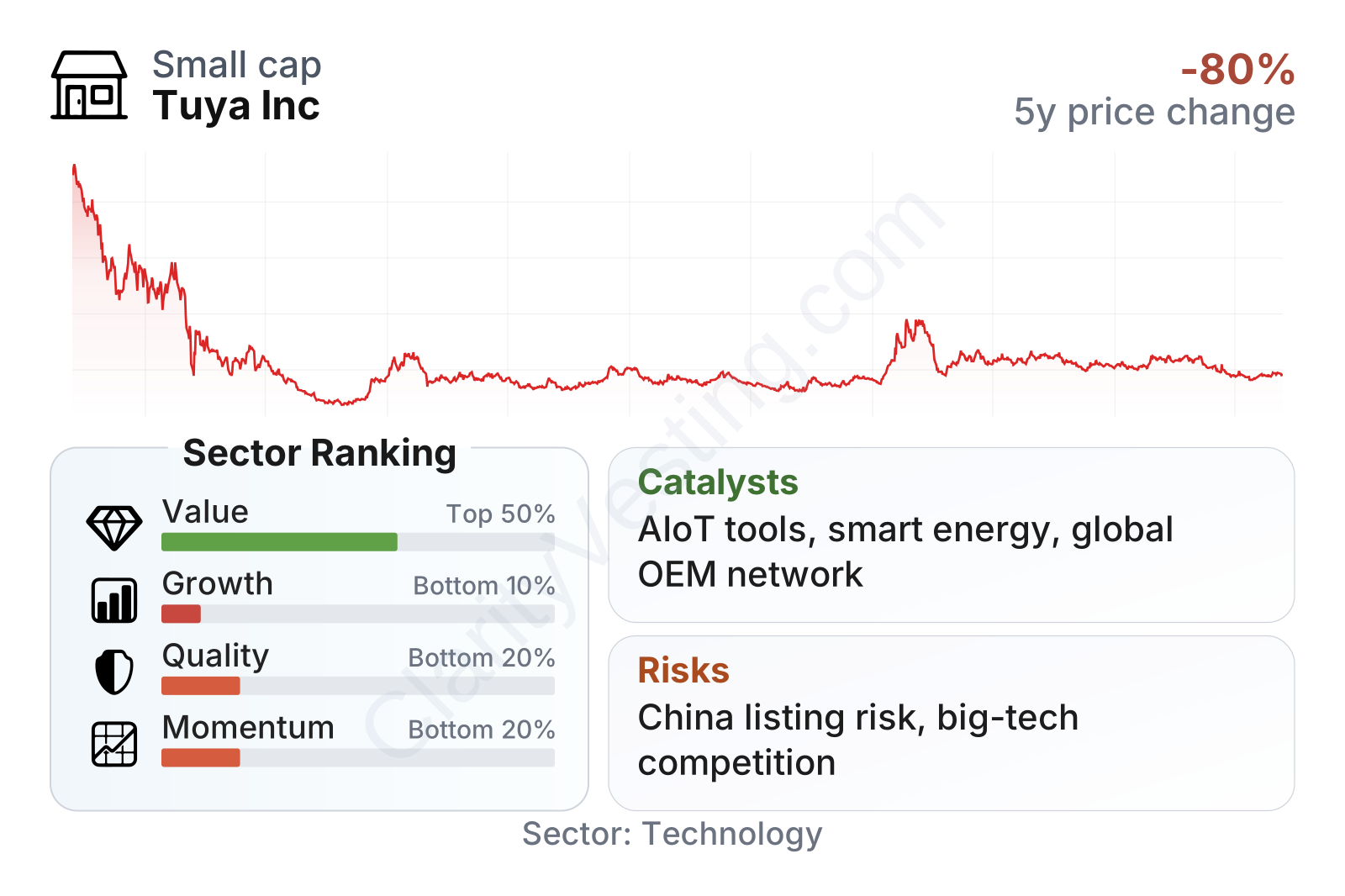
Tuya is a small-cap technology company with relatively low share-price volatility compared with many software names, as shown by a beta well below 1. On valuation, it currently trades at a lower earnings multiple than the sector median, while its free cash flow yield is somewhat stronger than average. The weaker side is not valuation but business quality and consistency: the company ranks near the bottom of the sector on long-term growth, profitability history, and price momentum, even though the most recent profitability has improved a lot.
The stock’s history has been rough. After a steep drop from 2021 into 2022, the shares stabilized at much lower levels and later saw only a partial recovery. That pattern usually reflects a market that wants more proof that the recent turnaround in profits and cash generation can last.
Growth
Tuya operates in a sector with a credible long-term tailwind. The number of connected devices used in homes, offices, hotels, retail spaces, and industrial settings has kept expanding, and many brands prefer ready-made platforms rather than building everything internally. As a result, a company that provides device connectivity, cloud management, software development tools, and cross-device compatibility is positioned in a market that should keep growing over time.
The company’s strategy also makes sense on paper. Tuya tries to serve a broad range of customers globally, from consumer smart-home brands to commercial and industry users. It has been pushing beyond basic consumer gadgets into areas such as energy management, smart buildings, hospitality, and broader enterprise use cases. That matters because these categories can offer larger deployments and potentially stickier customer relationships than one-off consumer devices.
Revenue growth has been uneven. Tuya went through a sharp contraction in 2022, then returned to solid growth in 2023 and 2024, while growth slowed again through much of 2025 before a very strong jump in the latest quarterly comparison. That latest spike looks encouraging, but it should be read carefully because unusually high year-over-year growth can sometimes be helped by an easy comparison base. The broader takeaway is that the business has clearly recovered from its downturn, but it has not yet shown a smooth, steady growth pattern over multiple years.
Cash generation tells a more constructive story. Free cash flow was deeply negative in 2022, then turned clearly positive in 2024 and stayed positive through 2025 and into 2026. That shift suggests the company’s improvement is not only accounting-based; it is also showing up in real cash creation. For a platform business, this is an important sign because it indicates tighter cost control and a more durable operating model.
A major catalyst is the company’s move into artificial intelligence for connected devices. Tuya has been promoting AI-enabled development tools and integrations that help customers build smarter products and services on top of its existing platform. If customers adopt these tools widely, AI could raise the value of Tuya’s platform rather than turning it into a basic connectivity utility. Another useful catalyst is the company’s global ecosystem approach: by working with brands, manufacturers, developers, and channel partners, Tuya can grow with the broader adoption of connected devices without needing to own the end brands itself.
Recent company updates have also pointed to expanding commercial applications, including smart energy and building-related solutions. That is notable because these segments can diversify the company away from purely consumer electronics cycles, which have been a source of volatility in the past.
Risks
This article is for informational purposes only and does not constitute financial advice. Some content is AI-generated. See Disclaimer


