Stock Analysis · TTM Technologies Inc (TTMI)
Overview
TTM Technologies is a U.S.-based electronics manufacturing company that builds printed circuit boards, radio-frequency components, and complete electronic assemblies used in complex systems. In simple terms, it makes the hardware backbone that allows advanced electronics to function in markets where reliability matters a great deal, especially aerospace and defense, data center and networking equipment, medical technology, industrial systems, and some automotive applications.
The business is organized around two main product families. The larger one is printed circuit boards, including high-density, rigid-flex, and other specialized boards used in demanding environments. The second is a smaller but strategically important group focused on RF and specialty components and on manufacturing services that help customers move from design to finished assemblies.
Based on recent company reporting, revenue is concentrated in the following end markets and product areas:
- Aerospace and defense: about 45% of revenue. This includes electronics used in military platforms, avionics, radar, secure communications, and other mission-critical systems.
- Data center computing: about 20%. This covers hardware used in servers, networking infrastructure, and AI-related computing platforms.
- Medical, industrial, and instrumentation: about 14%. These are products for healthcare equipment, factory systems, and precision instruments.
- Automotive: about 11%. This includes electronics for vehicle systems, especially where durability and precision are important.
- Networking and communications: about 10%. These products support telecom and broader communications infrastructure.
From a product standpoint, printed circuit boards remain the clear core of the company, while RF components and related manufacturing solutions add exposure to more specialized, higher-value applications. The overall mix matters because defense and advanced computing tend to require technically demanding products, which can support better pricing and deeper customer relationships than simpler, more commoditized electronics work.
The operating profile has improved since the 2023 downturn. Revenue moved from roughly $2.2 billion in 2023 to about $2.9 billion in 2025, while operating income and net income recovered strongly. Cost of revenue is still the dominant expense, as expected in electronics manufacturing, but the recent expansion in gross profit and operating income suggests better utilization, improved mix, and healthier demand in the company’s more specialized programs.
Key Figures
| Metric | Value | Sector ⓘ |
|---|---|---|
| Date | Sep 12, 2026 | |
| Context | ||
| Sector | Technology | |
| Industry | Electronic Components | |
| Market Cap ⓘ | $12.89B | |
| Beta ⓘ | 2.15 | |
Value (Cheapness) | ||
| P/E Ratio ⓘ | 55.86 | 29.51 |
| FCF Yield ⓘ | -0.12% | 4.25% |
| EBIT / EV ⓘ | 2.50% | 2.85% |
| PEG ⓘ | 0.36 | |
Growth (Business expansion) | ||
| Revenue Growth ⓘ | 37.40% | 15.40% |
| RPS Growth (5Y CAGR) ⓘ | 7.30% | 8.56% |
| EPS Growth (5Y CAGR) ⓘ | -1.16% | -11.88% |
| Margin Growth (5Y Trend) ⓘ | 3.66% | 0.46% |
| FCF Growth (5Y CAGR) ⓘ | N/A | 9.80% |
Quality (Business durability) | ||
| ROIC (Latest) ⓘ | 11.35% | 9.44% |
| ROIC (5Y Median) ⓘ | 3.84% | 8.30% |
| Net Debt / EBIT (Latest) ⓘ | 1.67 | 0.54 |
| Net Debt / EBIT (5Y Median) ⓘ | 3.69 | 0.44 |
| Operating Margin (Latest) ⓘ | 10.13% | 9.58% |
| Operating Margin (5Y Median) ⓘ | 5.38% | 8.25% |
| Debt to Equity (Latest) ⓘ | 55.73% | 33.33% |
| Profit Margin (Latest) ⓘ | 7.01% | 7.14% |
| Free Cash Flow (Latest) ⓘ | -$15.14M | |
Momentum (Price trend) | ||
| 3Y Return ⓘ | +874.87% | +45.48% |
| 12M Return (excl. last month) ⓘ | +196.16% | +23.48% |
| 6M Return ⓘ | +39.65% | +20.93% |
| Price vs. 200-Day MA ⓘ | +4.12% | +7.43% |
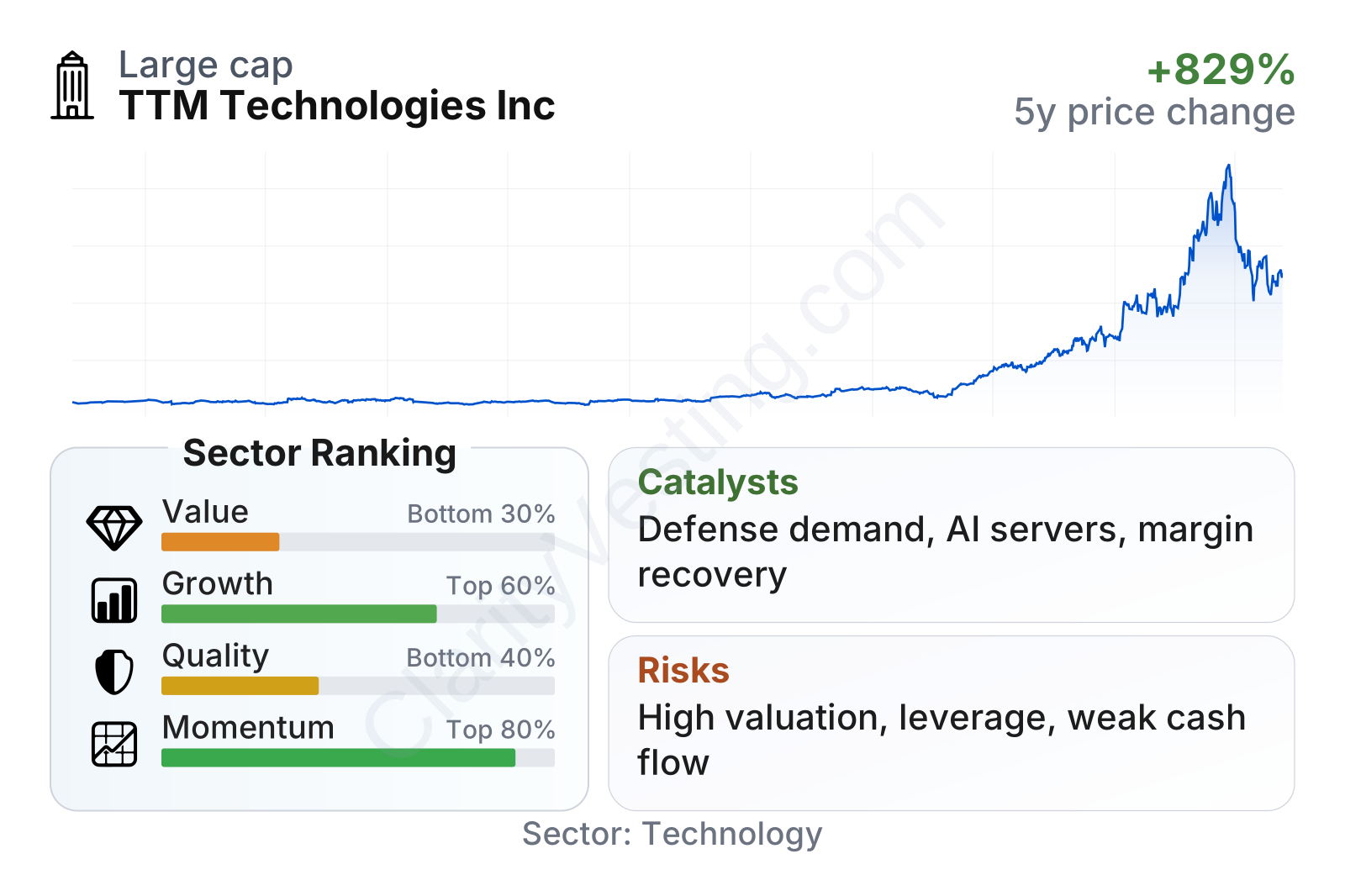
TTM Technologies is now a mid-to-large-sized company within the electronic components space, and its share price performance has been exceptionally strong over the last three years. The table points to a business with above-median recent growth and very strong market momentum, but with a more mixed picture on value and balance-sheet quality. Profitability has improved meaningfully, yet leverage remains higher than the sector median and free cash flow is still weak on a trailing basis. In other words, the market is clearly recognizing the company’s recent acceleration, but that optimism has already pushed valuation metrics well above typical sector levels.
Growth
TTM Technologies operates in several areas that are benefiting from long-term structural demand. Defense electronics has been supported by higher military spending, supply-chain localization, and the need for more sophisticated communications, sensing, and control systems. At the same time, data center infrastructure has become a major growth engine as AI computing drives demand for advanced servers, networking gear, and high-performance interconnect solutions. These are favorable markets for a manufacturer that specializes in complex, high-reliability boards and assemblies rather than only low-end volume production.
The company’s strategy also makes sense in that context. It has been leaning into higher-complexity products, domestic manufacturing relevance, and close relationships with customers that need engineering support and dependable execution. That is a better place to compete than commodity electronics manufacturing, where price pressure is usually harsher. Its defense exposure can also provide a degree of resilience because many programs are long-cycle and qualification-heavy.
Recent growth has clearly accelerated. After a weak stretch in 2023, revenue growth turned positive again in 2024 and strengthened materially through 2025 and into 2026, reaching levels well above the broader sector median. That rebound suggests the company is not just recovering from a soft patch, but is also capturing stronger demand in its priority markets, especially defense and advanced computing.
One area to watch is cash generation. Free cash flow has been negative on a trailing basis even as revenue and earnings improved. That does not automatically signal deterioration because working capital swings, capital spending, and growth investments can temporarily depress cash flow. Still, for a long-term business assessment, it is important that stronger earnings eventually translate into consistently positive cash generation.
Recent company communications have highlighted demand tied to AI infrastructure and continued strength in aerospace and defense programs. Those themes are meaningful because they are not short-lived product cycles; they reflect broader spending priorities that can persist for years. If TTM continues to win content in these end markets, it could further improve its revenue mix toward technically demanding products with better margins.
Risks
This article is for informational purposes only and does not constitute financial advice. Some content is AI-generated. See Disclaimer


