Stock Analysis · Tesla Inc (TSLA)
Overview
Tesla is best known for electric vehicles, but it is broader than a carmaker. The company designs and sells battery-electric cars, develops charging infrastructure, supplies solar and energy storage systems, and builds software tied to vehicle autonomy and connected services. Over time, management has positioned Tesla as a company spanning transportation, energy, software, and manufacturing automation.
Its revenue is still heavily concentrated in vehicles. Based on recent company reporting, the main sources of revenue are approximately:
- Automotive sales: about 77% of revenue. This includes sales of Model 3, Model Y, Model S, Model X, Cybertruck, and related regulatory credits tied to vehicle emissions rules.
- Automotive leasing: about 4% of revenue. This covers vehicles provided under lease arrangements.
- Services and other: about 12% of revenue. This includes non-warranty after-sales services, used vehicle sales, retail merchandise, insurance-related activities, Supercharging, and paid software features where recognized in this segment.
- Energy generation and storage: about 7% of revenue. This includes Megapack utility-scale battery systems, Powerwall residential storage, solar products, and related services.
The business mix matters because Tesla is trying to evolve from a mostly vehicle-driven company into one with larger contributions from energy storage, software, and services. Revenue has grown sharply over several years, but the profit structure has become less favorable as price cuts, new model ramps, and heavy investment have weighed on margins. That makes Tesla a large company with multiple long-term ambitions, yet one whose current economics still depend mostly on selling cars efficiently at scale.
The long-term picture shows a company that nearly doubled revenue from 2021 to 2024, while spending more on research and development each year. However, operating income and net income have come under pressure more recently, which suggests that growth has not translated into steadily stronger profitability.
Key Figures
| Metric | Value | Sector ⓘ |
|---|---|---|
| Date | Sep 12, 2026 | |
| Context | ||
| Sector | Consumer Cyclical | |
| Industry | Auto Manufacturers | |
| Market Cap ⓘ | $1.44T | |
| Beta ⓘ | 1.84 | |
Value (Cheapness) | ||
| P/E Ratio ⓘ | 332.22 | 17.10 |
| FCF Yield ⓘ | 0.40% | 8.53% |
| EBIT / EV ⓘ | 0.39% | 6.46% |
| PEG ⓘ | 4.35 | |
Growth (Business expansion) | ||
| Revenue Growth ⓘ | 25.50% | 5.75% |
| RPS Growth (5Y CAGR) ⓘ | 11.55% | 9.14% |
| EPS Growth (5Y CAGR) ⓘ | -38.59% | -18.21% |
| Margin Growth (5Y Trend) ⓘ | -6.50% | -0.23% |
| FCF Growth (5Y CAGR) ⓘ | 15.60% | 4.91% |
Quality (Business durability) | ||
| ROIC (Latest) ⓘ | 4.48% | 12.61% |
| ROIC (5Y Median) ⓘ | 17.12% | 10.72% |
| Net Debt / EBIT (Latest) ⓘ | -1.06 | 2.10 |
| Net Debt / EBIT (5Y Median) ⓘ | -0.74 | 2.32 |
| Operating Margin (Latest) ⓘ | 5.36% | 9.25% |
| Operating Margin (5Y Median) ⓘ | 10.47% | 9.64% |
| Debt to Equity (Latest) ⓘ | 10.76% | 75.78% |
| Profit Margin (Latest) ⓘ | 3.67% | 5.33% |
| Free Cash Flow (Latest) ⓘ | $5.76B | |
Momentum (Price trend) | ||
| 3Y Return ⓘ | +36.62% | +14.53% |
| 12M Return (excl. last month) ⓘ | -3.91% | +3.08% |
| 6M Return ⓘ | -7.49% | +0.55% |
| Price vs. 200-Day MA ⓘ | -8.39% | -0.54% |
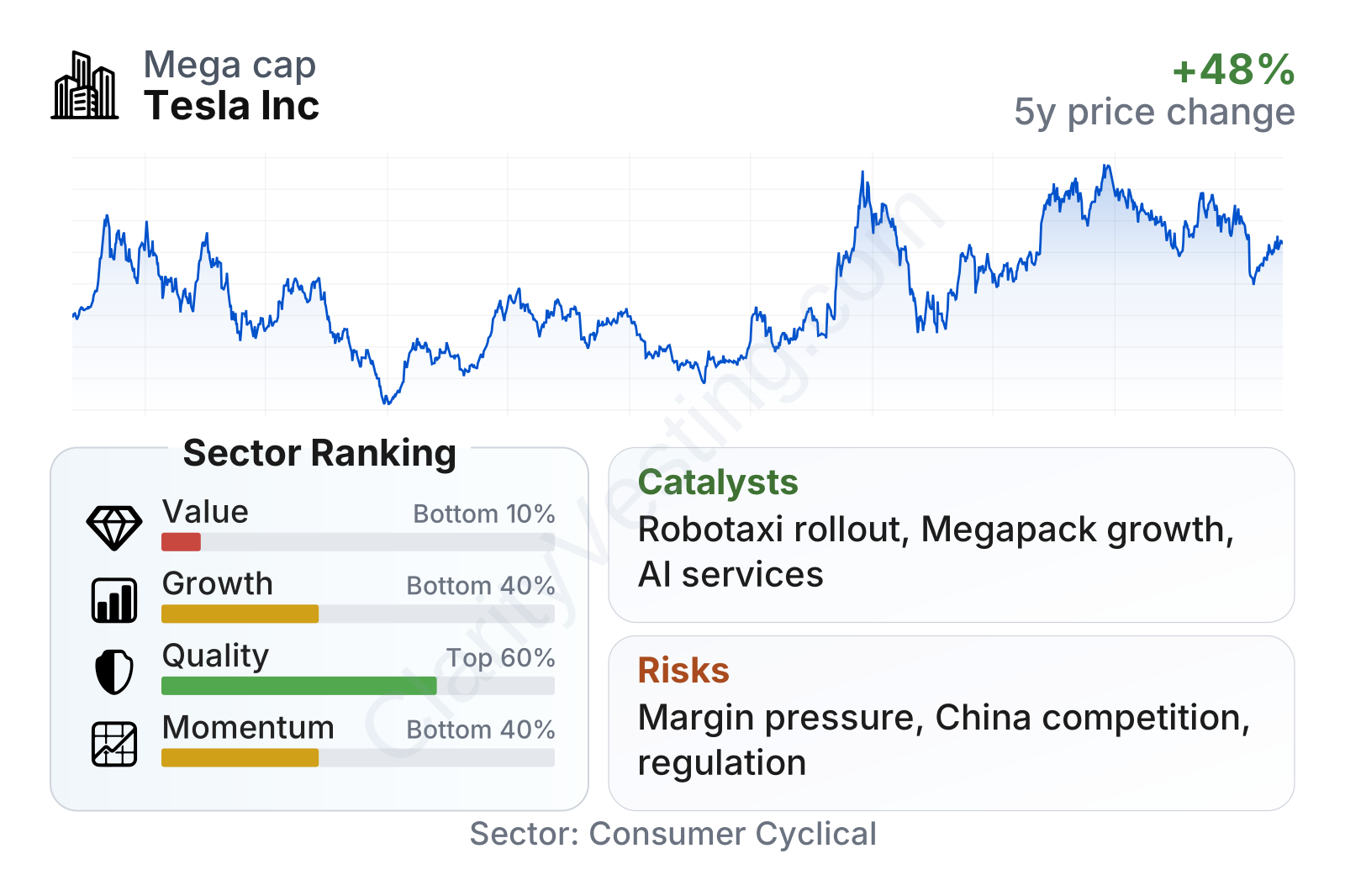
Tesla remains one of the largest companies in its sector and its share price has been very volatile, with wide swings over the past few years. The latest metrics table points to a mixed profile: revenue growth and cash generation are still meaningful, balance-sheet strength is clearly above many peers, but valuation stands far above sector norms while profitability is no longer as strong as it was earlier in the cycle.
On growth, recent year-over-year revenue expansion is still ahead of the sector median, and five-year free cash flow growth has been solid. On quality, the company’s very low leverage stands out positively, but current returns on invested capital and operating margin are weaker than the sector median. On value, Tesla screens as expensive by almost every common measure, which means a large part of the market’s expectations is tied to future breakthroughs rather than current earnings power.
Growth
Tesla operates in markets with clear long-term growth drivers. Electric vehicles are still gaining share globally, even if adoption rates vary by region and policy support changes over time. Grid-scale battery storage is also expanding quickly as utilities and commercial customers add renewable energy and need more balancing capacity. These are real structural trends, and Tesla has exposure to both.
Revenue growth has been uneven after the company’s earlier surge. There was a period of very rapid expansion, followed by a clear slowdown and even some negative quarters, before growth turned positive again more recently. That pattern suggests Tesla is no longer in a simple straight-line expansion phase. It is still growing, but the path now depends more on execution, product mix, and pricing discipline than on broad market momentum alone.
Tesla’s strategy for future growth rests on several pillars. First, it continues to push manufacturing scale and cost reduction, which is essential in electric vehicles where affordability can widen demand. Second, it is expanding in energy storage, an area that is becoming more important and may offer a different margin profile than vehicles. Third, the company keeps investing heavily in software and autonomous driving capabilities, aiming to create higher-value recurring revenue streams over time. Fourth, its charging network and ecosystem can strengthen customer retention and brand reach.
Free cash flow has remained positive, although not in a perfectly smooth way. After a notable dip, it recovered strongly and remains in the multi-billion-dollar range. That matters because it shows Tesla still has internal funding capacity for factories, AI infrastructure, product development, and energy expansion without relying heavily on debt.
A major catalyst is the possibility that software and autonomy become economically meaningful rather than remaining mostly an expectation. Tesla has repeatedly highlighted progress in self-driving development and has tied part of its long-term vision to robotaxi-style use cases and AI-enabled services. If those activities begin generating visible commercial results, the company’s revenue mix and margin profile could change significantly. Another catalyst is the build-out of Megapack and other storage products, where demand from utilities appears strong and less tied to consumer vehicle cycles.
Recent company updates have also kept attention on new vehicle platforms, production ramp execution, AI and compute investment, and the expansion of energy storage capacity. For long-term analysis, the most important point is that Tesla still has multiple potential growth engines beyond unit car sales, but several of them remain partly future-facing rather than fully proven in today’s financial results.
Risks
This article is for informational purposes only and does not constitute financial advice. Some content is AI-generated. See Disclaimer


