Stock Analysis · 361 Degrees International Limited (TSIOF)
Overview
361 Degrees International Limited is a Chinese sportswear company focused on athletic footwear, apparel, and related accessories. The group sells products under the core 361° brand and also operates other labels that target different customer segments, including children’s sportswear and higher-end performance categories. Its business is centered on mainland China, where it works through a large distributor and retail network, while also maintaining a smaller international presence.
The company’s revenue mainly comes from selling branded sports products. Based on recent annual reporting and company disclosures, the sales mix is broadly concentrated in the following areas:
- Adults’ footwear: approximately 40% to 45% of revenue. This includes running shoes, basketball shoes, training shoes, and other sports footwear under the main 361° brand.
- Adults’ apparel: approximately 30% to 35% of revenue. This covers sportswear such as tops, pants, jackets, and training clothing.
- Children’s products: approximately 18% to 22% of revenue. This segment includes footwear, apparel, and accessories sold under 361° Kids.
- Accessories and other brands: approximately 3% to 8% of revenue. This usually includes bags, socks, gear, and smaller contributions from newer or more specialized labels.
The business model is relatively straightforward: 361 Degrees designs and markets sportswear, then distributes it through wholesalers, distributors, and retail partners. That model can scale well when brand awareness improves, because rising sales do not always require the same pace of new fixed investment.
Over the last several years, revenue has moved up materially, with sales expanding from roughly RMB 5.9 billion in 2021 to more than RMB 10.8 billion in 2025. Profit also increased over that period, and the company has maintained a healthy gap between revenue and direct production costs, showing that its pricing and brand positioning have held up reasonably well.
The overall picture is of a mid-sized sportswear player that has been growing consistently, with footwear and apparel still doing most of the heavy lifting. The most visible trend is that revenue and net income both rose meaningfully from 2021 through 2025, while interest expense stayed low, suggesting growth has not depended on heavy borrowing.
Key Figures
| Metric | Value | Sector ⓘ |
|---|---|---|
| Date | Sep 12, 2026 | |
| Context | ||
| Sector | Consumer Cyclical | |
| Industry | Footwear & Accessories | |
| Market Cap ⓘ | $1.32B | |
| Beta ⓘ | -0.07 | |
Value (Cheapness) | ||
| P/E Ratio ⓘ | 6.10 | 17.10 |
| FCF Yield ⓘ | 67.65% | 8.53% |
| EBIT / EV ⓘ | N/A | 6.46% |
| PEG ⓘ | N/A | |
Growth (Business expansion) | ||
| Revenue Growth ⓘ | 8.00% | 5.75% |
| RPS Growth (5Y CAGR) ⓘ | 16.31% | 9.14% |
| EPS Growth (5Y CAGR) ⓘ | -9.28% | -18.21% |
| Margin Growth (5Y Trend) ⓘ | -4.56% | -0.23% |
| FCF Growth (5Y CAGR) ⓘ | 9.28% | 4.91% |
Quality (Business durability) | ||
| ROIC (Latest) ⓘ | 21.86% | 12.61% |
| ROIC (5Y Median) ⓘ | 10.76% | 10.72% |
| Net Debt / EBIT (Latest) ⓘ | -1.56 | 2.10 |
| Net Debt / EBIT (5Y Median) ⓘ | -2.81 | 2.32 |
| Operating Margin (Latest) ⓘ | 13.67% | 9.25% |
| Operating Margin (5Y Median) ⓘ | 15.65% | 9.64% |
| Debt to Equity (Latest) ⓘ | 4.22% | 75.78% |
| Profit Margin (Latest) ⓘ | 11.87% | 5.33% |
| Free Cash Flow (Latest) ⓘ | $894.58M | |
Momentum (Price trend) | ||
| 3Y Return ⓘ | +54.24% | +14.53% |
| 12M Return (excl. last month) ⓘ | -27.32% | +3.08% |
| 6M Return ⓘ | -9.15% | +0.55% |
| Price vs. 200-Day MA ⓘ | +40.42% | -0.54% |
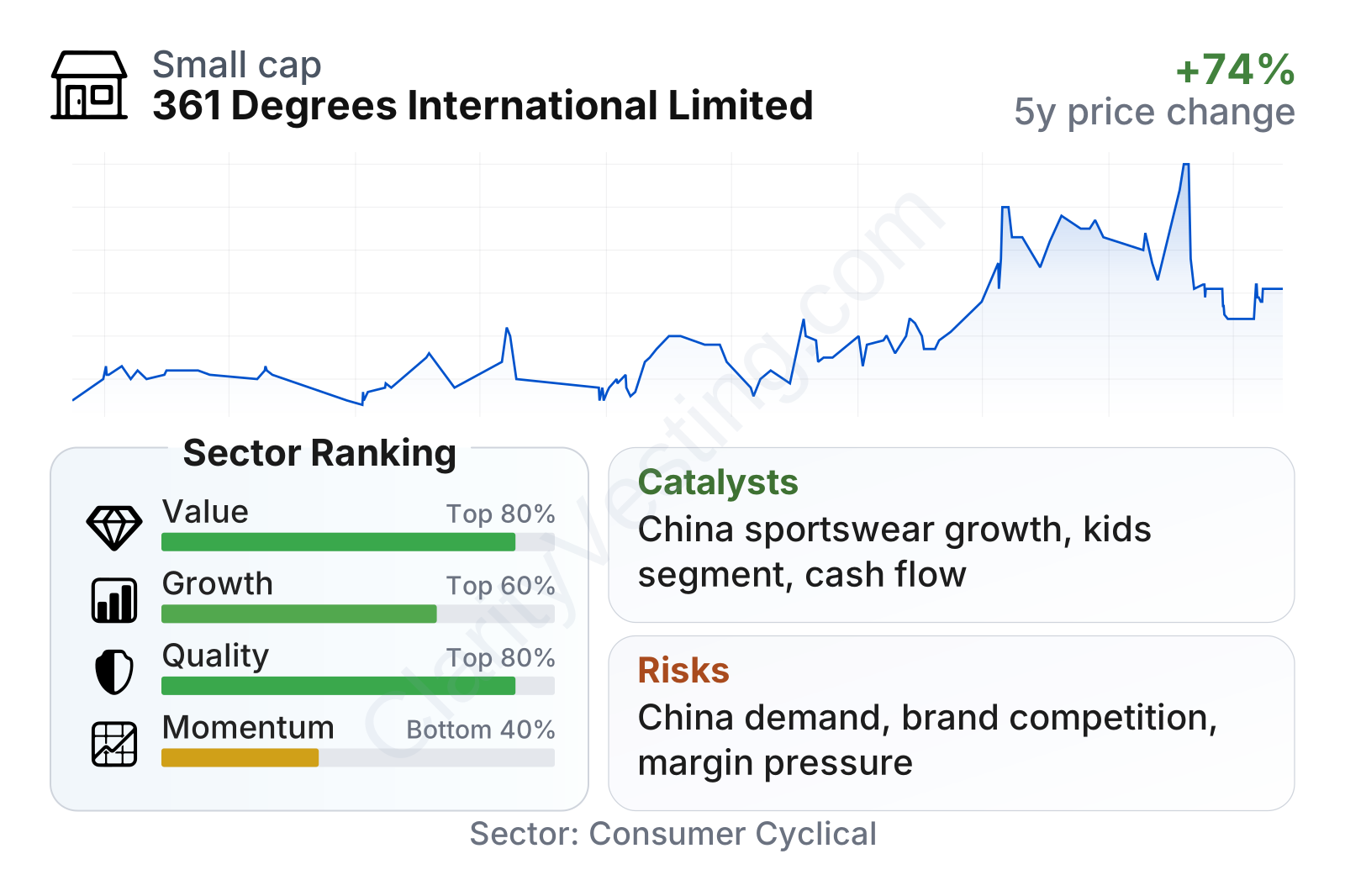
At a high level, the company stands out for a combination that is not common in consumer discretionary stocks: low leverage, strong cash generation, and valuation multiples that sit well below the sector median. Growth metrics are mixed rather than exceptional, but still better than much of the sector on revenue and cash flow trends. The weaker area is market momentum, where recent share performance has lagged even though the longer-term move has been positive.
Growth
361 Degrees operates in a segment with long-term structural support. Sports participation, fitness awareness, and demand for performance-oriented clothing have been expanding in China for years. That does not mean growth is smooth every year, but it does mean the company is tied to a category that can keep gaining share of consumer spending over time. Domestic sports brands also benefit from a market where local players have become stronger and more credible against global names.
The company’s strategy appears logical for future expansion. It is not trying to compete only as a premium niche brand or only as a discount label. Instead, it covers a broad part of the market through its core brand, children’s line, and specialized categories. That gives it several paths for growth: more store penetration, deeper product breadth, stronger repeat purchases, and a larger share of family spending through kids’ products.
Recent revenue growth has been positive and slightly ahead of the sector median, while the five-year revenue-per-share trend looks stronger than many peers. That matters because it suggests the business has been expanding in a way that is visible at the shareholder level, not only through headline sales growth. Earnings growth over five years has been less smooth, but still compares better than a sector where many companies also experienced pressure.
Cash generation is one of the more attractive parts of the profile. Free cash flow has been strong in absolute terms and the five-year trend is favorable. For a branded consumer company, that is important because it provides flexibility for product development, channel support, marketing, dividends, or future expansion without depending heavily on outside financing.
A meaningful catalyst is the company’s continued push into performance sports and children’s categories. Running, basketball, and youth athletics can support repeat demand because customers replace shoes and apparel regularly. Another support factor is the company’s role as a domestic Chinese sports brand at a time when local brands have become more accepted by consumers. If management continues to convert that trend into better product mix and distribution efficiency, revenue could keep compounding.
Recent company reporting also points to continued scale gains rather than a stalled business. Sales moved above RMB 10 billion in the latest full-year period, and profitability remained solid. That does not guarantee a straight line forward, but it does show the business is still participating in category growth rather than losing relevance.
Risks
This article is for informational purposes only and does not constitute financial advice. Some content is AI-generated. See Disclaimer