Stock Analysis · TriMas Corporation (TRS)
Overview
TriMas Corporation is a diversified manufacturer that sells specialized products used in packaging, aerospace, and industrial applications. The company focuses on engineered components rather than broad commodity products, which means its businesses are tied to specific end uses such as dispensing systems for consumer packaging, fasteners and precision parts for aircraft, and cylinders or fittings used in industrial settings.
Based on the company’s recent reporting structure, revenue mainly comes from three operating segments:
- Packaging: approximately 50% to 55% of revenue. This segment includes dispensing products, closures, and other packaging components used in beauty, personal care, food, beverage, home care, and pharmaceutical applications.
- Aerospace: approximately 25% to 30% of revenue. This business supplies fasteners, collars, blind bolts, and precision-machined parts used on commercial and military aircraft.
- Specialty Products: approximately 20% to 25% of revenue. This segment includes steel cylinders, fittings, and other niche industrial products used in energy, transport, and general industrial markets.
That mix matters for long-term analysis. Packaging tends to provide recurring demand tied to everyday consumer products, aerospace offers exposure to a long aircraft production cycle, and specialty industrial products add diversification but can be more economically sensitive.
The longer financial picture shows a business that became smaller after portfolio changes, with annual revenue moving from the high $800 million range earlier in the decade to the mid-$600 million range more recently. Gross profit has remained positive through that transition, but operating profit has been more uneven, reflecting restructuring, portfolio reshaping, and margin pressure in some periods.
The business mix has shifted over the last few years. Revenue is lower than it was before, but the cost base has also come down. The main question is not scale alone, but whether the newer portfolio can produce steadier margins and stronger cash generation than the older one.
Key Figures
| Metric | Value | Sector ⓘ |
|---|---|---|
| Date | Sep 12, 2026 | |
| Context | ||
| Sector | Consumer Cyclical | |
| Industry | Packaging & Containers | |
| Market Cap ⓘ | $1.38B | |
| Beta ⓘ | 0.59 | |
Value (Cheapness) | ||
| P/E Ratio ⓘ | 18.26 | 17.10 |
| FCF Yield ⓘ | 11.94% | 8.53% |
| EBIT / EV ⓘ | 9.42% | 6.46% |
| PEG ⓘ | 1.94 | |
Growth (Business expansion) | ||
| Revenue Growth ⓘ | 1.60% | 5.75% |
| RPS Growth (5Y CAGR) ⓘ | -5.44% | 9.14% |
| EPS Growth (5Y CAGR) ⓘ | -25.43% | -18.21% |
| Margin Growth (5Y Trend) ⓘ | -3.21% | -0.23% |
| FCF Growth (5Y CAGR) ⓘ | -6.17% | 4.91% |
Quality (Business durability) | ||
| ROIC (Latest) ⓘ | -4.10% | 12.61% |
| ROIC (5Y Median) ⓘ | 7.09% | 10.72% |
| Net Debt / EBIT (Latest) ⓘ | -15.06 | 2.10 |
| Net Debt / EBIT (5Y Median) ⓘ | 6.14 | 2.32 |
| Operating Margin (Latest) ⓘ | 6.96% | 9.25% |
| Operating Margin (5Y Median) ⓘ | 7.44% | 9.64% |
| Debt to Equity (Latest) ⓘ | 30.35% | 75.78% |
| Profit Margin (Latest) ⓘ | 136.25% | 5.33% |
| Free Cash Flow (Latest) ⓘ | $164.23M | |
Momentum (Price trend) | ||
| 3Y Return ⓘ | +61.08% | +14.53% |
| 12M Return (excl. last month) ⓘ | +10.47% | +3.08% |
| 6M Return ⓘ | +8.85% | +0.55% |
| Price vs. 200-Day MA ⓘ | +1.28% | -0.54% |
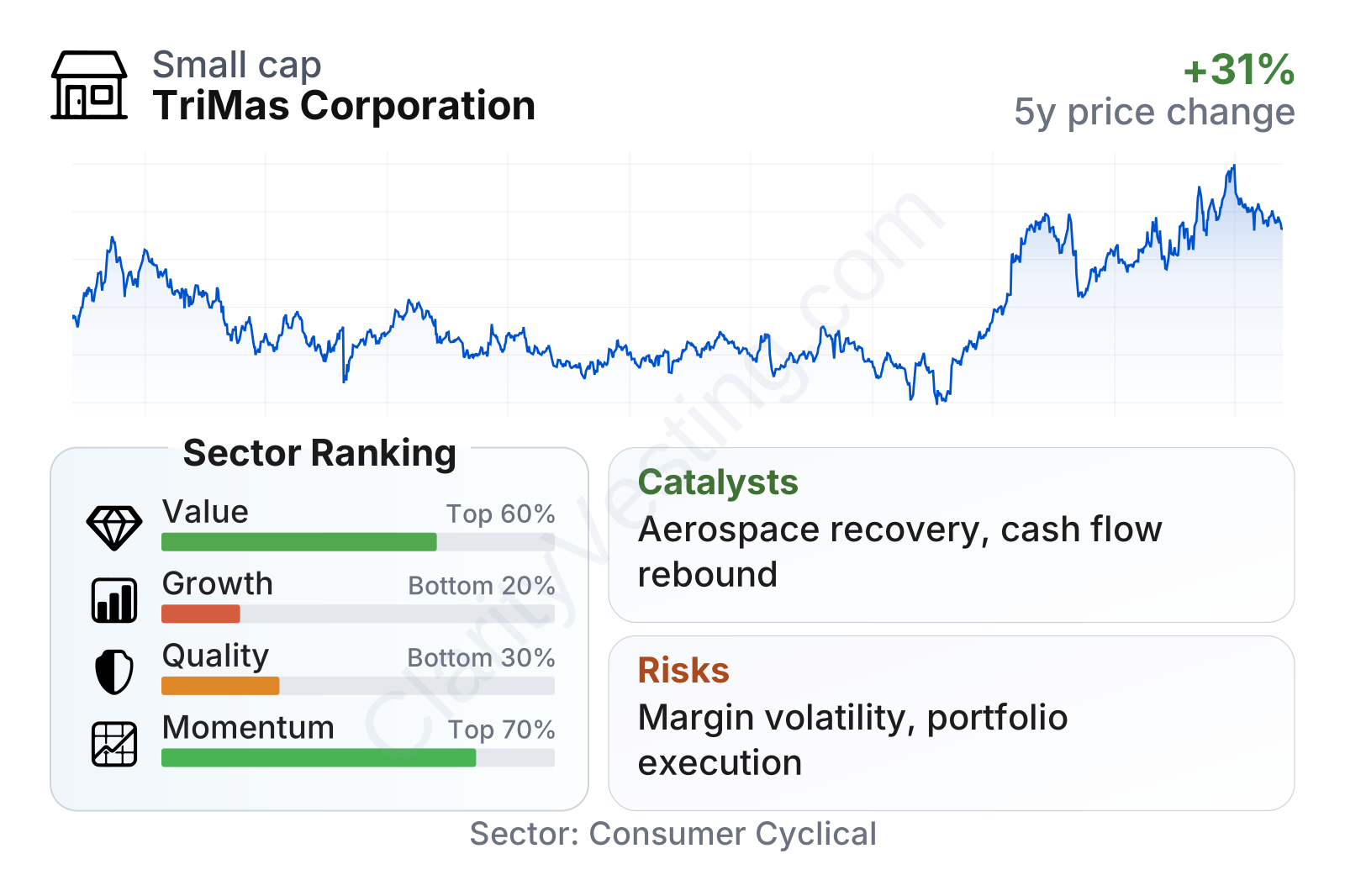
TriMas is a small-cap industrial company with a stock that has been notably stronger than much of its sector over the last 12 months and 3 years. On valuation, the picture is mixed: earnings-based multiples look above the sector median, while cash-flow-based measures look more favorable. Growth and quality metrics are weaker relative to peers, mainly because recent revenue and earnings trends have been inconsistent, while leverage has improved sharply.
The share price trend has been strong since mid-2025 after several years of uneven trading. That strength suggests the market has responded positively to operational improvement, portfolio actions, or one-time financial effects, but it also means expectations are no longer low.
Growth
TriMas operates in end markets that are generally attractive over a long horizon, but not all for the same reason. Packaging benefits from stable consumer demand and the ongoing push toward product differentiation, convenience, dosing accuracy, and sustainability. Aerospace has a stronger cyclical profile, but the long-term backdrop remains supported by aircraft build rates, aftermarket demand, and defense spending. Specialty industrial markets are more mixed and tend to move with industrial activity.
The company’s strategy is sensible in principle: focus on specialized products where engineering, qualification, customer relationships, and reliability matter more than pure price competition. That approach can support better margins than undifferentiated manufacturing, especially in aerospace and dispensing systems.
Revenue growth has been volatile. TriMas has moved through periods of expansion, contraction, and rebound, which reflects both market conditions and portfolio changes rather than a clean, steady growth path. The latest year-over-year reading is weak, so the headline growth rate should be viewed carefully in context. For this company, segment mix and acquisition or divestiture effects can heavily influence reported sales.
Cash generation has improved meaningfully from the lows seen in 2023 and 2024. That is an important point because for an industrial manufacturer, cash flow often gives a clearer picture than accounting earnings alone. Rising free cash flow can support debt reduction, acquisitions, internal investment, and shareholder returns, provided it proves durable.
A key catalyst is aerospace. If production schedules at major aircraft manufacturers continue to normalize and supply-chain bottlenecks ease, TriMas could benefit from higher demand for fasteners and precision components. Another possible catalyst is packaging innovation, especially in dispensing and closure systems where customers want performance improvements rather than simple low-cost parts.
Recent company communications have also pointed to continued portfolio management. For a company of this size, small acquisitions or divestitures can have a noticeable impact on growth, margin mix, and market perception. That can create opportunity, but it also adds complexity when comparing one year to another.
Risks
This article is for informational purposes only and does not constitute financial advice. Some content is AI-generated. See Disclaimer