Stock Analysis · Trimble Inc (TRMB)
Stock Analysis · Trimble Inc (TRMB)

Overview

Trimble Inc. is a technology company that helps customers connect the physical world with digital tools. In simple terms, its products and software help people measure, map, design, build, monitor, and manage real-world assets more accurately and efficiently. Its customers are mainly in construction, geospatial surveying, transportation and logistics, agriculture, utilities, and field service industries. Trimble is best known for combining hardware, software, and positioning technologies such as GPS, laser, sensors, and workflow applications into practical tools used on job sites, farms, roads, and infrastructure projects.

The business has changed meaningfully over time. Trimble has been shifting away from being mainly a hardware device maker and toward a more software- and subscription-oriented model. That matters because software revenue is usually more recurring, carries higher margins, and can make results less dependent on one-time equipment purchases. The company also simplified its portfolio in recent years, including the reshaping of its architecture and construction activities through the joint venture tied to its buildings business, which changed the mix of reported revenue and profitability.

Based on its recent reporting structure and business mix, Trimble’s revenue sources can be summarized approximately as follows:

  • Buildings and infrastructure software and technology: the largest contributor, supported by construction workflow, project management, and connected jobsite solutions.
  • Geospatial: surveying, mapping, and civil engineering tools used by surveyors, governments, and infrastructure teams.
  • Resources and utilities: precision agriculture, water, and utility-related solutions.
  • Transportation: fleet management, routing, mobility, and logistics technology.
  • Field systems and smaller activities: a mix of hardware, services, and specialized industry solutions.

Exact percentages can move from year to year because Trimble has been actively reshaping the business. Broadly, construction- and infrastructure-related activities appear to represent the biggest share, while geospatial remains a major core franchise and transportation and resources add diversification across end markets.

The company’s cost profile also shows why the software transition matters: gross profit remains strong, while research and development spending is consistently significant, underscoring that Trimble competes through product depth and workflow integration rather than through low-cost hardware alone. Reported earnings, however, have been affected by portfolio changes and one-time items, so headline profit can look more volatile than the underlying operating model.

The broad pattern over the last several years is a business with solid gross profit and meaningful spending on product development, while reported net income has swung more sharply than revenue because of restructuring, transaction effects, and accounting items.

Key Figures

MetricValueSector
DateJul 18, 2026
Context
SectorTechnology
IndustryScientific & Technical Instruments
Market Cap $12.53B
Beta 1.38
Value
(Cheapness)
P/E Ratio 27.1531.76
FCF Yield 2.02%4.18%
EBIT / EV 4.76%2.56%
PEG 1.45
Growth
(Business expansion)
Revenue Growth 11.80%13.50%
RPS Growth (5Y CAGR) 0.98%8.57%
EPS Growth (5Y CAGR) -29.11%-21.87%
Margin Growth (5Y Trend) -1.22%0.41%
FCF Growth (5Y CAGR) -34.06%9.76%
Quality
(Business durability)
ROIC (Latest) 7.26%8.54%
ROIC (5Y Median) 8.42%8.12%
Net Debt / EBIT (Latest) 1.860.38
Net Debt / EBIT (5Y Median) 1.950.38
Operating Margin (Latest) 17.16%9.58%
Operating Margin (5Y Median) 16.27%8.25%
Debt to Equity (Latest) 25.06%33.52%
Profit Margin (Latest) 12.38%6.96%
Free Cash Flow (Latest) $252.80M
Momentum
(Price trend)
3Y Return -0.60%+30.91%
12M Return (excl. last month) -31.90%+28.90%
6M Return -32.90%+5.38%
Price vs. 200-Day MA -23.13%+7.61%
Better than sector median
Slightly worse than sector median
More than 20% worse than sector median

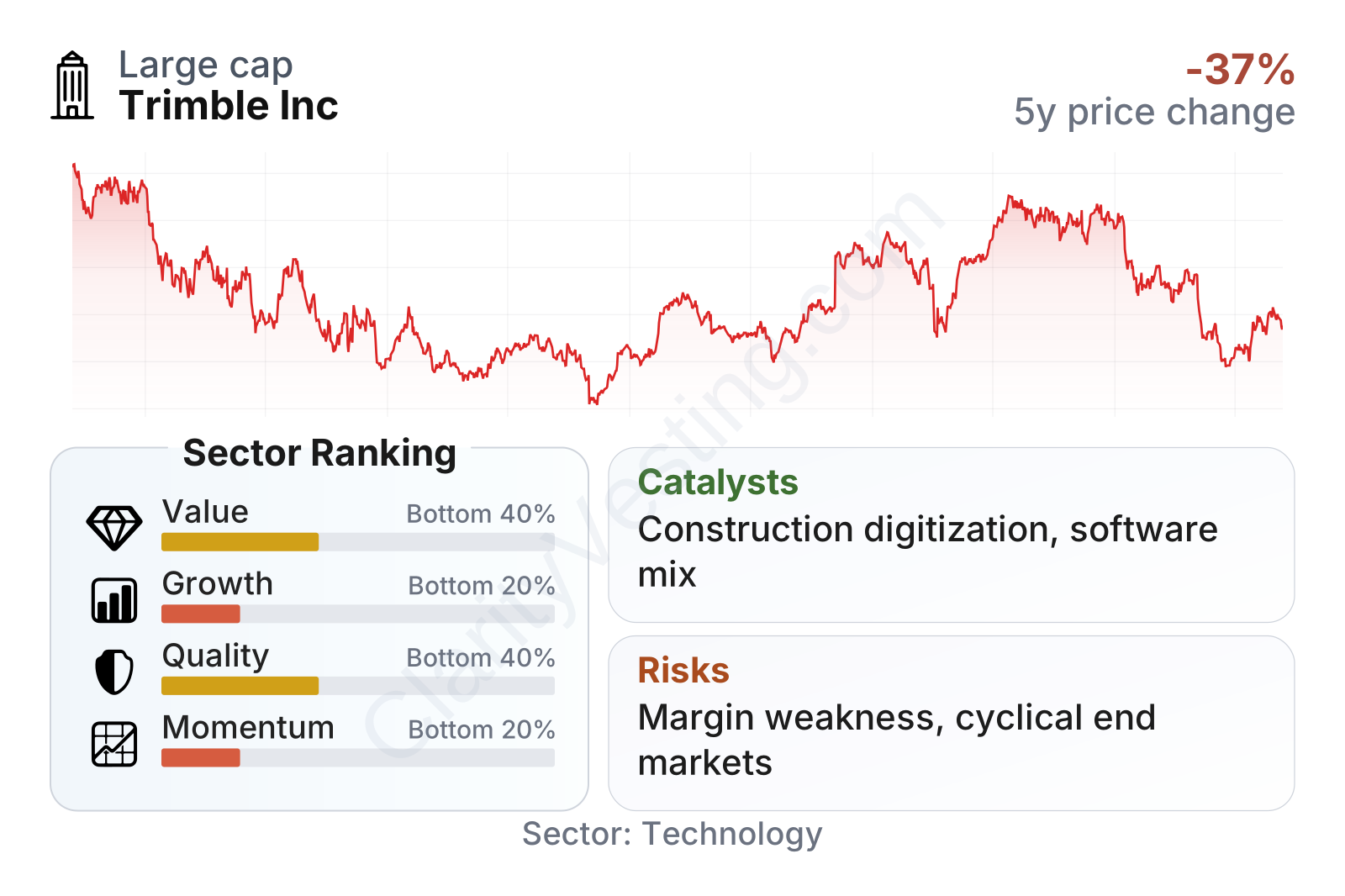
Trimble sits around a mid-cap size in the technology sector, with share-price volatility above the market average. The overall profile is mixed: profitability and operating efficiency look better than many peers, but growth and market momentum have been weaker. The company’s operating margin and profit margin are both above the sector median, suggesting the business still converts revenue into earnings better than many comparable firms. At the same time, revenue growth has only recently improved, long-term per-share growth has been soft, and free cash flow generation has trended down from earlier peaks. Debt levels look manageable on an equity basis, but leverage relative to EBIT remains higher than the sector median, which makes earnings stability important.

Growth

Trimble operates in markets that have attractive long-term characteristics. Construction, infrastructure, geospatial intelligence, precision agriculture, and logistics are all being pushed toward greater digitization. Customers increasingly want better productivity, less waste, more automation, and more connected workflows. Those needs are structural rather than temporary. In that sense, the company is positioned in growth areas, especially where physical operations are still under-digitized.

Its strategy also makes industrial sense. Instead of selling only devices, Trimble is trying to embed itself deeper into customer workflows through software, data, cloud platforms, and subscriptions. That can create stickier relationships because once a contractor, surveyor, or fleet operator relies on Trimble tools across multiple steps of a workflow, switching becomes harder. The company’s positioning is strongest where accuracy, compliance, productivity, and field-to-office integration are important.

Recent top-line growth has improved from prior declines, with year-over-year revenue returning to positive territory and moving back into a low-double-digit range. That is encouraging, but the longer view is less impressive: the five-year growth profile remains weak relative to much of the technology sector. In other words, there are signs of stabilization and recovery, but not yet a long enough record to call it a consistently fast-growing business.

Cash generation is another area to watch closely. Trimble remains free-cash-flow positive, which is important, but the trailing twelve-month level has fallen materially from earlier highs. That does not automatically signal a broken business, especially during periods of portfolio transition, but it does mean the case for stronger future performance rests partly on management’s ability to convert its software-heavy mix into steadier cash output.

One of the more important catalysts is the company’s push into connected construction and infrastructure workflows. Governments and private customers continue to invest in infrastructure modernization, while labor shortages and cost pressure make automation more valuable. In agriculture, precision tools can help reduce inputs and improve yields, and in transportation, software can improve fleet efficiency and compliance. Across all of these markets, demand is increasingly tied to measurable productivity gains, which fits Trimble’s value proposition well.

Another notable opening is the company’s growing emphasis on recurring software revenue and platform integration. If management continues to execute on this shift, the business could become less cyclical, more predictable, and potentially more profitable over time. Recent company updates have also emphasized partnerships, product integration, and operational simplification, which support that direction.

Risks

Trimble’s main risk is that it is in the middle of a business transition rather than already at the finish line. The move toward software and recurring revenue is logical, but it can create uneven revenue recognition, shifting margins, and temporary pressure on cash flow. Investors looking only at headline earnings may also struggle to interpret the company because one-time gains, tax effects, and portfolio transactions have made reported net income unusually volatile.

End-market exposure is another important risk. Construction, agriculture, transportation, and capital equipment spending can all weaken when economic conditions soften. Even if Trimble’s products improve efficiency, customers can delay purchases of hardware, software upgrades, or major digital projects during uncertain periods. That makes the company less defensive than some pure enterprise software firms.

Balance-sheet risk looks moderate rather than extreme. Debt to equity has come down substantially from earlier elevated levels and now sits below the sector median, which is a constructive sign. Even so, leverage measured against EBIT remains higher than many peers, so the company still benefits from stable operating profit and disciplined capital allocation.

Profitability is a relative strength, but it needs interpretation. Trimble’s margins are generally stronger than the sector median, showing that the core business has solid economics. However, past spikes in net margin were influenced by non-recurring items, so normalized earnings power is lower than those unusually high readings might suggest. The more useful takeaway is that the company appears fundamentally profitable, but not in a perfectly smooth way.

On competition, Trimble has real advantages but is not the undisputed leader across every category. Its strengths include a long industry history, trusted brands in surveying and positioning, deep workflow integration, and a broad installed base across construction and field operations. Those advantages can create switching costs, especially when hardware, software, and data are used together.

The competitive picture is fragmented and depends on the end market. In geospatial and surveying, Trimble faces firms such as Hexagon. In construction software and workflows, it overlaps with Autodesk and other digital construction platforms. In agriculture, Deere and AGCO also push precision technology, while transportation solutions face both specialized telematics providers and larger fleet software companies. Trimble’s position is strongest where customers need an end-to-end operational stack rather than a single standalone tool.

A further risk is execution complexity. Trimble serves many industries and product lines, which can support diversification but also makes the organization harder to manage. If management fails to integrate products well, misses cross-selling opportunities, or does not simplify the portfolio effectively, the market may continue to view the company as a collection of businesses rather than a cohesive platform.

There does not appear to be a major recent public scandal or governance shock dominating the investment case. The more relevant concern is operational execution: whether management can turn strategic repositioning into steadier growth, cleaner reporting, and stronger cash conversion.

Valuation

Trimble’s valuation is not obviously stretched when compared with many technology peers, but it is also not clearly cheap once its uneven growth profile is considered. The current earnings multiple sits below the sector median in the latest snapshot, which gives the shares some support relative to more expensive technology names. That said, the lower multiple reflects a business with weaker recent momentum and a less convincing long-term growth record.

The historical pattern shows that Trimble’s valuation has moved around sharply, partly because earnings themselves have been affected by one-time items. That makes the price-to-earnings ratio less reliable than usual if viewed in isolation. A cleaner way to think about valuation is to combine three facts: the company has above-average margins, a credible software transition, and strategically valuable market positions, but it also has softer cash flow trends and only modest long-term growth. In that context, the current price looks more like a valuation that assumes improvement is possible, rather than one that fully prices in a strong and proven acceleration.

So the current stock price appears broadly understandable rather than extreme. It reflects a company with meaningful industrial technology assets and better profitability than many peers, but it also leaves limited room for disappointment if the transition to more recurring and faster-growing revenue takes longer than expected.

Conclusion

Trimble stands out as a specialized industrial technology company with a practical role in the digitization of construction, geospatial work, agriculture, and transportation. The business is not built around consumer hype; it is built around helping customers save time, improve accuracy, and run physical operations more efficiently. That gives it exposure to durable long-term themes that should remain relevant for years.

The most attractive part of the company today is the combination of solid margins, established market positions, and a strategic shift toward software and recurring revenue. Those elements give Trimble a credible path to becoming a higher-quality and more predictable business than it was in its more hardware-heavy past.

The main challenge is that the financial record still shows a transition in progress. Growth has only recently reaccelerated, free cash flow has weakened from earlier levels, and reported earnings have been noisy. As a result, the market is being asked to weigh good strategic positioning against an operating profile that still needs cleaner proof of consistency.

Overall, Trimble looks more compelling as a company with real long-term industrial relevance than as a straightforward high-growth technology name. The central question is less about whether its markets matter and more about how efficiently management can turn those market opportunities into steadier expansion and stronger cash generation. At the current valuation, that makes the company look like a business with credible upside from execution, but not one insulated from disappointment.

Sources:

  • Trimble Inc. — Annual Report on Form 10-K for fiscal year 2025
  • Trimble Inc. — Quarterly Report on Form 10-Q for quarter ended March 28, 2025 / subsequent 2025 quarterly filings available through SEC EDGAR
  • SEC EDGAR — Trimble Inc. filings database
  • Trimble Investor Relations — earnings releases and shareholder materials
  • Trimble Investor Relations — company-hosted earnings call materials and presentations
  • Trimble Inc. corporate website — business segment and product information
  • Wikipedia — Trimble Inc. basic company history and general background

This article is for informational purposes only and does not constitute financial advice. Some content is AI-generated. See Disclaimer
Sign up for exclusive research and insights.

Unsubscribe anytime.