Stock Analysis · TripAdvisor Inc (TRIP)
Stock Analysis · TripAdvisor Inc (TRIP)

Overview

TripAdvisor Inc operates online travel platforms that help people discover, compare, and book travel experiences. The company is best known for its large collection of user reviews covering hotels, restaurants, attractions, and destinations, but its business today is broader than reviews alone. It earns money by sending travelers to booking partners, selling advertising and subscription-based placements to hospitality businesses, and facilitating direct bookings for experiences and dining.

TripAdvisor reports its business through three main segments. Based on recent annual reporting, the revenue mix is approximately as follows:

  • Brand Tripadvisor — roughly 45% to 50% of revenue. This is the core Tripadvisor site and app, including hotel meta-search, media advertising, and subscription products for hotels, restaurants, and destinations.
  • Viator — roughly 40% to 45% of revenue. Viator is the company’s tours, activities, and experiences marketplace, where travelers book things to do before or during a trip.
  • TheFork — roughly 10% to 15% of revenue. TheFork focuses on online restaurant reservations, mainly in Europe.

This mix matters because TripAdvisor is no longer just a hotel review website. It is increasingly tied to the experiences category, which has become one of the more attractive parts of digital travel. Over the last few years, revenue recovered well from the pandemic period, and the business still shows very high gross profit relative to revenue, reflecting the economics of a digital platform. At the same time, operating costs and uneven profitability show that scale has not yet translated into consistently strong bottom-line performance.

The overall picture shows a business that rebuilt revenue meaningfully after 2021, while profit remained thin. Gross profit stayed strong, which is encouraging for the underlying model, but expense levels and shifts in cost structure have limited how much of that revenue becomes net income.

Key Figures

MetricValueSector
DateJul 18, 2026
Context
SectorConsumer Cyclical
IndustryTravel Services
Market Cap $1.70B
Beta 0.87
Value
(Cheapness)
P/E Ratio 132.5518.58
FCF Yield 10.69%7.99%
EBIT / EV 6.84%5.91%
PEG 0.34
Growth
(Business expansion)
Revenue Growth -4.00%5.50%
RPS Growth (5Y CAGR) 21.74%9.20%
EPS Growth (5Y CAGR) N/A-26.43%
Margin Growth (5Y Trend) 22.03%-0.18%
FCF Growth (5Y CAGR) 31.81%5.02%
Quality
(Business durability)
ROIC (Latest) 5.66%12.03%
ROIC (5Y Median) 0.79%10.82%
Net Debt / EBIT (Latest) 0.992.12
Net Debt / EBIT (5Y Median) -0.872.25
Operating Margin (Latest) 6.78%9.28%
Operating Margin (5Y Median) 7.25%9.64%
Debt to Equity (Latest) 199.79%75.23%
Profit Margin (Latest) 0.99%5.28%
Free Cash Flow (Latest) $181.30M
Momentum
(Price trend)
3Y Return -18.77%+10.68%
12M Return (excl. last month) -4.47%+5.26%
6M Return +4.22%-2.41%
Price vs. 200-Day MA +13.43%+1.55%
Better than sector median
Slightly worse than sector median
More than 20% worse than sector median

TripAdvisor is currently a mid-sized travel platform with a market value around the low billions of dollars and a stock volatility slightly below the broader market. The most notable contrast in the metrics is that growth and cash generation look better than the sector in several areas, while profitability quality and share-price momentum look weaker. Free cash flow remains a relative strength, but earnings-based valuation looks stretched because net profit is still very small. That combination usually signals a company in transition rather than one with a fully settled financial profile.

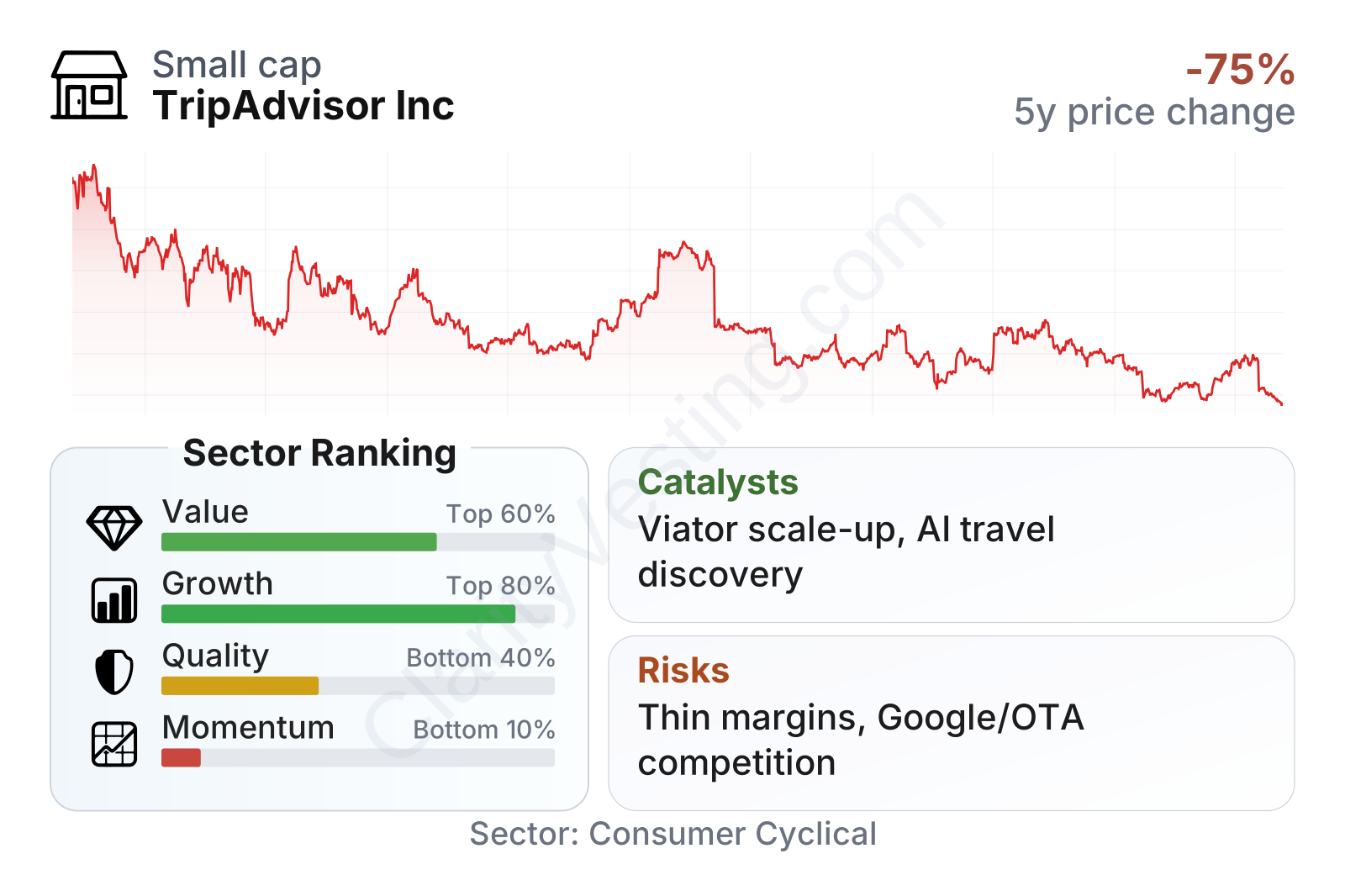
The stock chart also reflects that uncertainty. Shares are far below the highs seen a few years ago and have generally lagged the broader consumer discretionary group. That underperformance suggests the market has been cautious about the pace of recovery, the quality of earnings, and the company’s ability to convert travel demand into durable shareholder returns.

Growth

TripAdvisor operates in the global travel industry, a sector with favorable long-term drivers. People continue to shift travel planning, booking, and discovery online, and the experiences segment in particular remains underpenetrated compared with flights and hotels. That gives the company exposure to a part of travel where digital adoption can still improve. Viator is especially important here because tours and activities are fragmented, local, and harder to organize, which creates room for a marketplace with broad supply, strong search visibility, and consumer reviews.

The company’s strategy also makes logical sense. Instead of relying only on hotel shopper traffic, it is trying to build a broader travel ecosystem around experiences, restaurants, and travel discovery. Viator and TheFork are both more transaction-oriented than the legacy media and referral business, which can make revenue more directly tied to booking activity. If execution improves, this can create a more diversified platform and reduce dependence on advertising and hotel click-based monetization.

Recent revenue growth has clearly slowed after the sharp rebound that followed the pandemic recovery. Earlier periods showed very strong year-over-year expansion, but that surge has normalized and the latest reading has turned slightly negative. Even so, the longer-term trend still looks much better than the typical company in the sector, with five-year revenue per share growth remaining strong. In simple terms, TripAdvisor has already completed the easy rebound phase and now needs a more durable second stage of growth.

Cash generation is one of the more constructive elements in the profile. Free cash flow has been uneven from year to year, but it remains positive and has improved from the lower points seen during the reset period. That matters because a travel platform with recurring consumer traffic, established brands, and limited physical infrastructure can become much more valuable if management keeps converting bookings into cash even when accounting earnings stay modest.

A meaningful catalyst is the continued expansion of Viator. Company reporting has highlighted ongoing focus on experiences supply, product improvements, and international reach. If that business continues taking share in tours and activities, it could gradually reshape the company toward a category with better structural growth than the mature hotel referral business. Another potential opening comes from the use of artificial intelligence in trip planning, search, and personalization. TripAdvisor’s large base of reviews, intent-driven travel content, and merchant relationships could become more useful if AI tools increase user engagement and booking conversion rather than divert traffic away.

Recent company updates have also emphasized product investment and platform efficiency efforts. Those developments are significant because TripAdvisor does not need explosive revenue growth alone; it also needs better operating leverage. In that sense, future progress likely depends as much on execution and margin improvement as on headline demand for travel.

Risks

The biggest risk is that TripAdvisor participates in a competitive part of online travel without clearly dominating the highest-value booking layer. In hotels, large online travel agencies and search platforms have stronger direct booking ecosystems, bigger marketing budgets, and broader consumer reach. In experiences, Viator is important, but it still faces competition from other major travel marketplaces and from direct supplier relationships. In restaurant reservations, TheFork is well known in some European markets, but it does not have the same global scale as the largest travel or local discovery platforms.

TripAdvisor does have real competitive advantages. Its brand is widely recognized, its review content is extensive, and its platforms benefit from network effects: more users create more reviews and engagement, which can attract more travel suppliers. Viator also has a meaningful position in a fragmented market, and that is valuable because fragmentation can favor marketplaces that aggregate supply efficiently. Still, the company is not the clear overall leader in online travel. Booking Holdings, Expedia Group, Airbnb, Google’s travel tools, and a range of local and category-specific platforms all compete for attention, traffic, and bookings.

Balance sheet structure deserves attention. Debt relative to equity has risen to around 200%, clearly above the sector median and much higher than the company’s own levels not long ago. Net debt compared with EBIT remains more manageable than many peers, but the jump in leverage signals less room for error if demand weakens or margins disappoint. For a business with modest net income, a heavier debt load can amplify pressure.

Profitability is another weak point. TripAdvisor has moved back into positive net margins after earlier losses, but current profit margin remains around 1%, far below the sector norm. That tells readers the business is operating with little cushion. A small deterioration in traffic acquisition costs, conversion, consumer demand, or marketing efficiency can have an outsized effect on earnings. The operating margin is also below sector median, reinforcing the idea that the company’s recovery is not yet translating into robust profitability.

There is also platform risk. Travel discovery increasingly depends on how consumers search online, and that means TripAdvisor is exposed to changes in search engine behavior, app ecosystems, and AI-generated travel planning tools. If users get answers directly from search interfaces or competing travel apps instead of visiting Tripadvisor properties, traffic and monetization could weaken. Regulation, privacy changes, and online reputation management issues are additional risks because reviews and merchant visibility are central to the brand.

No major public scandal stands out as a defining current threat, but the more important near-term risk is strategic execution. If Viator growth slows, if TheFork remains subscale, or if the legacy Tripadvisor brand continues to mature without stronger monetization, the company could remain stuck in a pattern of decent revenue and weak earnings.

Valuation

Valuation looks mixed depending on which lens is used. On earnings, the stock appears expensive: the current price-to-earnings ratio is far above the sector median, and the company’s own history shows that this measure has been unstable for years. That is not necessarily because the market is assigning an extreme growth premium; it is largely because net income is very thin, which makes the P/E ratio look inflated.

On cash flow and enterprise value measures, the picture is less demanding. Free cash flow yield is stronger than the sector median, and EBIT relative to enterprise value also compares favorably. This suggests the market is not valuing TripAdvisor like a high-confidence growth leader. Instead, it seems to be pricing a business with useful assets and solid cash generation, but with open questions around margin quality, leadership position, and strategic durability.

In practical terms, the current stock price looks easier to justify through cash flow than through accounting earnings. That creates an unusual valuation setup: the shares do not look obviously cheap, but they also do not reflect the profile of a fully trusted compounder. Much depends on whether the company can prove that Viator and the wider platform can deliver steadier growth with better margins over time.

Conclusion

TripAdvisor today is a more interesting company than its legacy reputation as a hotel review website might suggest. The business has rebuilt revenue, holds recognizable digital travel brands, and has meaningful exposure to experiences through Viator, arguably the most attractive part of its portfolio. The model also still produces solid gross profit and decent cash flow, which gives the company a base to work from.

At the same time, the investment profile remains constrained by thin profitability, rising leverage, and a competitive position that is important but not dominant. The core question is no longer whether travel demand exists; it is whether TripAdvisor can convert that demand into stronger, more reliable earnings while defending traffic and relevance in an online environment shaped by larger travel platforms and AI-driven discovery tools.

The overall direction is cautiously constructive on the business mix, especially because of experiences, but less convincing on financial quality. TripAdvisor looks like a company with real assets and credible growth angles, yet still one that needs to prove its recovery can mature into a stronger and more durable earnings model. That tension explains why the valuation can look acceptable on cash flow while still appearing demanding on earnings.

Sources:

  • Tripadvisor, Inc. — Annual Report on Form 10-K for fiscal year 2025
  • Tripadvisor, Inc. — Quarterly Report on Form 10-Q for quarter ended March 31, 2026
  • SEC EDGAR — Tripadvisor, Inc. filing database
  • Tripadvisor Investor Relations — Shareholder letters and earnings materials
  • Tripadvisor, Inc. — 2026 earnings call materials hosted by the company
  • Wikipedia — TripAdvisor basic company background and segment context

This article is for informational purposes only and does not constitute financial advice. Some content is AI-generated. See Disclaimer


Sign up for exclusive research and insights.

Unsubscribe anytime.
