Stock Analysis · Tapestry Inc (TPR)
Overview
Tapestry Inc. is an American luxury accessories and fashion company that owns a portfolio of brands centered on handbags, small leather goods, footwear, apparel, and jewelry. Its best-known names are Coach, Kate Spade, and Stuart Weitzman. The group sells through directly operated stores, department stores, wholesale partners, and digital channels, which gives it exposure to both full-price and outlet shoppers across North America, Asia, and Europe.
The business is heavily driven by brand revenue, with Coach by far the main engine. Based on recent annual reporting, the revenue mix is approximately:
- Coach: about 76% of revenue. This includes handbags, wallets, accessories, footwear, ready-to-wear, and related products sold through stores, outlets, e-commerce, and wholesale.
- Kate Spade: about 20% of revenue. The brand focuses on handbags, accessories, apparel, jewelry, and gifting categories.
- Stuart Weitzman: about 4% of revenue. This business is mainly women’s luxury footwear and related accessories.
Geographically, North America remains the largest market, while Greater China, the rest of Asia, and Europe provide international growth opportunities. The company’s model is attractive because accessories can carry high margins when a brand has pricing power, recognizable design, and efficient control over distribution.
The broader financial flow shows a business with a high gross profit profile typical of branded luxury accessories. Revenue has expanded meaningfully into fiscal 2026, and profitability recovered sharply after a weak fiscal 2025, suggesting that the group’s earnings can move a lot depending on brand momentum and expense discipline.
Key Figures
| Metric | Value | Sector ⓘ |
|---|---|---|
| Date | Sep 12, 2026 | |
| Context | ||
| Sector | Consumer Cyclical | |
| Industry | Luxury Goods | |
| Market Cap ⓘ | $23.28B | |
| Beta ⓘ | 1.43 | |
Value (Cheapness) | ||
| P/E Ratio ⓘ | 16.06 | 17.10 |
| FCF Yield ⓘ | 7.79% | 8.53% |
| EBIT / EV ⓘ | 7.52% | 6.46% |
| PEG ⓘ | 1.63 | |
Growth (Business expansion) | ||
| Revenue Growth ⓘ | 8.90% | 5.75% |
| RPS Growth (5Y CAGR) ⓘ | 11.37% | 9.14% |
| EPS Growth (5Y CAGR) ⓘ | 19.65% | -18.21% |
| Margin Growth (5Y Trend) ⓘ | 7.39% | -0.23% |
| FCF Growth (5Y CAGR) ⓘ | 24.30% | 4.91% |
Quality (Business durability) | ||
| ROIC (Latest) ⓘ | 51.95% | 12.61% |
| ROIC (5Y Median) ⓘ | 27.65% | 10.72% |
| Net Debt / EBIT (Latest) ⓘ | 1.55 | 2.10 |
| Net Debt / EBIT (5Y Median) ⓘ | 2.24 | 2.32 |
| Operating Margin (Latest) ⓘ | 23.93% | 9.25% |
| Operating Margin (5Y Median) ⓘ | 17.04% | 9.64% |
| Debt to Equity (Latest) ⓘ | 571.16% | 75.78% |
| Profit Margin (Latest) ⓘ | 19.09% | 5.33% |
| Free Cash Flow (Latest) ⓘ | $1.81B | |
Momentum (Price trend) | ||
| 3Y Return ⓘ | +301.45% | +14.53% |
| 12M Return (excl. last month) ⓘ | +40.47% | +3.08% |
| 6M Return ⓘ | -16.40% | +0.55% |
| Price vs. 200-Day MA ⓘ | -13.95% | -0.54% |
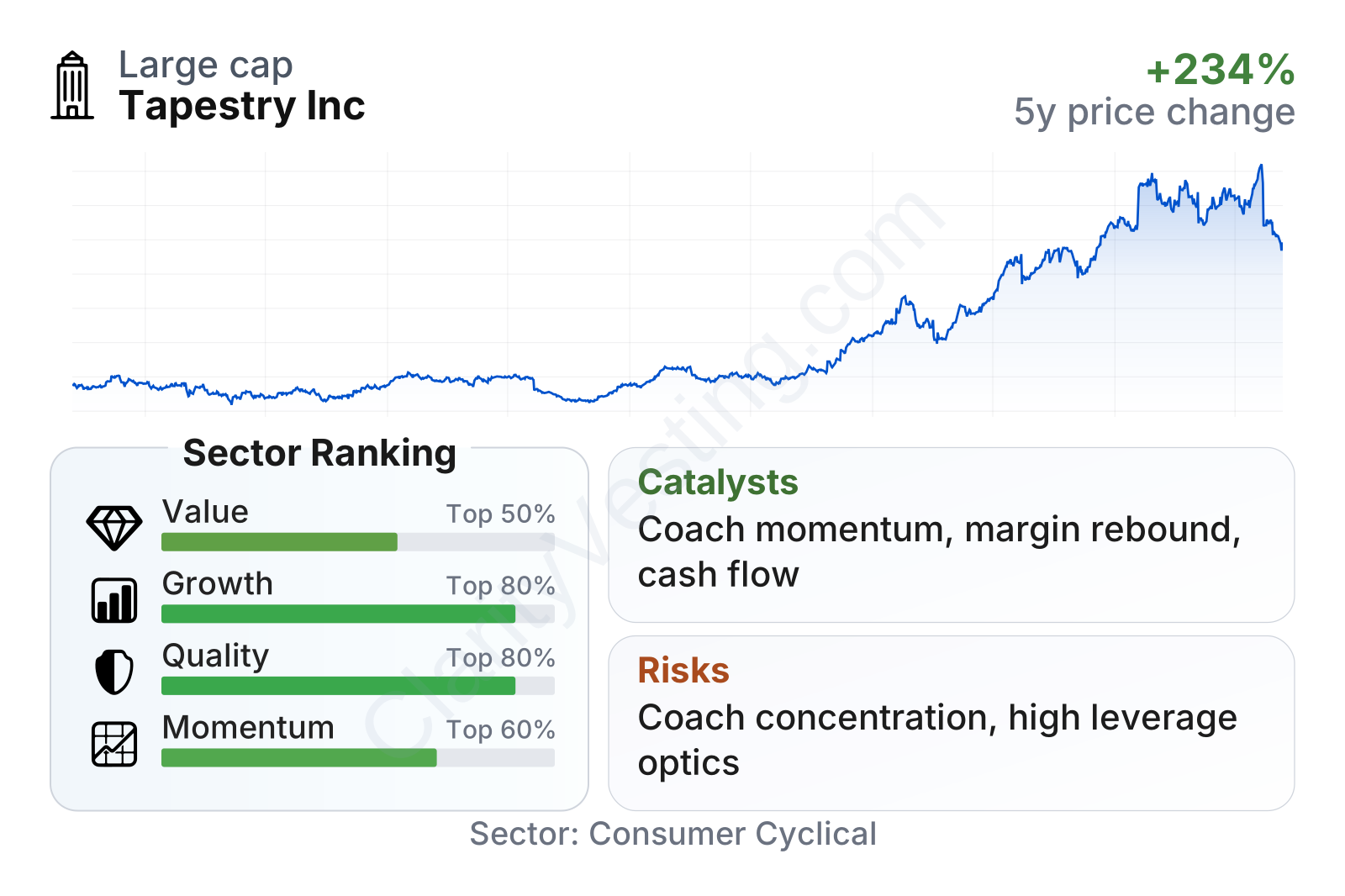
Tapestry is a large consumer discretionary company with above-average share price volatility, reflected in a beta around 1.4. The most notable feature in the current metrics is the contrast between strong operating quality and only middle-of-the-pack value scores. Growth and quality rank well versus much of the sector, with particularly strong returns on invested capital, healthy operating margins, and much better five-year cash flow expansion than the industry median. Momentum is still positive over longer periods, although the shorter-term share trend has cooled after a very strong run.
Growth
Tapestry operates in the global luxury and premium accessories market, a segment supported over time by brand loyalty, international tourism, digital shopping, and consumer demand for products that combine fashion and identity. This is not a straight-line growth sector because spending can weaken during economic slowdowns, but the best brands can still compound over time through pricing, category expansion, and geographic reach.
The company’s strategy appears coherent for long-term expansion. Management has been leaning into Coach as the lead growth vehicle, investing in brand heat, younger customer acquisition, direct-to-consumer relationships, and international development. That matters because Coach is the company’s strongest asset and has recently shown the best traction. Tapestry has also been working on product innovation, data-driven marketing, and omnichannel execution, which can improve both conversion and customer retention.
Revenue growth was uneven for a period, with some quarters of flat or negative movement, but the latest trend shows a clear reacceleration. Recent year-over-year revenue growth moved back into solid positive territory and is running ahead of the sector median. That improvement is important because it suggests the business is not relying only on cost cutting; it is also regaining top-line momentum.
Cash generation has strengthened sharply. Trailing free cash flow is now around $1.8 billion, far above the levels seen in weaker years, and the five-year growth rate in free cash flow is especially strong relative to peers. For a branded consumer company, this matters because free cash flow supports marketing investment, store upgrades, debt service, and shareholder returns without needing constant external financing.
A meaningful recent catalyst is the company’s operational rebound after the pressure seen in fiscal 2025. Fiscal 2026 figures show a much stronger revenue base, a large jump in operating income, and a major recovery in net income. Another positive development is the continued emphasis on Coach, which has been the clearest source of brand strength inside the portfolio. If management can keep Coach growing while stabilizing the smaller labels, Tapestry has a more credible path to sustained earnings growth than it did a year earlier.
Risks
This article is for informational purposes only and does not constitute financial advice. Some content is AI-generated. See Disclaimer


