Stock Analysis · Toast Inc (TOST)
Overview
Toast is a software and payments company focused mainly on restaurants, cafes, bars, and other food-service businesses. Its platform combines point-of-sale hardware, payment processing, restaurant software, online ordering, payroll, marketing, team management, inventory support, and supplier-related tools. The goal is to give restaurants one connected system instead of many separate vendors.
Its revenue model is built around two main engines: financial technology services tied to payment volume, and subscription services tied to software and hardware. Based on recent annual filings, the business mix is still led by payment-driven activity, while subscription and platform tools provide an important layer of recurring gross profit.
The main sources of revenue are approximately:
- Financial technology solutions: about 89% to 92% of revenue in recent years. This includes payment processing and other transaction-based services used when restaurants accept card payments and run commerce through Toast’s system.
- Subscription services: about 7% to 9% of revenue. This includes software subscriptions for point-of-sale, payroll, team management, marketing, online ordering, delivery-related tools, and other restaurant operations products.
- Hardware and professional services: about 1% to 3% of revenue. This includes terminals, handhelds, kitchen display devices, installation, onboarding, and related services.
That mix matters because transaction revenue grows with customer volume, while subscription revenue tends to be steadier and can expand as more software modules are adopted. Over the last several years, Toast has also improved the economics of the business: revenue has risen sharply, gross profit has expanded, and the company moved from large net losses to positive earnings.
Overview of the recent business flow: the company’s revenue rose from roughly $1.7 billion in 2021 to more than $6.1 billion in 2025, while net income improved from a loss of nearly $500 million to a profit of more than $300 million. Gross profit has scaled faster than operating costs, showing that the platform is gaining efficiency as it gets larger.
The progression is notable: Toast is no longer only a fast-growing platform spending heavily to build scale. It is increasingly showing the profile of a maturing software-and-payments business with rising profitability.
Key Figures
| Metric | Value | Sector ⓘ |
|---|---|---|
| Date | Sep 12, 2026 | |
| Context | ||
| Sector | Technology | |
| Industry | Software - Infrastructure | |
| Market Cap ⓘ | $18.46B | |
| Beta ⓘ | 1.73 | |
Value (Cheapness) | ||
| P/E Ratio ⓘ | 40.95 | 29.51 |
| FCF Yield ⓘ | 3.12% | 4.25% |
| EBIT / EV ⓘ | 2.43% | 2.85% |
| PEG ⓘ | 0.25 | |
Growth (Business expansion) | ||
| Revenue Growth ⓘ | 23.10% | 15.40% |
| RPS Growth (5Y CAGR) ⓘ | 31.48% | 8.56% |
| EPS Growth (5Y CAGR) ⓘ | N/A | -11.88% |
| Margin Growth (5Y Trend) ⓘ | N/A | 0.46% |
| FCF Growth (5Y CAGR) ⓘ | N/A | 9.80% |
Quality (Business durability) | ||
| ROIC (Latest) ⓘ | 19.52% | 9.44% |
| ROIC (5Y Median) ⓘ | -16.61% | 8.30% |
| Net Debt / EBIT (Latest) ⓘ | -2.59 | 0.54 |
| Net Debt / EBIT (5Y Median) ⓘ | N/A | 0.44 |
| Operating Margin (Latest) ⓘ | 6.47% | 9.58% |
| Operating Margin (5Y Median) ⓘ | -6.31% | 8.25% |
| Debt to Equity (Latest) ⓘ | 0.85% | 33.33% |
| Profit Margin (Latest) ⓘ | 7.14% | 7.14% |
| Free Cash Flow (Latest) ⓘ | $576.00M | |
Momentum (Price trend) | ||
| 3Y Return ⓘ | +51.65% | +45.48% |
| 12M Return (excl. last month) ⓘ | -22.71% | +23.48% |
| 6M Return ⓘ | +16.38% | +20.93% |
| Price vs. 200-Day MA ⓘ | +6.72% | +7.43% |
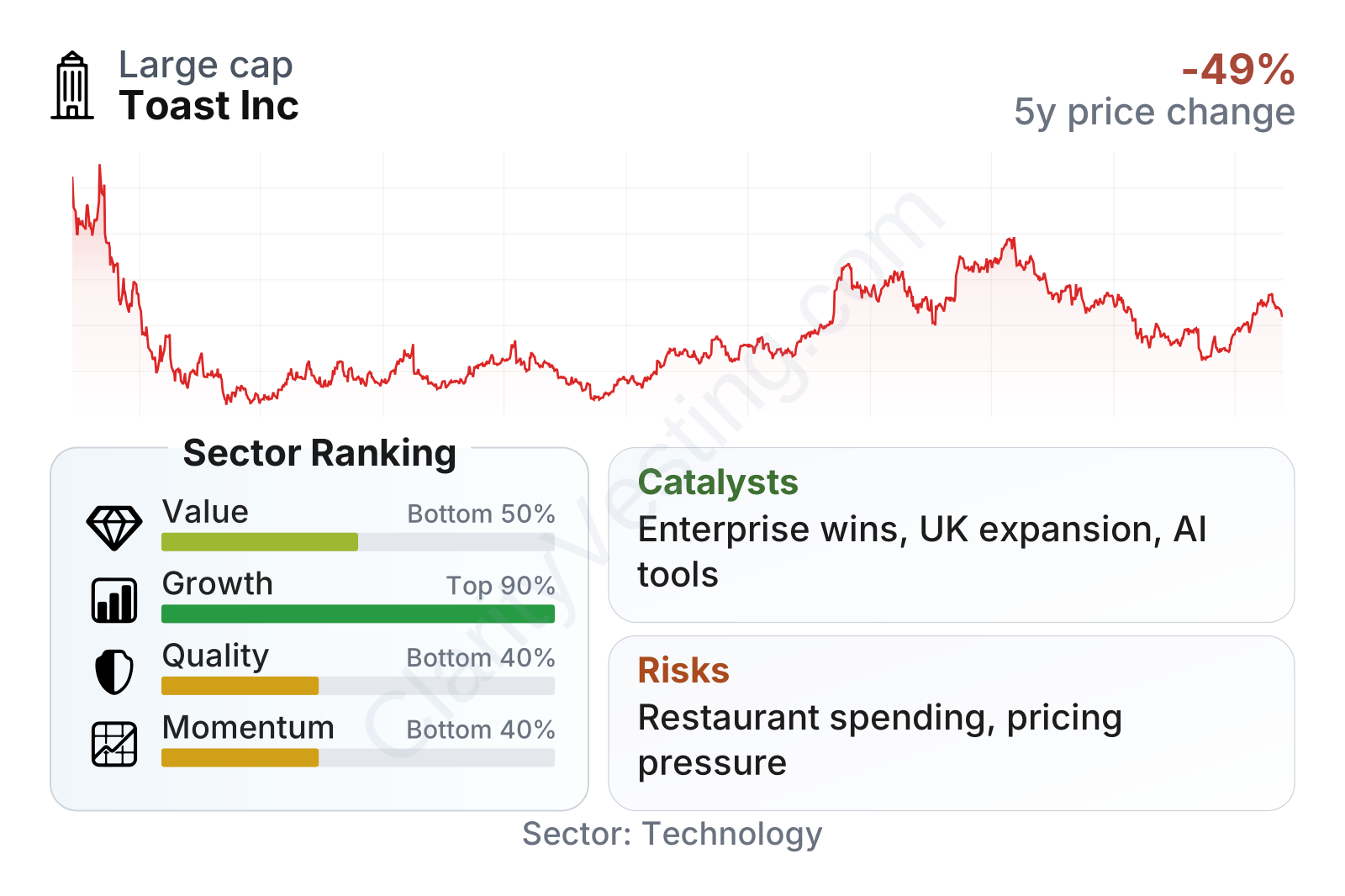
Toast is now a large public company, but its share price history has been volatile. After a steep decline following its 2021 listing, the stock recovered strongly over the following years, although the last 12-month period has been weaker than the broader software group. In fundamentals, the strongest area is growth, where Toast ranks near the top of its sector, helped by revenue growth of about 23% year over year and a five-year revenue-per-share growth rate above 30%.
The quality picture is mixed but improving. Profit margin is now around 7%, roughly in line with the sector, and return on invested capital is strong on a trailing basis. Balance-sheet quality stands out positively: debt to equity is below 1%, far lower than the sector median, and net cash remains a meaningful support. On valuation, the stock trades above the sector median on earnings and below the sector median on free-cash-flow yield, which points to a market already recognizing the company’s progress.
Growth
Toast operates in a sector with clear long-term tailwinds. Restaurants continue shifting from paper-based and fragmented tools toward integrated digital systems covering payments, ordering, kitchen workflows, guest engagement, payroll, and analytics. This is not only a software upgrade cycle; it is also an operating model change for an industry that has historically been under-digitized. That creates room for platforms that can bundle many functions into one product.
Toast’s strategy fits that opportunity well. It starts with core point-of-sale and payments, then adds more modules over time. That approach can deepen customer relationships, raise switching costs, and increase revenue per location without depending entirely on opening new accounts. The company has also been pushing upmarket into more complex restaurant groups while continuing to serve independent operators, which broadens its addressable market.
Revenue growth has cooled from the extremely high post-IPO phase, which is normal as the company gets larger, but growth has remained strong at a little above 20% recently. That is still better than the sector median and suggests Toast is gaining share in a market that remains far from fully penetrated.
Another important change is the shift in cash generation. Free cash flow moved from negative territory a few years ago to well above $600 million on a trailing basis. That matters because it shows growth is becoming more self-funded. For a long-term business case, that is often more durable than expansion driven mainly by external financing.
Recent company updates have also pointed to product expansion beyond basic payments, including AI-assisted and workflow tools, international steps through markets such as the U.K., and broader offerings for enterprise restaurant brands. These initiatives can open new layers of growth if execution remains strong, especially because larger restaurant chains and multi-location operators can bring higher payment volume and wider software adoption.
Risks
This article is for informational purposes only and does not constitute financial advice. Some content is AI-generated. See Disclaimer


