Stock Analysis · Toll Brothers Inc (TOL)
Overview
Toll Brothers is a U.S. homebuilder focused mainly on the luxury and upper-middle-end housing market. The company develops communities, acquires land, builds detached and attached homes, and sells those homes primarily to move-up, empty-nester, active-adult, and second-home buyers. It also has related operations that support the home sale process, including architecture, engineering, mortgage, title, insurance, smart home features, and landscaping services. In addition to for-sale housing, Toll Brothers has expanded into rental apartments, student housing, and build-to-rent through its multifamily platform and investment partnerships.
The business is still overwhelmingly driven by homebuilding, with the largest share coming from delivering completed homes and selling communities across a broad footprint in states such as Texas, Florida, California, Arizona, and the Northeast. Based on recent company reporting, revenue sources are approximately structured as follows:
- Home sales: about 96% to 98% of total revenue. This includes sales of luxury single-family homes, attached homes, active-adult communities, and certain master-planned community products.
- Land sales and other: about 1% to 3%. This includes sales of land parcels, lots, and other ancillary real estate-related items.
- Financial services and other ancillary businesses: about 1%. This mainly includes mortgage, title, and related settlement services tied to home closings.
Toll Brothers’ revenue mix matters because it shows that the company is not a diversified industrial group or a broad financial company disguised as a builder. It is fundamentally a housing company, and that means results depend heavily on demand for new homes, pricing, input costs, and financing conditions. At the same time, its focus on affluent buyers gives it a somewhat different profile from mass-market builders, since its customers may be less rate-sensitive on average and often have more flexibility in down payments or cash purchases.
The company’s earnings progression in recent years shows a business that has grown revenue while keeping a meaningful share of each sales dollar as profit, even though the homebuilding cycle remains uneven. Costs have risen over time, but operating income and net income also expanded strongly from 2021 through 2024 before moderating in 2025, which reflects both the strength of the franchise and the cyclical nature of the business.
The visual flow highlights a favorable longer-term pattern: revenue moved higher over several years, and profitability improved materially from 2021 to 2024 before easing in 2025. Even with that moderation, the company remained solidly profitable, which is important in a cyclical industry where weaker players can see margins compress much faster.
Key Figures
| Metric | Value | Sector ⓘ |
|---|---|---|
| Date | Sep 12, 2026 | |
| Context | ||
| Sector | Consumer Cyclical | |
| Industry | Residential Construction | |
| Market Cap ⓘ | $12.43B | |
| Beta ⓘ | 1.33 | |
Value (Cheapness) | ||
| P/E Ratio ⓘ | 10.87 | 17.10 |
| FCF Yield ⓘ | 8.77% | 8.53% |
| EBIT / EV ⓘ | 11.30% | 6.46% |
| PEG ⓘ | 0.89 | |
Growth (Business expansion) | ||
| Revenue Growth ⓘ | -9.70% | 5.75% |
| RPS Growth (5Y CAGR) ⓘ | 11.99% | 9.14% |
| EPS Growth (5Y CAGR) ⓘ | -8.67% | -18.21% |
| Margin Growth (5Y Trend) ⓘ | 3.75% | -0.23% |
| FCF Growth (5Y CAGR) ⓘ | -4.55% | 4.91% |
Quality (Business durability) | ||
| ROIC (Latest) ⓘ | 10.69% | 12.61% |
| ROIC (5Y Median) ⓘ | 12.52% | 10.72% |
| Net Debt / EBIT (Latest) ⓘ | 1.17 | 2.10 |
| Net Debt / EBIT (5Y Median) ⓘ | 0.98 | 2.32 |
| Operating Margin (Latest) ⓘ | 14.77% | 9.25% |
| Operating Margin (5Y Median) ⓘ | 16.27% | 9.64% |
| Debt to Equity (Latest) ⓘ | 34.14% | 75.78% |
| Profit Margin (Latest) ⓘ | 11.14% | 5.33% |
| Free Cash Flow (Latest) ⓘ | $1.09B | |
Momentum (Price trend) | ||
| 3Y Return ⓘ | +72.86% | +14.53% |
| 12M Return (excl. last month) ⓘ | +16.64% | +3.08% |
| 6M Return ⓘ | -1.89% | +0.55% |
| Price vs. 200-Day MA ⓘ | -6.47% | -0.54% |
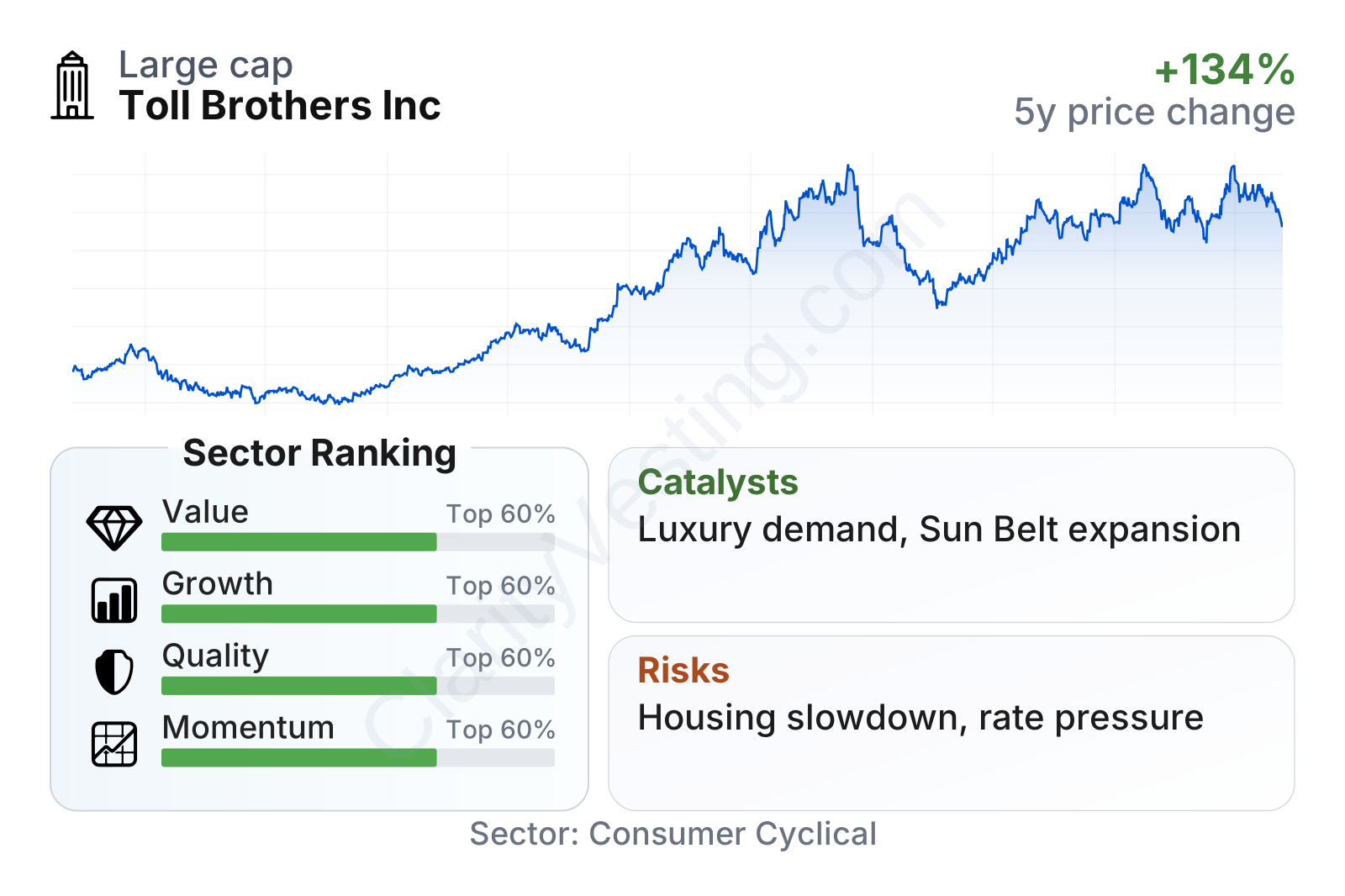
Toll Brothers screens as a large public homebuilder with above-average share price performance over the last several years, but with moderate volatility. The stock’s beta above 1 suggests it tends to move more than the broader market, which is common for cyclical housing names.
The overall financial profile looks balanced rather than extreme. On valuation, the company trades at a lower earnings multiple than the sector median, while free cash flow yield is roughly in line with the broader group and EBIT relative to enterprise value looks stronger than average. On quality, profitability remains clearly above sector norms, and leverage is lower than many peers. Growth is more mixed: the recent year-over-year revenue trend has turned negative, but the five-year record for revenue per share and margin improvement remains constructive. In short, the table points to a company that looks operationally stronger than many peers, even if near-term growth has cooled.
Growth
Residential construction is a cyclical sector, but the long-term backdrop still offers support. The U.S. has dealt with a structural housing shortage in many markets for years, and limited resale inventory has often pushed buyers toward new construction. That environment can help builders such as Toll Brothers, especially when existing homeowners are reluctant to sell because they are locked into older low-rate mortgages. New homes can become one of the few available ways for households to find the location, size, and features they want.
Toll Brothers’ strategy also makes sense for future expansion because it is not trying to compete only on volume. Its positioning in luxury housing can support stronger pricing and margins than more entry-level builders usually achieve. The company has also broadened its exposure through active-adult communities, urban and suburban attached products, and multifamily development. That gives it more than one avenue for growth, even though home sales remain the central engine.
The revenue trend has been uneven. Earlier years showed strong double-digit growth in several periods, but more recent quarters turned negative. That does not automatically signal a broken business. For homebuilders, timing of deliveries, community mix, incentives, and mortgage conditions can swing year-over-year comparisons sharply. The more important point is that Toll Brothers has shown it can grow over a full cycle while keeping margins at a comparatively strong level.
Cash generation has also remained healthy, although not perfectly smooth from year to year. That is normal in homebuilding because land spending, construction timing, and working capital can create large swings. Even so, recent trailing free cash flow sits above $1 billion, which gives the company flexibility to invest in land, support development, and return capital while maintaining a manageable balance sheet.
A meaningful catalyst is the company’s customer profile. Toll Brothers serves buyers with higher incomes and often stronger balance sheets, which can cushion demand when mortgage affordability is under pressure. Another catalyst is community expansion in faster-growing regions such as the Sun Belt, where population and job growth continue to support housing demand. The company has also emphasized land discipline and option structures in recent years, which can reduce risk compared with owning too much land too early in the cycle.
Recent company updates have also pointed to a substantial backlog, active community count growth, and continued focus on spec inventory management and incentives to keep sales moving. Those are important operational levers in a housing market where rates can change demand quickly.
Risks
This article is for informational purposes only and does not constitute financial advice. Some content is AI-generated. See Disclaimer


