Stock Analysis · Trainline PLC (TNLIY)
Overview
Trainline PLC is a digital rail and coach ticketing platform. It allows travelers to search routes, compare fares, book tickets, and manage trips through its apps and websites. The company operates primarily in the United Kingdom and across continental Europe, connecting customers to many rail and coach operators through one interface. Its role is not to run trains; it acts as a distribution and technology layer between transport operators and passengers.
The business is built around transaction volume on its platform and the fees and commissions attached to those bookings. Based on the company’s recent annual reporting, revenue is mainly generated from the following sources:
- UK Consumer: about 65% to 70% — ticket sales to leisure and business travelers booking rail and some coach travel in the UK through Trainline’s consumer app and website.
- International Consumer: about 20% to 25% — ticket sales made through consumer-facing platforms for travel in Spain, Italy, France, and other European markets.
- Trainline Solutions: about 10% to 15% — software, booking technology, and platform services provided to rail carriers, travel companies, and corporate or white-label partners.
That mix shows a company still centered on the UK market, but with a meaningful and growing European opportunity. It also highlights a favorable business model: Trainline does not need to own trains or stations, so expansion can come more from technology, customer acquisition, and partnerships than from heavy physical investment.
Over the last several years, revenue has risen sharply from the post-pandemic recovery period, and profitability has improved even faster. More recently, top-line growth has slowed to low single digits, but margins have continued to strengthen. That suggests the company is moving from recovery mode into a more mature phase where operational discipline matters more.
The profit profile has improved notably since 2022. Revenue more than doubled over four years, while operating income moved from a loss to a solid positive level. Even with modest revenue growth in the latest year, earnings expansion remained strong, helped by disciplined operating costs and healthy gross margins.
Key Figures
| Metric | Value | Sector ⓘ |
|---|---|---|
| Date | Nov 14, 2026 | |
| Context | ||
| Sector | Consumer Cyclical | |
| Industry | Travel Services | |
| Market Cap ⓘ | $949.09M | |
| Beta ⓘ | 0.40 | |
Value (Cheapness) | ||
| P/E Ratio ⓘ | 11.04 | 17.68 |
| P/B Ratio ⓘ | 5.51 | 2.77 |
| FCF Yield ⓘ | 15.02% | 7.36% |
| Dividend Yield ⓘ | N/A | 2.55% |
| EBIT / EV ⓘ | N/A | 7.05% |
| PEG ⓘ | 0.45 | |
Growth (Business expansion) | ||
| Revenue Growth ⓘ | 2.30% | 5.20% |
| RPS Growth (5Y CAGR) ⓘ | 28.57% | 8.97% |
| EPS Growth (5Y CAGR) ⓘ | N/A | -12.17% |
| BVPS Growth (5Y CAGR) ⓘ | -2.55% | 5.63% |
| Margin Growth (5Y Trend) ⓘ | 30.91% | -0.17% |
| FCF Growth (5Y CAGR) ⓘ | -10.16% | 5.89% |
| DPS Growth (5Y CAGR) ⓘ | N/A | 10.17% |
Quality (Business durability) | ||
| ROIC (Latest) ⓘ | N/A | 11.44% |
| ROA (Latest) ⓘ | 15.42% | 5.57% |
| ROIC (5Y Median) ⓘ | 11.76% | 10.52% |
| ROA (5Y Median) ⓘ | 5.09% | 5.37% |
| Net Debt / EBIT (Latest) ⓘ | 1.01 | 2.06 |
| Net Debt / EBIT (5Y Median) ⓘ | 1.10 | 2.24 |
| Net Debt / EBITDA (Latest) ⓘ | 0.75 | 1.45 |
| Net Debt / Assets ⓘ | 28.91% | 21.26% |
| EBITDA / Interest ⓘ | N/A | 9.63 |
| Operating Margin (Latest) ⓘ | 25.05% | 9.14% |
| Operating Margin (5Y Median) ⓘ | 14.24% | 9.64% |
| Debt to Equity (Latest) ⓘ | 128.17% | 73.06% |
| Profit Margin (Latest) ⓘ | 17.63% | 5.35% |
| Free Cash Flow (Latest) ⓘ | $142.54M | |
Momentum (Price trend) | ||
| 3Y Return ⓘ | -20.96% | +20.92% |
| 12M Return (excl. last month) ⓘ | -13.80% | 0.00% |
| 6M Return ⓘ | -10.67% | +1.89% |
| Price vs. 200-Day MA ⓘ | -7.22% | +1.11% |
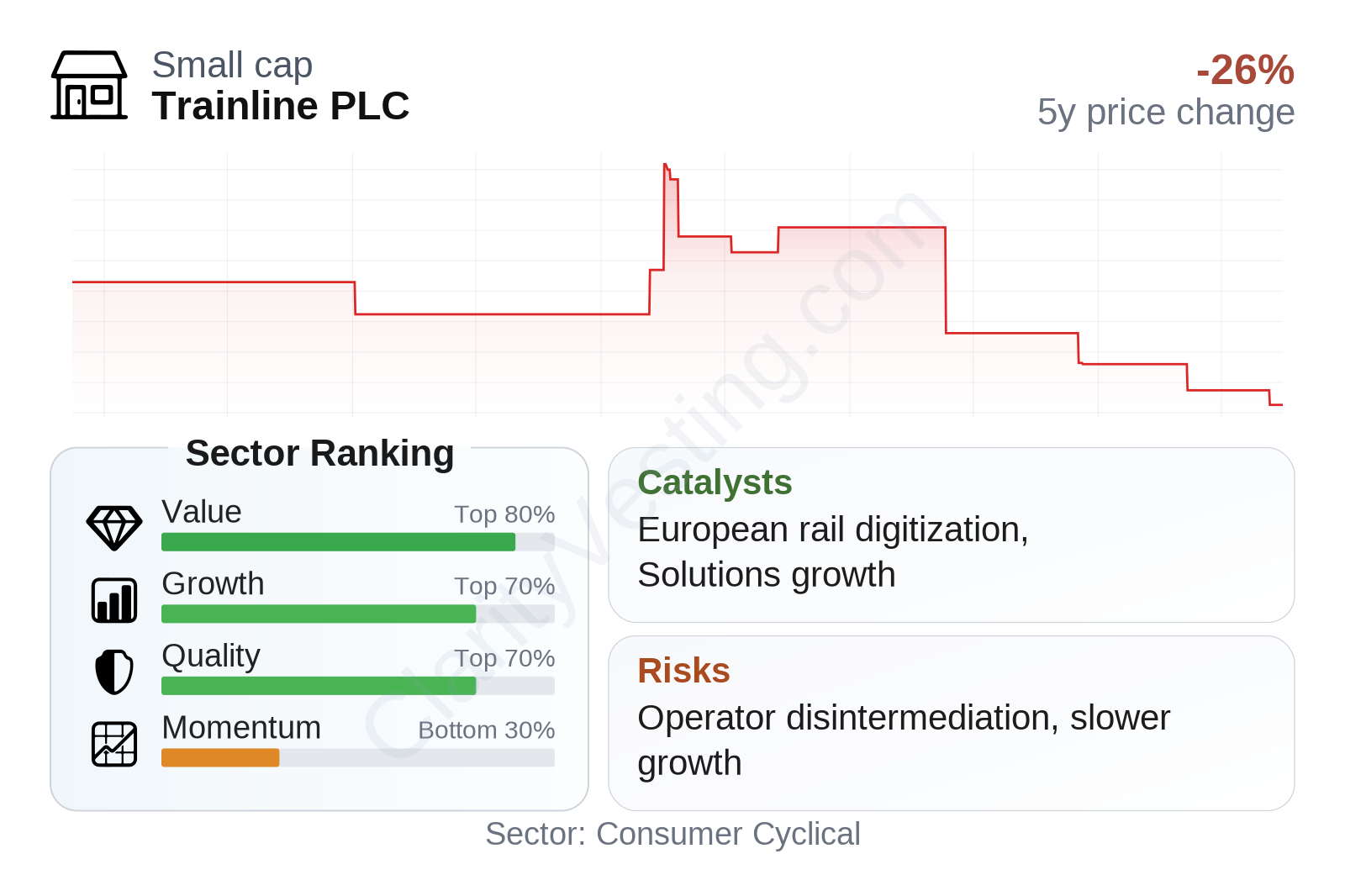
Trainline appears inexpensive on earnings and cash flow compared with much of its sector, with a price-to-earnings ratio around 11 and a free cash flow yield comfortably above the sector median. At the same time, the price-to-book ratio is high, which is common for platform businesses whose value comes more from software, brand, and customer relationships than from tangible assets. Quality looks strong: profit margins and operating margins are well above typical sector levels, and leverage relative to earnings remains manageable. Growth is more mixed. The long-term record is good, especially on revenue per share and margin expansion, but the latest year shows much slower revenue growth. Share price momentum has been weak, which helps explain why valuation multiples remain restrained.
Trainline is a mid-sized travel technology company rather than a giant industry incumbent. Its stock has also shown relatively low beta, meaning it has historically moved less than the broader market. That does not remove risk, but it does suggest price swings have been less extreme than many consumer-facing stocks.
Growth
Trainline operates in a segment with credible long-term growth drivers. Rail is often favored by governments and travelers because it is more energy-efficient than air or car travel on many routes, and Europe in particular continues to push for digital ticketing, cross-border rail usage, and lower-emission transport. These trends support the need for platforms that simplify rail booking across fragmented operators and countries.
The company’s strategy also makes sense. It focuses on making rail travel easier through features such as fare comparison, mobile ticketing, disruption information, and cross-border trip planning. This matters because rail distribution remains fragmented in Europe, with different operators, booking systems, and ticketing rules. Trainline’s value comes from reducing that complexity for users. The more operators and routes it integrates, the more useful the platform becomes.
There is also a second leg to the strategy beyond direct consumer sales. Through Trainline Solutions, the company can supply booking and retail technology to transport partners and other travel businesses. That can expand reach without requiring Trainline to spend as heavily on direct customer acquisition every time it enters a new channel.
Near-term growth has clearly cooled, with the latest year-over-year revenue increase around 1%. That is much slower than the company’s multi-year recovery phase. However, the broader five-year picture remains favorable, with strong revenue-per-share growth and a major improvement in operating margins. In other words, the business has already proven it can scale; the key question now is how much additional growth it can unlock from Europe, new features, and partner distribution.
One important catalyst is the continued modernization of rail retailing in Europe. As more operators open digital access and as passengers expect app-based booking for increasingly complex itineraries, aggregators with broad coverage can gain share. Another opportunity is modal shift: if more travel demand moves toward rail for cost or environmental reasons, Trainline can benefit without needing to own transport assets itself.
Risks
This article is for informational purposes only and does not constitute financial advice. Some content is AI-generated. See Disclaimer