Stock Analysis · T-Mobile US Inc (TMUS)
Overview
T-Mobile US is a wireless telecommunications company serving consumers, businesses, and government customers across the United States and Puerto Rico. Its core business is mobile connectivity: phone plans, data services, and related products that run on its nationwide wireless network. The company also sells devices such as smartphones and tablets, provides fixed wireless broadband for homes and businesses, and offers advertising and technology services through smaller business lines.
The company’s revenue mix is still heavily centered on wireless service, which is the most important part of the business because it tends to be recurring and carries better economics than equipment sales. Based on recent annual reporting, the main sources of revenue can be summarized as follows:
- Postpaid service revenue: approximately 60% to 65% of total revenue. This includes monthly wireless plans for phone customers and business accounts. This is generally the largest and most stable category.
- Equipment revenue: approximately 20% to 25%. This mainly comes from smartphone and device sales, including upgrades and new customer additions.
- Other service revenue: approximately 10% to 15%. This includes prepaid, wholesale, and some broadband-related service revenue.
- Other revenue: typically a small remainder, generally below 5%. This may include accessories, advertising, and various smaller operating lines.
T-Mobile’s business model has become more attractive over time because a larger share of revenue is now coming from service rather than one-time device transactions. That matters because service revenue is more predictable, and it can support stronger margins and cash generation when customer retention remains solid.
Over the last several years, the company has also shown a notable improvement in how revenue turns into operating profit and net income. The broad pattern has been rising gross profit and operating income, even when total revenue growth was not always smooth, which suggests improving efficiency and better monetization of the network.
The long-term trend visible here is that profitability improved meaningfully from 2021 through 2024 as operating costs grew more slowly than gross profit. The 2025 revenue jump looks strong, but the mix appears less favorable than in 2024, so the key point is not just growth, but whether the company can preserve its stronger earnings structure as it expands.
Key Figures
| Metric | Value | Sector ⓘ |
|---|---|---|
| Date | Sep 12, 2026 | |
| Context | ||
| Sector | Communication Services | |
| Industry | Telecom Services | |
| Market Cap ⓘ | $190.03B | |
| Beta ⓘ | 0.33 | |
Value (Cheapness) | ||
| P/E Ratio ⓘ | 18.55 | 18.61 |
| FCF Yield ⓘ | 8.08% | 13.68% |
| EBIT / EV ⓘ | 5.82% | 4.54% |
| PEG ⓘ | 0.63 | |
Growth (Business expansion) | ||
| Revenue Growth ⓘ | 7.90% | 5.40% |
| RPS Growth (5Y CAGR) ⓘ | 5.16% | 4.62% |
| EPS Growth (5Y CAGR) ⓘ | 9.51% | -18.01% |
| Margin Growth (5Y Trend) ⓘ | 11.80% | 1.10% |
| FCF Growth (5Y CAGR) ⓘ | N/A | 5.88% |
Quality (Business durability) | ||
| ROIC (Latest) ⓘ | 9.52% | 8.38% |
| ROIC (5Y Median) ⓘ | 7.70% | 8.32% |
| Net Debt / EBIT (Latest) ⓘ | 6.34 | 1.99 |
| Net Debt / EBIT (5Y Median) ⓘ | 7.58 | 2.94 |
| Operating Margin (Latest) ⓘ | 19.36% | 14.89% |
| Operating Margin (5Y Median) ⓘ | 18.25% | 12.96% |
| Debt to Equity (Latest) ⓘ | 206.17% | 59.59% |
| Profit Margin (Latest) ⓘ | 11.46% | 8.77% |
| Free Cash Flow (Latest) ⓘ | $15.35B | |
Momentum (Price trend) | ||
| 3Y Return ⓘ | +36.87% | +46.64% |
| 12M Return (excl. last month) ⓘ | -28.47% | +2.16% |
| 6M Return ⓘ | -13.99% | +5.05% |
| Price vs. 200-Day MA ⓘ | -4.99% | +2.88% |
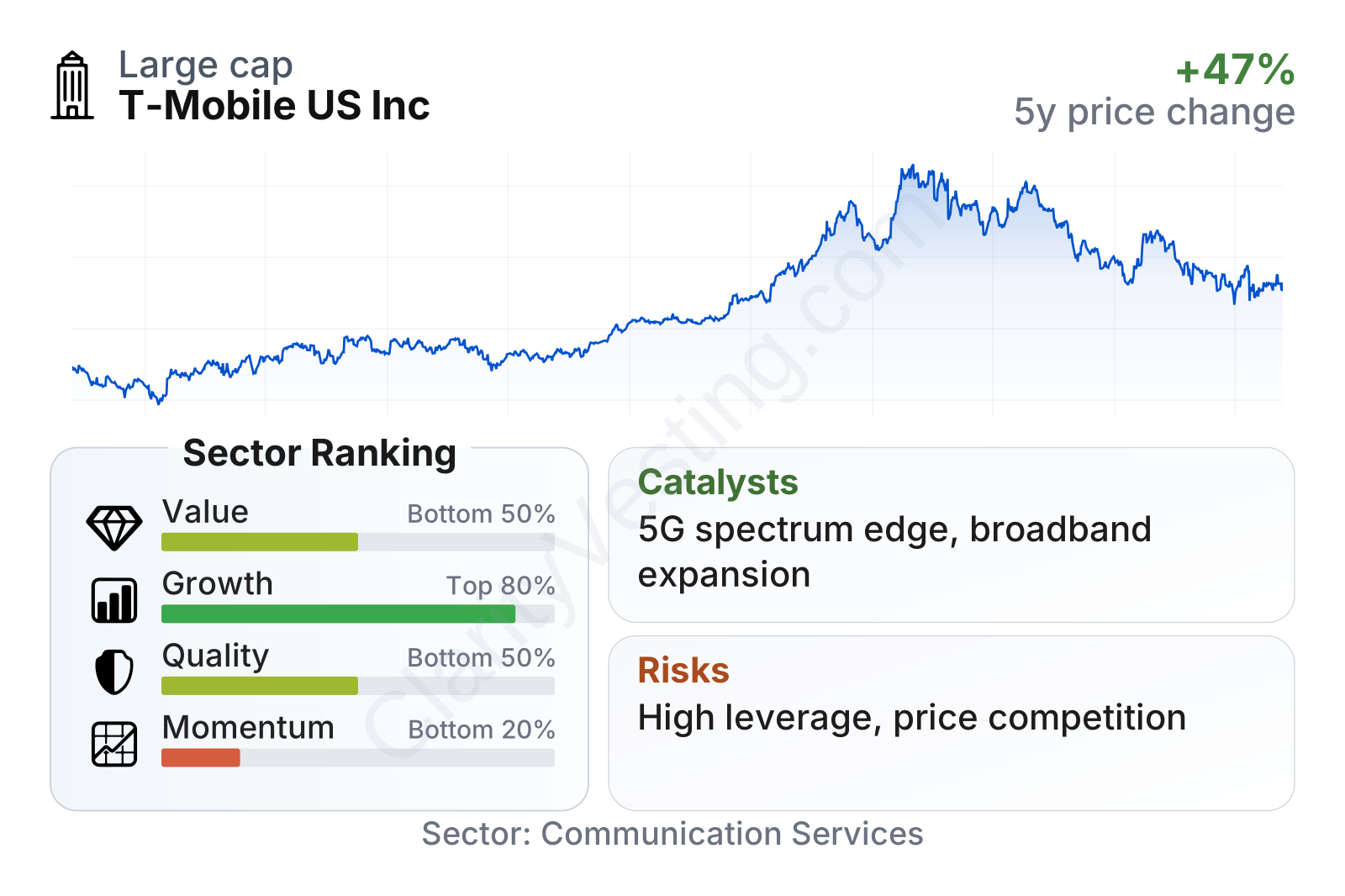
T-Mobile is one of the largest telecom companies in the U.S., and its stock has delivered a strong multiyear rise despite a weaker recent stretch. The metrics table points to a business with solid growth and improving profitability, while valuation looks close to the sector average on earnings. Quality is more mixed: operating performance is strong, but leverage remains much higher than the sector median. Momentum is currently soft, which reflects the stock’s pullback from earlier highs rather than a collapse in the underlying business.
Growth
The telecom sector is not a high-growth industry in the same way as software or semiconductors, but mobile connectivity remains essential infrastructure. Demand for wireless data, premium mobile plans, and home internet alternatives continues to expand. That gives T-Mobile room to grow even in a mature market, especially when it takes share from rivals rather than relying only on industrywide expansion.
T-Mobile’s strategy has been built around network quality, customer acquisition, and cross-selling. The Sprint merger gave it additional spectrum, especially mid-band spectrum that is well suited for balancing speed and coverage. That has been a major strategic asset because it helped the company strengthen 5G performance and market that advantage to both consumers and businesses.
A particularly important growth driver is fixed wireless access, T-Mobile’s home and small-business broadband offering delivered over its wireless network. This product lets the company use existing network infrastructure to enter parts of the broadband market without building a traditional cable system. If adoption continues, it can deepen customer relationships and diversify revenue beyond smartphones.
Revenue growth has clearly improved after a weaker period in 2022 and 2023. More recently, year-over-year growth moved back into a healthy mid-to-high single-digit range and at one point reached low double digits. That places the company modestly ahead of the sector median and suggests that its share gains and newer services are still contributing meaningfully.
Cash generation has strengthened sharply. Free cash flow moved from negative territory in 2022 to well above $15 billion on a trailing basis by 2026. That is an important signal for long-term analysis because it shows the company is converting its scale and past network investment into real financial flexibility. Stronger free cash flow can support debt reduction, spectrum spending, network upgrades, and shareholder returns without relying as heavily on external financing.
Recent company updates have continued to emphasize customer additions, broadband expansion, and AI-related initiatives to improve customer care and network efficiency. None of these changes alone transforms the business, but together they reinforce the view that T-Mobile is still in a phase of operational expansion rather than simple maintenance.
Risks
This article is for informational purposes only and does not constitute financial advice. Some content is AI-generated. See Disclaimer


