Stock Analysis · Temenos Group AG (TMSNY)
Overview
Temenos Group AG is a Swiss software company focused on banking technology. In simple terms, it sells the core software that banks use to run everyday operations such as accounts, payments, lending, deposits, compliance, and customer onboarding. Its products are used by retail banks, private banks, wealth managers, and other financial institutions in many countries. The company’s positioning is specialized rather than broad: instead of serving all industries, it concentrates on financial institutions and the systems that are difficult for banks to replace once installed.
Its business has gradually shifted toward subscription and cloud-based software, alongside maintenance and professional services. That matters for long-term analysis because recurring revenue is usually more predictable than one-time software license sales. Temenos also benefits from the fact that banks are under constant pressure to modernize old systems, improve digital services, reduce operating costs, and meet stricter regulatory requirements.
Based on company disclosures, the main revenue sources can be summarized approximately as follows, with the recurring base now the largest part of the mix:
- Subscription and SaaS / cloud revenue: roughly the largest and growing share, supported by the transition toward hosted and subscription-based banking software.
- Maintenance and support: a large recurring stream tied to installed customers that continue using and updating Temenos software.
- Services: implementation, consulting, and related project work, smaller than software-related recurring revenue but still important for customer deployments.
- License revenue: a smaller and more variable share than in the past, reflecting the move away from traditional up-front software deals.
From a business-quality perspective, the financial flow has become more attractive over time. Revenue has edged higher over the last several years, while cost of revenue stayed relatively flat, allowing gross profit to expand. A particularly notable recent change is the sharp rise in operating income and net income in 2025, alongside lower interest expense, which suggests stronger operating efficiency and a cleaner earnings profile than in earlier years.
Key Figures
| Metric | Value | Sector ⓘ |
|---|---|---|
| Date | Sep 12, 2026 | |
| Context | ||
| Sector | Technology | |
| Industry | Software - Application | |
| Market Cap ⓘ | $5.71B | |
| Beta ⓘ | 0.59 | |
Value (Cheapness) | ||
| P/E Ratio ⓘ | 29.56 | 29.51 |
| FCF Yield ⓘ | 6.69% | 4.25% |
| EBIT / EV ⓘ | 5.97% | 2.85% |
| PEG ⓘ | 2.86 | |
Growth (Business expansion) | ||
| Revenue Growth ⓘ | -1.40% | 15.40% |
| RPS Growth (5Y CAGR) ⓘ | 3.98% | 8.56% |
| EPS Growth (5Y CAGR) ⓘ | -0.67% | -11.88% |
| Margin Growth (5Y Trend) ⓘ | 20.02% | 0.46% |
| FCF Growth (5Y CAGR) ⓘ | -1.65% | 9.80% |
Quality (Business durability) | ||
| ROIC (Latest) ⓘ | N/A | 9.44% |
| ROIC (5Y Median) ⓘ | 13.72% | 8.30% |
| Net Debt / EBIT (Latest) ⓘ | 1.79 | 0.54 |
| Net Debt / EBIT (5Y Median) ⓘ | 3.30 | 0.44 |
| Operating Margin (Latest) ⓘ | 34.69% | 9.58% |
| Operating Margin (5Y Median) ⓘ | 22.01% | 8.25% |
| Debt to Equity (Latest) ⓘ | 226.40% | 33.33% |
| Profit Margin (Latest) ⓘ | 17.50% | 7.14% |
| Free Cash Flow (Latest) ⓘ | $382.22M | |
Momentum (Price trend) | ||
| 3Y Return ⓘ | +20.06% | +45.48% |
| 12M Return (excl. last month) ⓘ | +3.67% | +23.48% |
| 6M Return ⓘ | -11.26% | +20.93% |
| Price vs. 200-Day MA ⓘ | -6.19% | +7.43% |
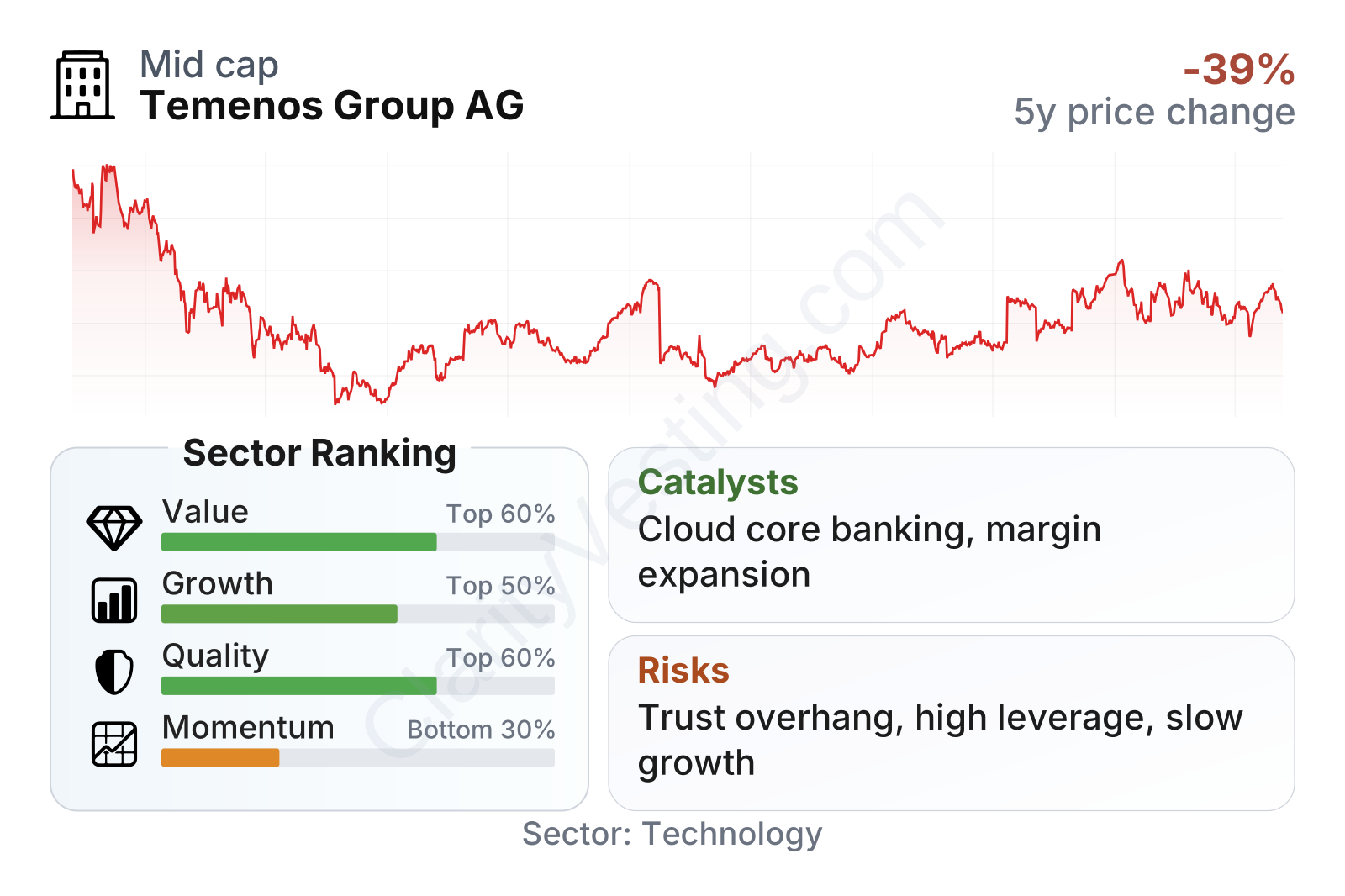
Temenos sits in the mid-cap range at about $5.5 billion, with a relatively low beta near 0.57, which means its share price has historically moved less than many technology names. The overall profile is mixed but understandable: value metrics look favorable versus much of the software sector, quality is solid thanks to high margins and healthy cash generation, growth is moderate rather than exceptional, and recent market momentum has been uneven after a strong rebound from earlier lows.
The stock history reflects that uneven path. Shares fell heavily from 2021 into 2022, then recovered in stages, with another pullback more recently. That pattern usually signals a company the market has reassessed several times, often because sentiment around growth, execution, or trust changed materially. For long-term readers, that makes operational consistency more important than short-term price moves.
Growth
Temenos operates in a sector with long-term structural demand. Banks around the world still rely on old core systems that are expensive to maintain and difficult to adapt. Replacing or modernizing those systems is a multi-year process, and vendors with proven banking expertise can benefit from that trend. The broader direction of the industry remains supportive: digital banking adoption, cloud migration, real-time payments, and tighter compliance requirements all create demand for specialized software platforms.
Temenos’s strategy broadly fits that backdrop. The company has been pushing further into software subscriptions and SaaS, which can deepen customer relationships and improve revenue visibility. It also remains focused on core banking, payments, and adjacent banking functions where banks are less likely to switch providers casually. This specialization is important because banks are not simply choosing a software tool; they are choosing infrastructure that touches customer accounts, transactions, and regulatory processes.
Revenue growth has not been consistently fast, but it has improved from the weaker period seen in 2022 and parts of 2023. Recent year-over-year growth has moved back into positive territory and is now running around the high-single-digit range. That is below the median of many software peers, so Temenos does not currently stand out as a pure high-growth name. Still, the recovery matters because it suggests the company is regaining traction after a period of disruption.
Cash generation is one of the more encouraging parts of the picture. Free cash flow weakened for a time but has rebuilt strongly, returning to roughly the levels seen several years ago. This supports the idea that the company’s recurring-revenue model and high-margin software base can convert accounting profits into real cash, which is especially relevant in enterprise software where reported earnings can sometimes be distorted by one-off items or acquisition-related accounting.
A meaningful catalyst is the continued move of banks toward cloud-native and subscription-based core platforms. Another is the company’s large installed base, which creates opportunities to cross-sell more modules over time. In addition, recent operating performance points to better efficiency, so even moderate revenue growth can have a larger effect on profits if margins remain elevated. Recent company updates have also emphasized product innovation around modern banking architecture and AI-related capabilities, which could help Temenos remain relevant as banks look for automation and faster deployment.
Risks
This article is for informational purposes only and does not constitute financial advice. Some content is AI-generated. See Disclaimer